
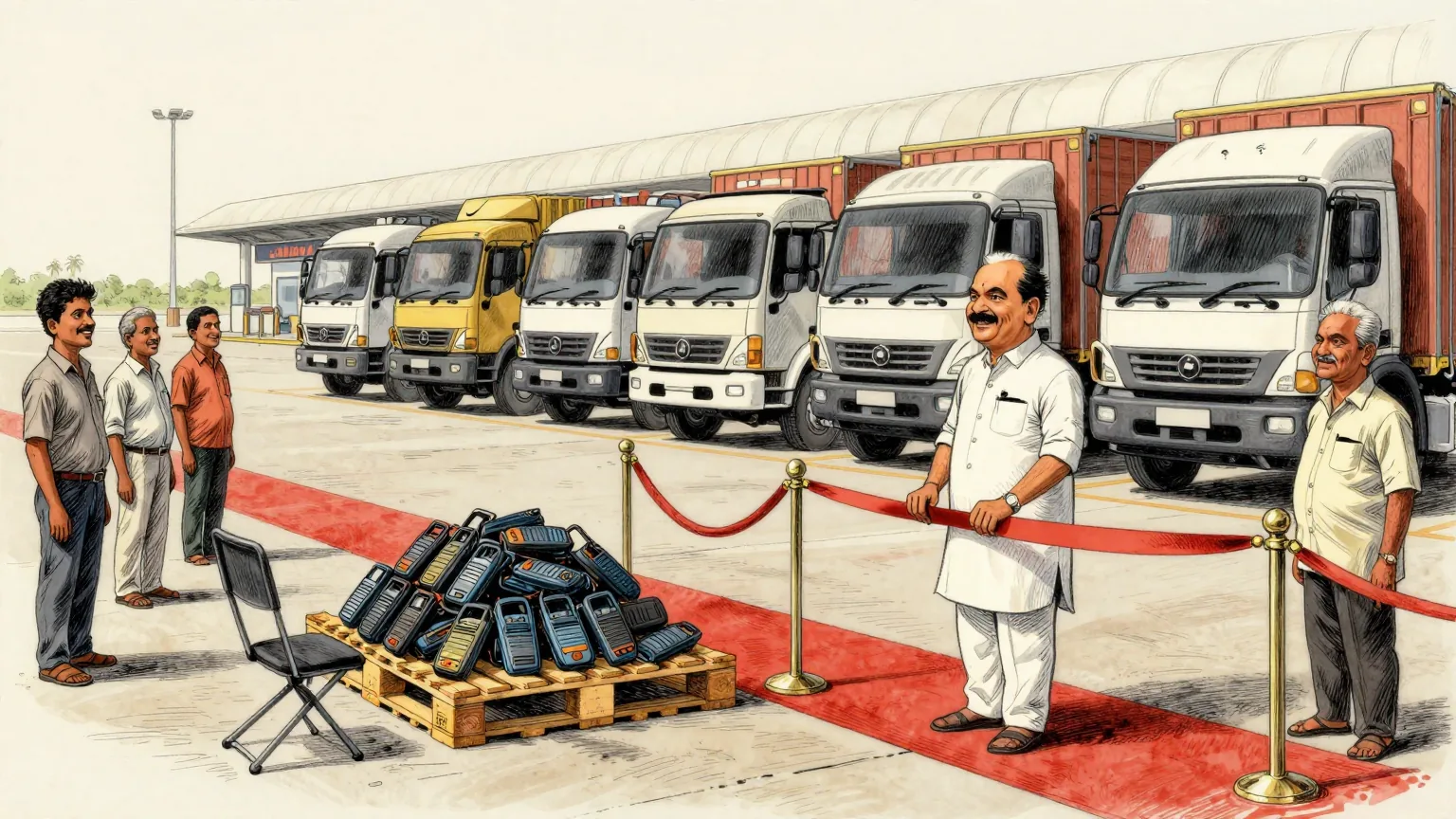
The Kerala State Road Transport Corporation has begun carrying freight, moving one tonne of mobile phones from Thiruvananthapuram to Aluva in its inaugural consignment on Wednesday.
The consignment had been flown from Delhi to Thiruvananthapuram International Airport by Air India. It was taken on to Aluva by road, in a truck hired by the corporation.
The service was flagged off by the Transport Minister, C.P. John, at a function held at the cargo terminal of Thiruvananthapuram Domestic Airport. The Minister said the project, which is included in the government's 100-day action plan, marked a significant milestone in the corporation's history.
It begins with five vehicles and will be expanded gradually. The corporation, the Minister said, would eventually operate a large fleet comprising over a hundred trucks. The five trucks currently in service have been taken on a wet-lease basis.
The stated purpose of the venture is to strengthen the corporation's existing logistics network and to boost non-ticket revenue. The corporation entered the sector after studying cargo service models already run by state road transport corporations elsewhere in India.
The Minister said the revenue generated from the initiative would be used in a manner that benefits the corporation's passengers. Two logistics firms, Scorpion Cart Logistics and Cargo Cart Logistics, are supporting the service.
Non-ticket revenue is a standing category in the accounts of a state transport undertaking. It is defined by what it is not: money that reaches the corporation without a fare being paid for a seat.
That definition is the part of this announcement worth reading slowly, because the inaugural consignment satisfies it completely. One tonne of mobile phones is, on the published criteria, an ideal source of non-ticket revenue.
The consignment paid to travel and occupied no seat. It claimed no concession. It did not ask to be set down between stops, did not query the change, and did not appear at a terminus at a quarter to midnight. It produced revenue precisely by not being a passenger.
The commercial logic then follows without difficulty. Fares in a state undertaking are set by policy; freight rates are set by the market. The best customer is therefore the one least able to buy a ticket, and the stated ambition is more than a hundred trucks, each of which carries none at all.
This newspaper accepts the Minister's undertaking that the proceeds will benefit passengers. It notes only that the subsidy now runs in the opposite direction from the usual one. The people who buy tickets are to be supported by goods that cannot.
Pursued to its end, the principle describes a recognisable organisation. It would hold a very large fleet, run a dense network across the state to a published timetable, and sell nothing whatsoever to anybody standing at a stop.
The Department of Unnecessary Research has one question outstanding, and has addressed it to nobody in particular: whether a tonne of telephones, having paid in full and complained at no point, is now the corporation's most satisfied customer.