
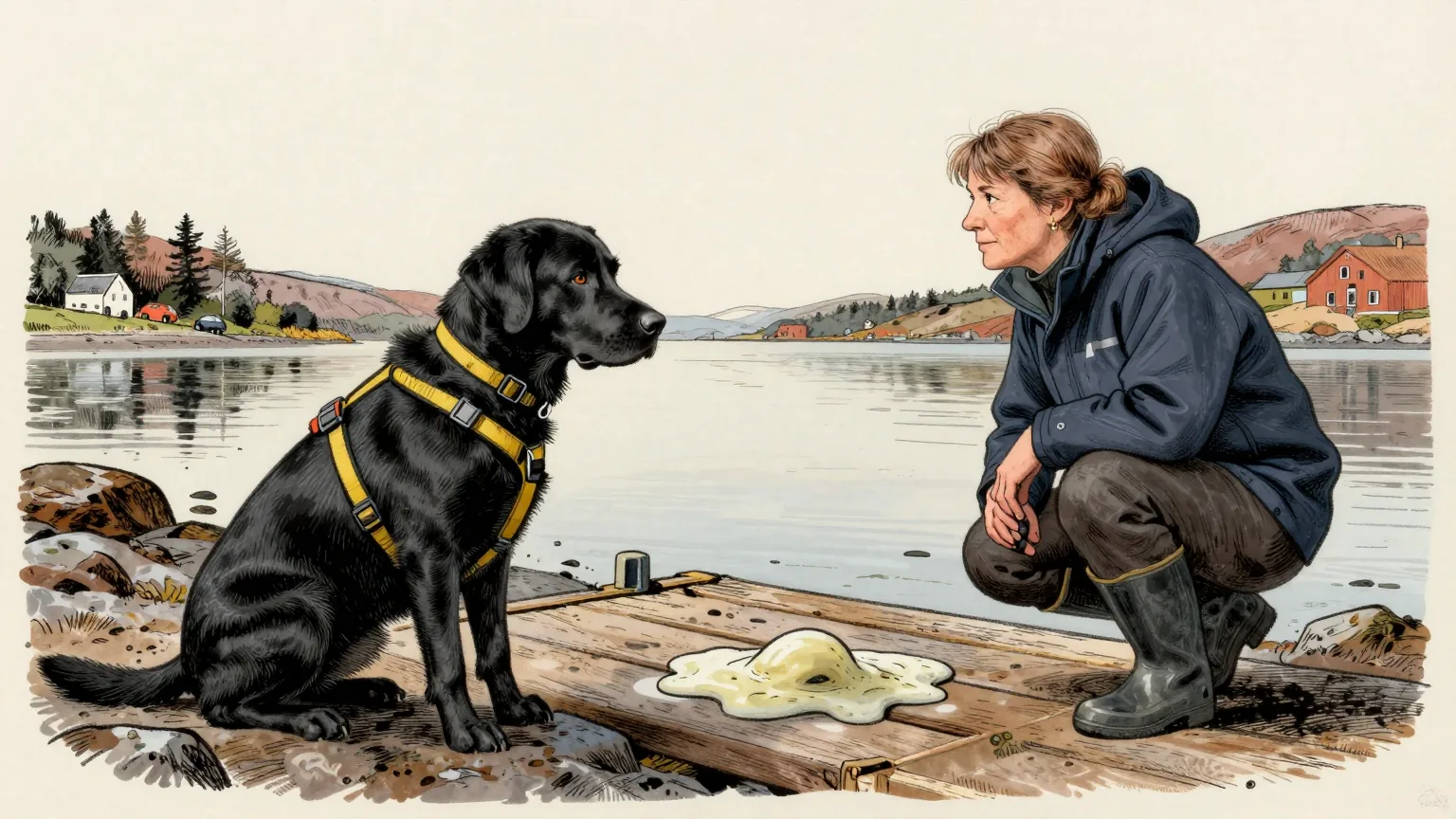
A Labrador from the Scottish Highlands has been named animal of the year by an international welfare charity, for tracking down an invasive marine creature called the carpet sea squirt.
Sgiath, pronounced Skee-ah, is a six-year-old black Labrador. Working at low tide with her owner, the marine ecologist Dr Texa Sim, she has found hundreds of colonies of the organism, which can smother and kill native species if it is left uncontrolled.
She is thought to be the UK's first sea squirt-hunting dog. The International Fund for Animal Welfare is presenting the award at its 26th annual Animal Action Awards ceremony on Thursday 15 October.
The carpet sea squirt, formally named Didemnum vexillum and nicknamed sea vomit, is believed by marine experts to have come from Japan. It arrived on the shores of the south of England and Wales in 2008 and has since spread to several seaside locations across the UK.
It can appear in shades from orange to cream, reproduces quickly during the warmer summer months, and is feared to spread further as seas warm.
The practical difficulty is that it does not look like much. Dr Sim says it resembles slime among seaweed and turns up on structures such as pontoons and oyster cages.
"When I first started this project, I genuinely didn't know whether it would work," she said. "No one had really explored whether dogs could help tackle this problem in the marine environment. It began as a proof-of-concept project and has exceeded every expectation I had."
Sgiath was originally trained as a mountain rescue dog. She proved good enough at it that Sim, who is based near Glencoe, wondered whether the same skills could be turned to marine conservation work.
At low tide the dog will, as Sim puts it, "dive down under the seaweed". "She just does a survey with her nose, essentially, she can pinpoint exactly where it is, so it's much easier," she said.
The two roles require opposite behaviour. To locate and draw attention to a lost hiker on mountainous terrain, Sgiath is trained to bark and bounce around. Conservation work needs a quieter approach, and she is trained to give what handlers call a passive indication. "It's a kind of a stillness, or a stare," Sim said.
Dr Martyn Kurr, a marine biologist at Bangor University, told BBC News that non-native biofouling species such as the carpet sea squirt can outcompete native wildlife for valuable nutrients. "These species also clog up aquaculture pens, marine infrastructure, and machinery such as boat propellors," he said. Controlling them costs millions of pounds every year across Europe.
Kurr said scientists were just starting to realise that "these wonderful animals can smell changes in water that signal a marine invasion which otherwise might have gone unnoticed".
It is worth setting out Sgiath's professional position precisely, because it is stronger than most. She holds two qualifications whose response protocols are mutually exclusive, and must therefore establish which kind of emergency she has arrived at before deciding whether to bark continuously or to stand perfectly still.
Her detection record is the part that defeats scrutiny. Her handler says she is always right. The organism is hard for people to see. The only instrument capable of confirming a find is the dog that reported it.
This newspaper does not question the result. We observe only that Britain's working register of carpet sea squirt colonies now rests on the testimony of a Labrador, and that the Labrador has never been contradicted.
The remuneration deserves a note of its own. Sgiath is driven to do the job by treats and play, which makes her the only member of the survey team whose entire compensation package fits in a coat pocket.
The Department of Unnecessary Research has examined the award and finds the category sound. Hundreds of colonies of an invasive species have been located by an animal that reports a discovery by going quiet and staring at it. Nothing in the citation requires her to know why.