
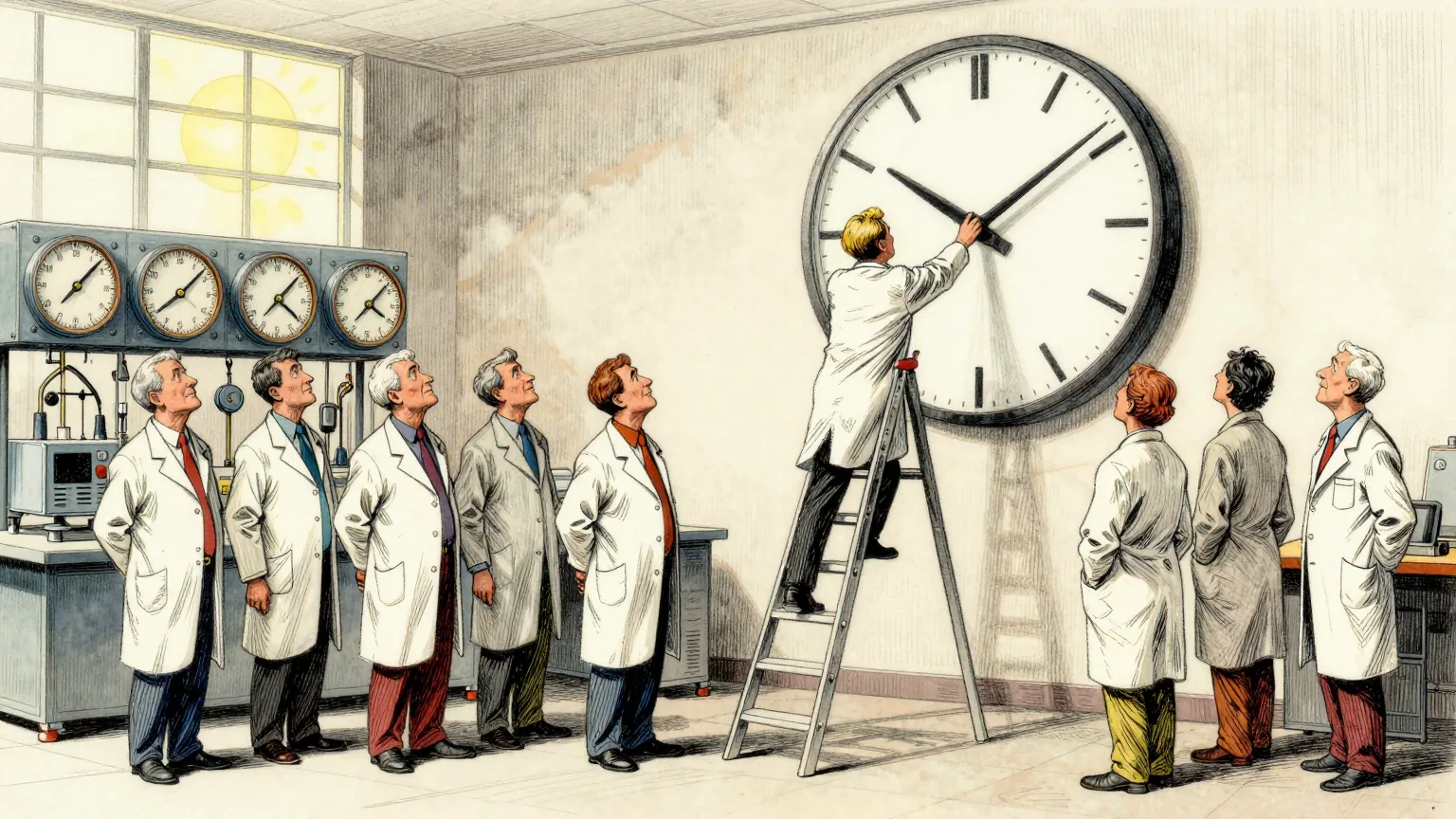
The General Conference on Weights and Measures is expected to abolish the leap second, the occasional one-second adjustment that keeps civil time in step with the rotation of the Earth.
Twenty-seven leap seconds have been inserted into Coordinated Universal Time since 1972, each of them keeping UTC in step with UT1, the astronomical time scale that follows the Earth's fluctuating rotation.
The proposal does not alter the rotation of the Earth, the length of the second, or the way either is measured. It alters the permitted gap between the two scales, increasing it from 0.9 seconds to one hour.
On that basis no adjustment would be needed for several centuries. Many national bodies support the proposal and it is widely expected to pass. If approved, the change would take effect on 20 May 2027.
The reason is that leap seconds have become an engineering hazard rather than an astronomical one. They are difficult to apply consistently across networks.
There is also a newer problem. The Earth's rotation has sped up in recent years, raising the possibility of a negative leap second, meaning the removal of a second rather than the addition of one. That has never been done.
Experts have estimated a 30 per cent probability that global systems will need a negative leap second by 2035. Computer systems designed to absorb an added second are not necessarily built to lose one.
Setnam Shemar, principal scientist at the UK's National Physical Laboratory, said the proposal would avoid the risks associated with leap seconds for centuries.
"Leap seconds can be difficult to implement reliably, and if not applied correctly, they can cause differences in time across networks, potentially leading to the failure of systems such as mobile phone networks or electricity grids," he said. "These risks could increase if a negative leap second had to be implemented for the first time."
"Previously, leap seconds were added to UTC to keep it within 0.9 seconds of UT1," he said. "From 20 May 2027, a difference of up to 1 hour will be allowed before intervention is needed, ensuring the continuity of UTC for several centuries or more."
The link to the sky is not being cut. "The relationship between UTC and UT1 is important for some applications, such as astronomy and celestial navigation," Shemar said. "The decision would not sever that link: UT1 will continue to be monitored, and its difference from UTC will continue to be disseminated through established international services."
It is worth stating the remedy in its own terms. For fifty-four years the world has kept its clocks within nine-tenths of a second of the sky by correcting the clocks. From May 2027 it will keep them within an hour of the sky by permitting an hour.
The tolerance is widening by a factor of four thousand. This newspaper has checked the arithmetic twice, because it is the largest single improvement in timekeeping ever achieved without touching a clock.
The method generalises cleanly, and the Department of Unnecessary Research recommends immediate adoption elsewhere. A watch that is fifty-five minutes fast is not broken. It is inside specification, and will remain inside it for several centuries.
The astronomical link is the reassuring part. UT1 will go on being measured and its difference from UTC will go on being published throughout. Anyone who wishes to know what time it actually is will be able to look the figure up.
That leaves the 30 per cent chance that global systems will need a negative leap second by 2035, the one adjustment nobody has ever made. Under the new rule nobody will make it. The Earth will be allowed to run fast by up to an hour, the discrepancy will be measured and published the whole way, and the correction will fall to whoever is on duty in several hundred years' time.