
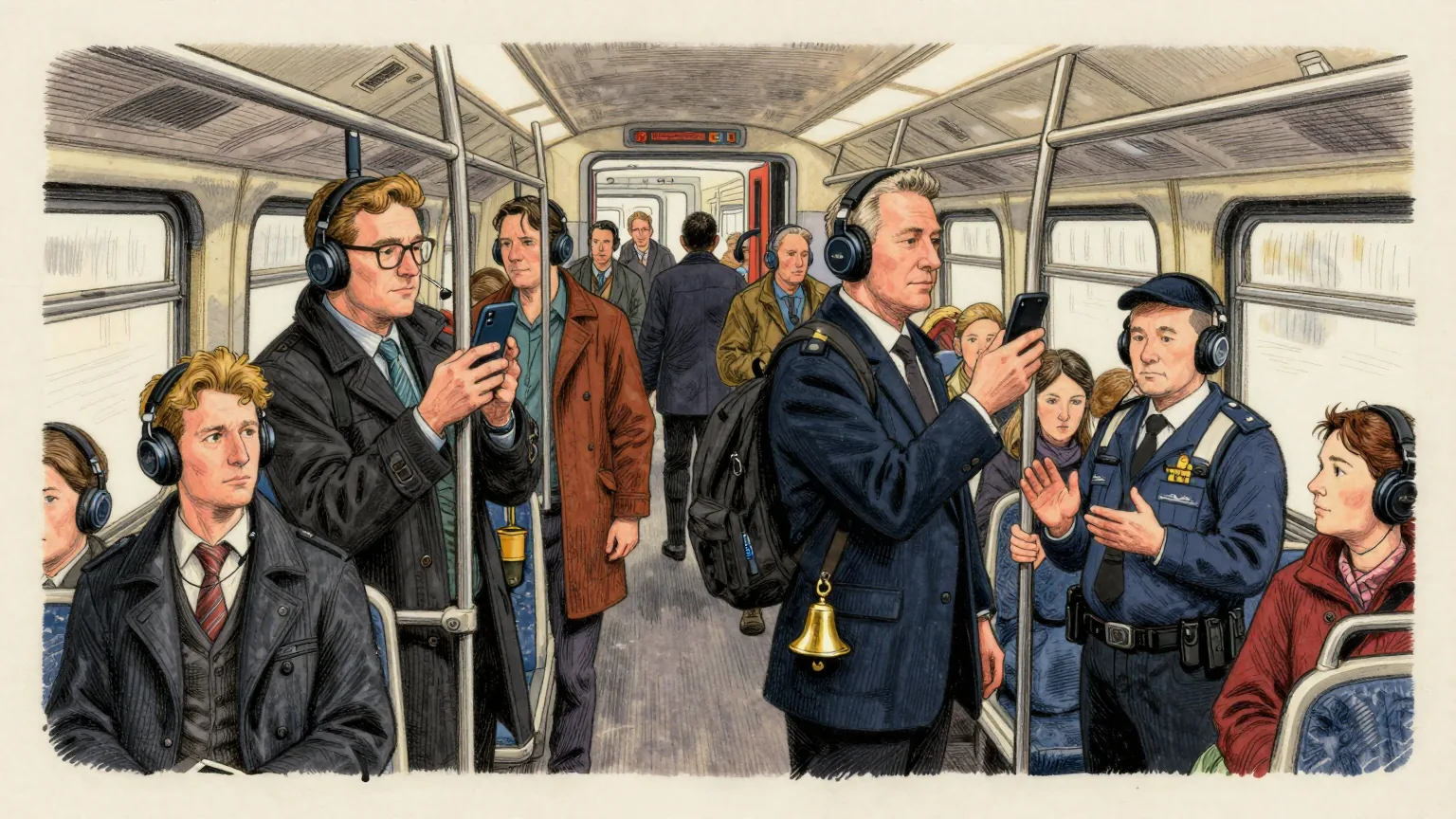
The prime minister, Andy Burnham, has announced a crackdown on "headphone dodgers" who play loud music on public transport, extending his promise to give voters "breathing space" to the confines of a train carriage.
The campaign against nuisance behaviour was unveiled on Monday alongside guidance allowing local transport authorities to levy fines of up to £100 for non-compliance.
"We've all been on the train when someone starts blasting music or videos from their phone. It gets on your nerves and can quickly spoil the journey," Burnham said in a statement. "So, we're launching a nationwide campaign reminding passengers to use headphones on trains. On top of that, we're giving local leaders new powers to tackle loud music, vaping and littering on buses."
"It's a simple thing, but one that will make journeys that little bit better for all of us," he added.
Under the plan, ministers will issue guidance to local transport authorities in England advising them how to use new powers granted under the Bus Services Act, which allows them to set and enforce their own rules on board. The guidance will say authorities should issue fines of up to £100 if bus passengers refuse to comply with a request to stop certain nuisance behaviour.
Officials said drivers would not be expected to enforce the rules. That job would be left to transport safety officers or police officers.
A poster campaign will run alongside the new powers under the slogan "share the carriage, not the noise", encouraging passengers to use headphones, avoid making calls on speakerphone and watch videos quietly.
Train operating companies already have the power to issue fines of up to £1,000 for similar behaviour.
Burnham is the latest in a line of politicians to promise action on the subject. The London mayor, Sadiq Khan, unveiled a campaign in the summer urging passengers to "travel kind", including by wearing headphones, and the Liberal Democrats have called for bus travellers to face £1,000 fines as well as those on trains.
The scramble follows polling showing that noise on public transport is a major annoyance. About 60 per cent of voters back action against people who play videos or music out loud in public spaces, and a recent poll by YouGov found voters would support £1,000 fines for playing music out loud on buses and trains. A separate survey by the same company found speakerphone conversations listed among their top three irritants.
Unions were less impressed. Unite said the proposals were well-meaning but inadequate for the challenges its bus members face, with its general secretary, Sharon Graham, adding: "The proposed penalties are not going to deal with the issues facing workers."
What has been published, on that reading, is not a prohibition but a tariff. Noise has been priced, and the price varies by mode. A passenger who wishes to broadcast at the lower rate should take the bus. The guidance does not say this. The arithmetic does.
The terminology supports it. A fare dodger dodges a fare, so a headphone dodger dodges headphones, which makes headphones the fare and £100 the penalty charge for travelling without them. On a train the same unworn item costs £1,000, which is a premium of the kind usually reserved for peak travel.
The Department of Unnecessary Research has therefore asked for a ruling on the guided busway, the tram, and the rail replacement service, where the carriage is a bus. It has also asked which rate applies to a passenger who boards quietly and is still playing the same song when the train arrives.
Nobody has suggested that noise is ten times worse on a train. Only that it is ten times more expensive.