
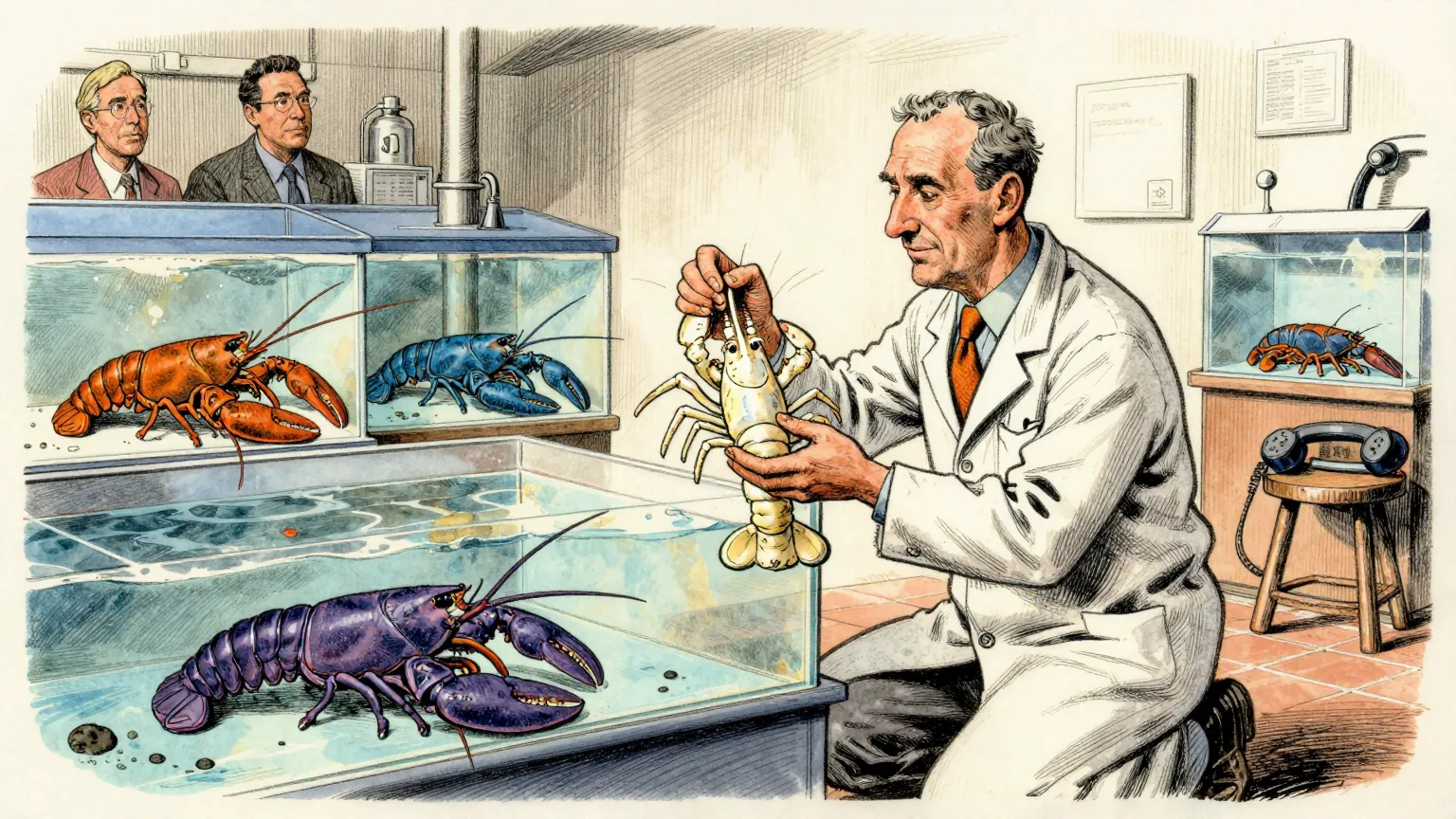
A white lobster has been moved from an aquarium in Boothbay to a laboratory further down the Maine coast, where it will spend the rest of its life as a genetics problem.
The lobster is called Casper. White colouration occurs in roughly one American lobster in 100 million.
It was donated by the Maine State Aquarium to the Arthur P. Girard Marine Science Center at the University of New England, joining the invertebrate physiology laboratory run by Markus Frederich, professor of marine sciences.
The laboratory is looking for the molecular mechanisms that make some American lobsters emerge a colour other than the mottled brown typical of the species. It analyses more than 15,000 genes, using genetic material collected without harming the animals.
"Animals like Casper capture people's attention because they are so rare and beautiful," Frederich said. "But, for us, they also provide an amazing opportunity to ask fundamental biological questions."
Casper joins a collection. Peaches, an orange lobster, represents a colouration occurring about once in 30 million. Currant is blue and Fig is purple. The laboratory also holds calico and split-coloured specimens.
Peaches has been the most scientifically productive so far, having produced offspring ranging from typical brown through orange to blue, which allows inheritance to be studied directly rather than inferred.
The donation was arranged by Rue Motulsky, a UNE graduate whose student work on the DNA project contributed new insights into lobster colouration.
The published figures invite a calculation this newspaper has been unable to resist. A one-in-100-million lobster and a one-in-30-million lobster, treated as independent events, should occur together about once in three quadrillion lobsters.
Add the blue one, the purple one, the calico and the split, and the tank becomes an object with no plausible frequency at all. Our analysts put its likelihood somewhere below the number of lobsters that have ever existed.
Two explanations are available, and the Department of Unnecessary Research prefers the second. Either the probabilities are wrong, or Maine has developed a mechanism that collects improbable lobsters and puts them in one room.
The mechanism is not hard to find once you look for it. It is called an aquarium, and it is attached to a state with a large lobster fishery, several thousand people hauling traps, and a firm habit of telephoning somebody when something unusual comes up in one.
That makes the tank at the marine science center the least random sample of lobsters in the world, and therefore the only place where the rare ones are ordinary.
Frederich's research question survives the arithmetic entirely, because it was never about how often a white lobster turns up. It is about which genes are doing it.
The odds, on the other hand, have now been comprehensively defeated by a telephone.