
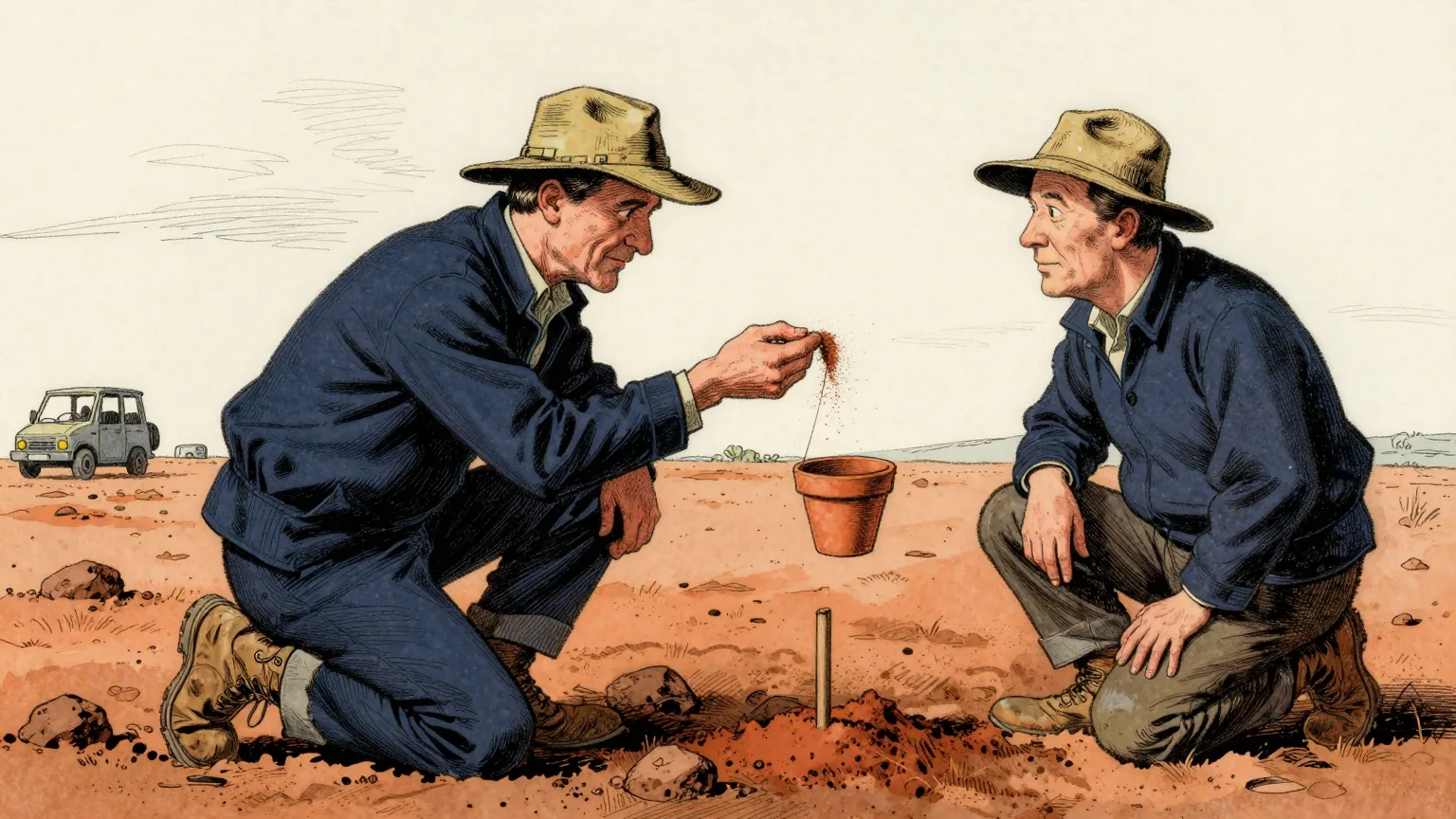
Mars has been given a soil survey. A doctoral student at the University of Sydney has produced the first comprehensive classification system and map of Martian soils, a framework intended to let researchers compare landscapes across the planet and identify promising sites for exploration, habitation and food production.
The work, by Daniel Irving of the Sydney Institute of Agriculture and the Faculty of Science, with his supervisor Professor Alex McBratney, was published in the journal CATENA under the title "Areths and the Provisional Polythetic Areth Classification System". It was reported by Phys.org on Friday.
The researchers propose the term "areths" for Martian soils, from Ares, the Greek name for the planet. "This is the first time a classification system of this scale has been developed for Martian soils," Irving said.
The system sorts almost 800 million locations into 2,000 classes, arranged in a hierarchy of 10 major realms, 100 assemblages and 2,000 detailed forms, on the basis of texture, mineralogy, pH and profile thickness. The resulting map covers 92 per cent of the Martian surface. Many of its inputs are inferred from orbital observations and models, using relationships established on Earth.
As a proof of concept, all 2,000 classes were assessed for water-holding capacity, pH, profile thickness, clay content and gravel content.
The winner is a class the team has named Nohibareth, which scored 0.93 on a scale of 0 to 1. It has a modelled average pH of 6.8, a clay content of 72 per cent and minimal sand or gravel, and a water-holding capacity of about 202 millimetres per metre. It is found mainly in the midlatitudes around Tharsis, central Arabia Terra and Elysium Planitia, and it covers 0.14 per cent of the surface of Mars.
The rest does less well. Water-holding capacity was the limiting factor in 73 per cent of forms, and every class in the realms from Fareth to Mareth scored below 0.3.
The researchers are careful about what this does not show. Perchlorate toxicity, nitrogen availability and depth profiles are not included in the assessment, and they say the results do not mean crops could be grown directly in Martian soil. Martian soils contain no organic matter at all.
That absence is less disqualifying than it sounds. "People often think soil needs lots of organic matter to function," McBratney said, and the framework is designed to describe what is there rather than what is missing. He added: "A future greenhouse on Mars would need more than air, water and light."
The approach may also be useful closer to home, in arid and extreme landscapes such as the Atacama Desert, the Pilbara and the polar regions. "This gives us a framework that can grow and evolve as new data becomes available," Irving said.
It is at this point that the achievement deserves to be stated in full, because stating it in full changes it.
Mars has been graded. Almost 800 million locations have been sorted, scored and ranked for agricultural quality. There is a top class and there are bottom classes, there is a best region and a worst, and the best region is scarce, covering fourteen hundredths of one per cent of the available land.
A grading implies a market, and this newspaper is obliged to report the consequences. Mars now has prime agricultural land. It has a great deal of marginal land. It has a shortage of the good stuff concentrated in the midlatitudes, which is where the good stuff always is.
The realms from Fareth to Mareth, all of them scoring below 0.3, together constitute the largest contiguous area of agriculturally disappointing ground ever mapped by anybody, and they have been disappointing for the whole of planetary history without a single complaint reaching the authorities.
Water-holding capacity, our analysts note, is the limiting factor in 73 per cent of forms. On Earth that is a drainage problem, addressed by a contractor. On Mars it is addressed by waiting.
The Department of Unnecessary Research has reviewed the paper and finds it unimpeachable, subject to one observation about sequence. Soil is normally classified by people who intend to grow something in it, after they have failed to. Mars is the first planet in the solar system to have been assessed for arable quality before anything on it has ever been hungry.