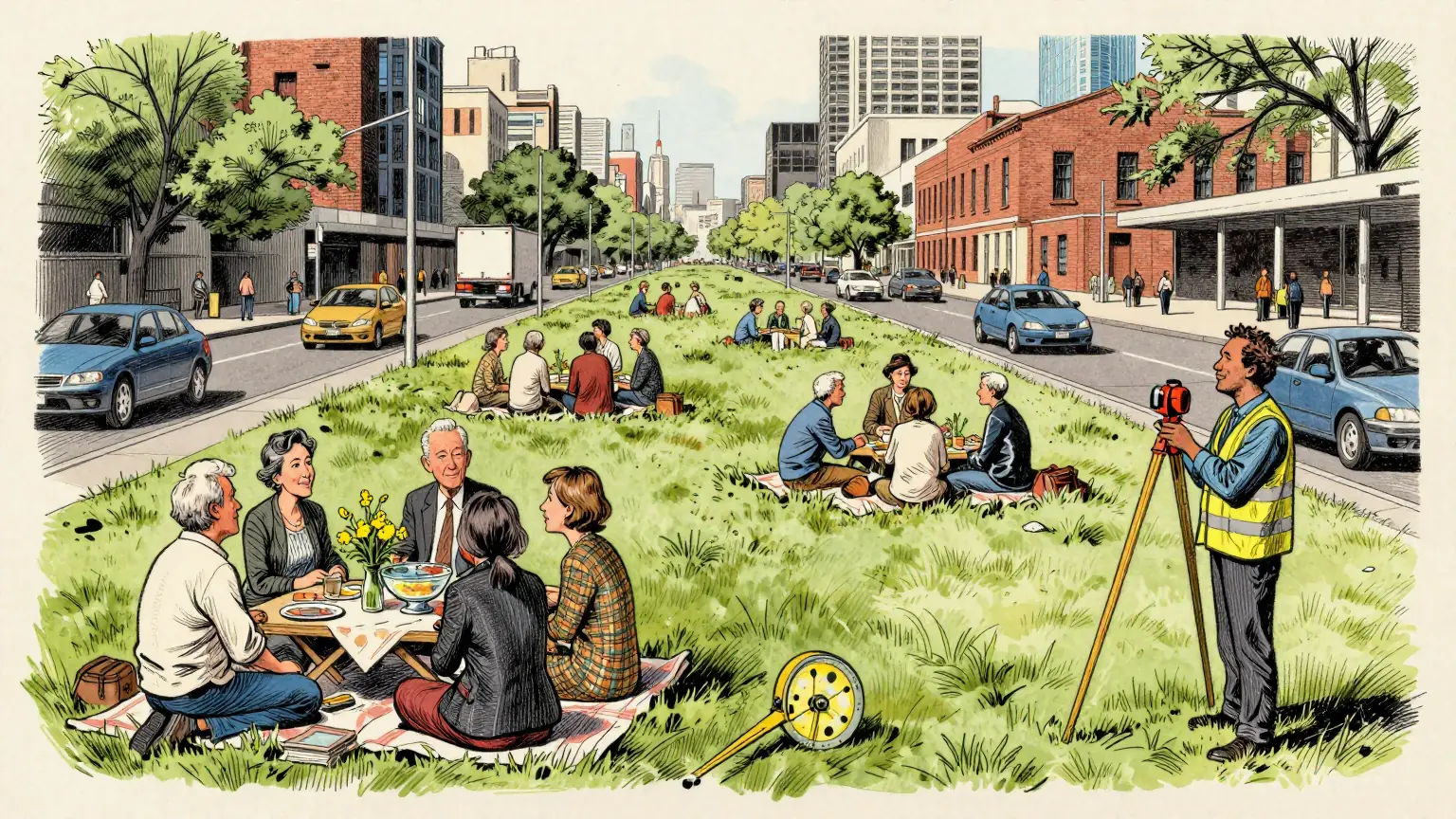
A few dozen people gathered on the grassy median strip in the middle of Canning Street in Carlton on Friday evening, spread out blankets, poured drinks and, in doing so, broke the rules.
The strip is one of several unusually wide grass medians running down Canning, Rathdowne and Drummond streets in inner-north Melbourne. They are considerably broader than an ordinary nature strip, and for years residents have used them for birthday parties, picnics and the sort of evening gathering that requires nothing beyond grass.
On Monday a local bar and bottle shop, the Wine Corner Store, announced on Instagram that consuming alcohol had been outlawed on the medians, blaming “a few unrelenting miserable neighbours who have been non-stop complaining to the council”.
The council had reverted the strips to a former classification, with the effect that they are no longer treated as park spaces. It said residents had complained about noise, rubbish and unsafe behaviour. The change followed a petition of 29 signatures submitted by a resident in August.
The reply was not proportionate. A counter-petition calling on the council to revoke the ban gathered more than 7,707 signatures within a few days, and residents began uniting under the banner Free the Strip!
Friday's protest was the result. One group arrived with a wooden table, a tablecloth, yellow flowers in a vase and a glass punch bowl, which they ladled from as they talked. Others sat on blankets and passed around bags of crisps.
“We need to be building community spaces and not getting rid of them,” said Sam Drummond, who attended. “Particularly post-Covid, there are very few spaces where people can come together and meet in public, in person.”
Rachel Richmond, a Canning Street resident who had called on neighbours to gather, described the evening as “the most civilised act of civil disobedience I've ever participated in”. She was alert to how it looked. “This might seem like a very ridiculously middle class thing to protest,” she said. “I mean, it's literal champagne socialism but honestly, sitting underneath it is an issue about public space and public enjoyment of space.”
The only disorder the Guardian reported on the median was a minor skirmish between a chihuahua and a labrador, both on leads.
The local councillor for the Carlton North ward, Edward Crosling, said there had been “genuine amenity concerns”, particularly among people living near the bottle shop, but that council staff had gone too far in banning drinking outright. “There are some people that have been behaving not fantastically but the majority of people are just having a picnic,” he said.
Crosling said he was preparing a motion for the council's October meeting that he expected would re-classify the median as open space, alongside separate measures addressing the concerns raised near the wine bar. The venue's owner, Steve Misfud-Ellul, told Australian Associated Press his business had wrongly taken the blame, and that “ninety-nine per cent of the time it's people sitting, picnicking on a patch of grass, with the loudest noise being laughing”.
It is worth being precise about what the council did, because it did nothing whatever to the grass. No turf was lifted. No fence was erected. No bollard was sunk. A classification was restored, and the classification is the entire dispute.
This newspaper regards it as the most efficient public works programme in Victoria. Melbourne acquired and then lost several thousand square metres of open space inside a week, at a cost of nothing, and the grass was not required to attend.
The economy of the mechanism deserves study. A park becomes a not-park when a former classification is reinstated, and becomes a park again when a motion passes in October. Neither event involves earth-moving equipment. The strip is landscaped by vote.
The Department of Unnecessary Research notes that in the interval the median has no positive description at all. It is not open space. It is the ground in the middle of a road, currently supporting a punch bowl, a tablecloth, a vase of yellow flowers and two dogs who have settled their differences.
In October the council will move its motion and the median will be open space once more. Nothing will be planted. Nothing will be moved. The grass will simply be told what it is, and will comply.