
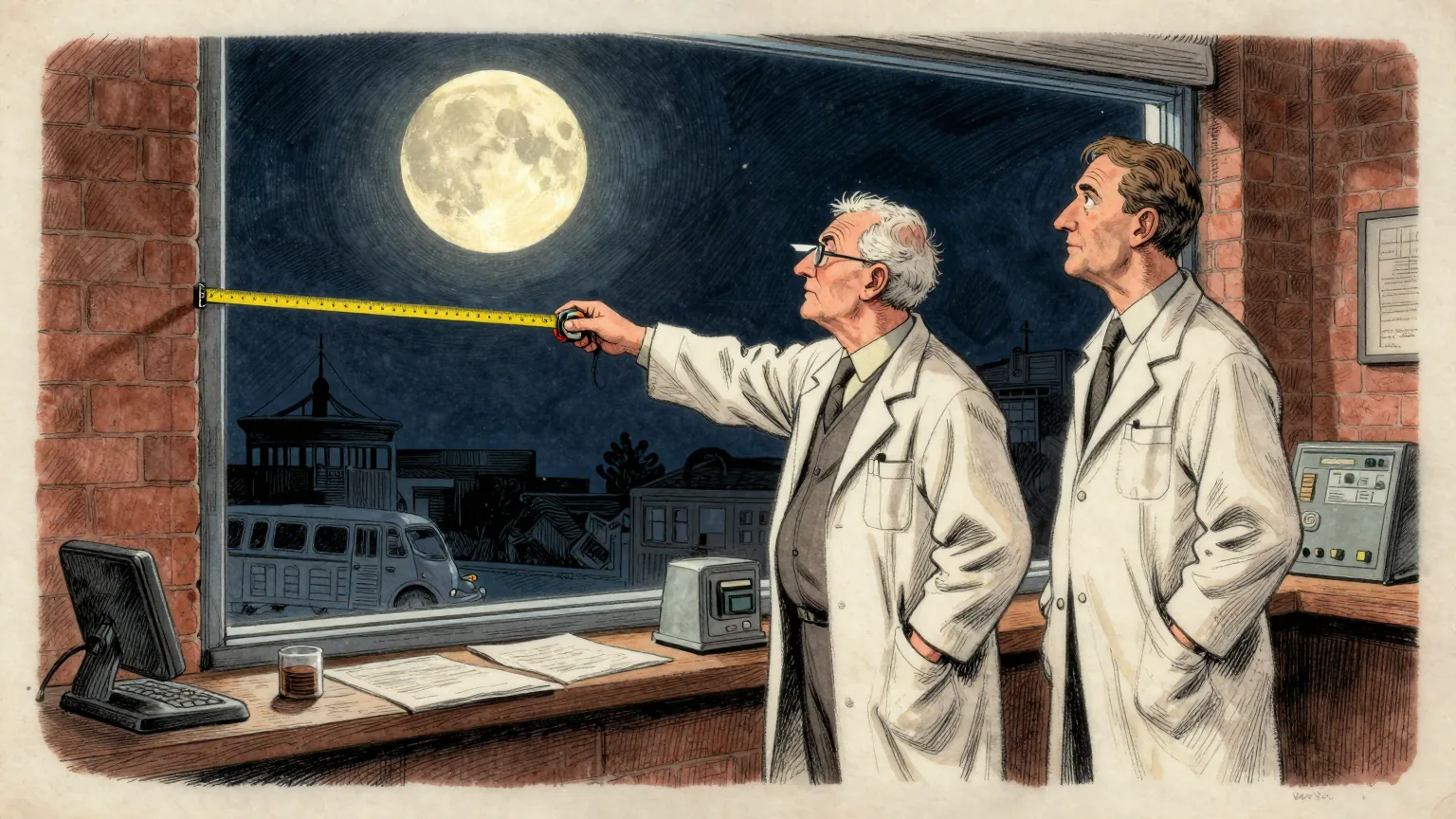
The Moon is getting smaller, and researchers have now counted the cracks that prove it.
A study published on 14 October in The Planetary Science Journal maps more than 10,000 young faults across the lunar surface and uses them to estimate how much the Moon has contracted as its interior cools.
The paper, "Thrust Faulting and the Late-Stage Contraction of the Moon", is the work of Thomas R. Watters, a scientist emeritus at the Center for Earth and Planetary Studies at the Smithsonian's National Air and Space Museum, with co-authors Maria Banks, Cole Nypaver and Mark Robinson.
Its figures come from the Lunar Reconnaissance Orbiter Camera, known as LROC, which has returned millions of images of the lunar surface across the roughly 17 years the orbiter has been circling the Moon.
The faults fall into two families. The team mapped over 8,900 lobate scarps, the step-like ridges that form where contraction breaks the crust and thrusts one side up over the other, and over 2,000 small mare ridges. Both appear in the highlands and in the dark volcanic plains.
From the displacement accumulated across those structures, the authors estimate that the Moon's radius has decreased by about 45 metres, or 148 feet, over the past 400 to 800 million years.
If the rate has held constant, that works out at 6 to 11 centimetres per million years. Expressed per year, which the paper also does, the Moon is shrinking by roughly 0.1 micrometres, or 0.0001 millimetres.
For comparison, Earth's plates move about 1.5 centimetres a year. Earth's surface is made of more than 15 lithospheric plates, and about 90 per cent of its tectonic and seismic activity is concentrated at the boundaries between them.
The Moon has one plate, which is why its faults are not confined to a few lines but spread across the whole surface. The areas with the thickest crust have the fewest of them.
The authors suggest that widespread faulting did not begin early in lunar history because a thick, fractured and porous crust insulated the interior and slowed its cooling. The larger scarp in the Mouchez L crater, near the north pole, stands more than 100 metres above the terrain around it.
"The number of these young faults revealed in LROC images is much greater than I ever imagined," Watters said.
This newspaper wishes to be precise about the magnitude of what has been established. The Moon is contracting by one ten-thousandth of a millimetre a year. It is doing so continuously, across its entire surface, and it has been doing so for at least 400 million years.
Our analysts have converted the figure into the units in which the public thinks. At 0.1 micrometres a year, the Moon loses a millimetre of radius every ten thousand years. A centimetre takes a million. The whole 45 metres took between 400 and 800 million years.
The Department of Unnecessary Research observes that the process is nonetheless irreversible, which is the only property a trend requires in order to be followed to its conclusion. The faults are still growing. Nothing in the paper reports that the cooling has stopped.
We therefore publish the finding in its proper form. The Moon is going away. It is going away by an amount no instrument on Earth could notice in a lifetime, over intervals of hundreds of millions of years, and the paper identifies no mechanism by which it will stop.
The Department has considered whether the remaining radius should be printed daily, as a market would print a closing price, and has decided against it. At 0.1 micrometres a year the figure would be identical every day for the next ten thousand years, and a column of unchanging numbers is the kind of thing readers write in about.