
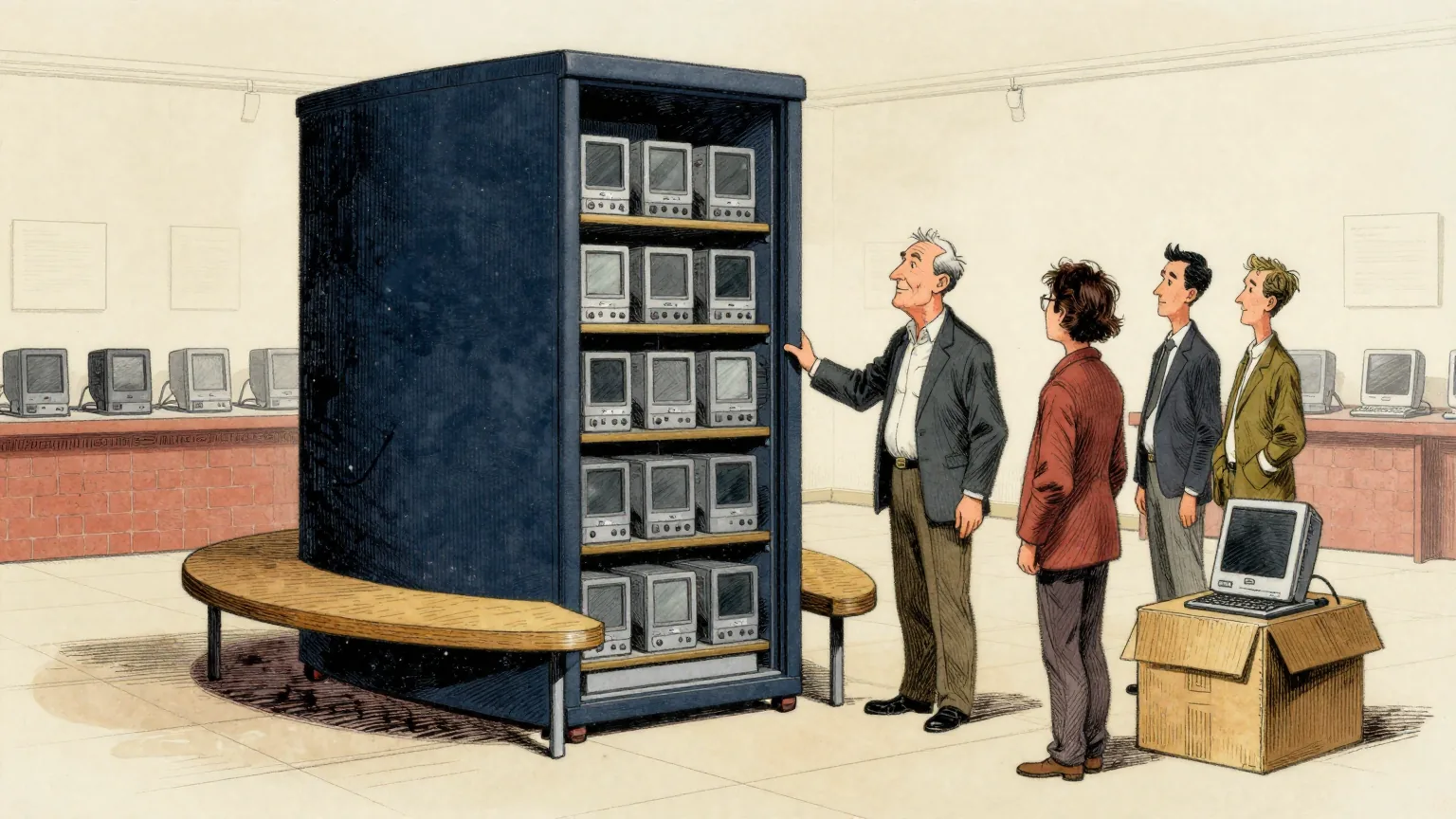
A Spanish computing museum has unveiled a full-size replica of the Cray-1, the supercomputer that defined high-performance computing in 1976, built from 30 Mac Minis that are mostly 14 years old.
The Museo de Historia de la Computacion developed the project over 18 months as a 50th-anniversary tribute to both the Cray-1 and the founding of Apple. The result is a 1:1 scale visual replica, now on permanent display alongside two unused authentic Cray CX1 systems.
The hardware is deliberately unglamorous. Five of the machines are quad-core i7 models and the remaining 25 are dual-core i5s. All but two date from 2012; the exceptions are from 2014. Networked together, they have been orchestrated into a cluster delivering 1.3 teraflops across 64 active cores in the most recent tests, measured with a custom matrix-multiplication script in Python.
The museum reports having previously reached 1.5 teraflops using all 70 available cores, before one node went offline.
Rather than a Linux distribution, the team settled on macOS Mojave, which met the project's needs through the operating system's built-in support for the Message Passing Interface, the layer that lets the nodes hand work to one another. One master Mac Mini sits in the terminal and directs the rest.
The engineering problem that remained was noise. The team used passive convection cooling, mounting each machine on an aluminium tray inside a steel rack chassis and standing them vertically so the tower acts as a thermal chimney, with hot air leaving through grilles at the top. Each machine produces 12 to 15 dBA at idle. The only audible components are two gigabit Ethernet switches at the base, at 30 to 33 decibels, which the team intends to replace with silent models.
The terminal is its own exercise in period reconstruction, combining elements of the DEC VT05 and the Processor Technology Sol-20 and incorporating an analogue control panel, with plans to add original lamps from an IBM System/3. Flat Samsung displays replaced the originally intended cathode-ray tubes, on the grounds that bridging two technological eras of connector was more trouble than authenticity was worth.
Visitors can watch matrix algorithms run in real time, from a single core up to the full cluster in parallel, which is the exhibit's actual educational point: the original Cray-1 used vector processing, applying one instruction to many data elements at once, while the replica distributes work across independent processors.
It is at this point that the fidelity of the reproduction requires attention. The replica is accurate to within nothing at all on height, diameter and shape. On the one specification for which the Cray-1 was famous, it is out by a factor of 8,125.
The arithmetic is not in dispute. The original's peak theoretical performance was approximately 160 megaflops. The replica has reached 1.3 teraflops, and 1.5 teraflops before the node failure, which is 9,375 times the machine it depicts.
The Department of Unnecessary Research has accordingly revised the accepted definition of a scale model. The dimensions are 1:1. The performance is 8,125:1. A visual replica, it turns out, is a replica of everything about a computer except the computing.
The museum's stated ambition completes the picture. The second half of the tower is currently empty, and a crowdfunding campaign is planned to fill it with 70 to 80 additional M4 Mac Minis, with the goal of producing a cluster capable of ranking on the TOP500 list of the world's fastest supercomputers.
This would make the exhibit a replica of the fastest computer in the world and, separately, one of the fastest computers in the world. The museum would then hold both the imitation and the thing imitated, in the same cabinet, at the same time.
The exhibit is cooled by hot air going upwards through a steel chimney, silently, at between 12 and 15 decibels a node. Nothing else about it is slower than the machine it copies.