
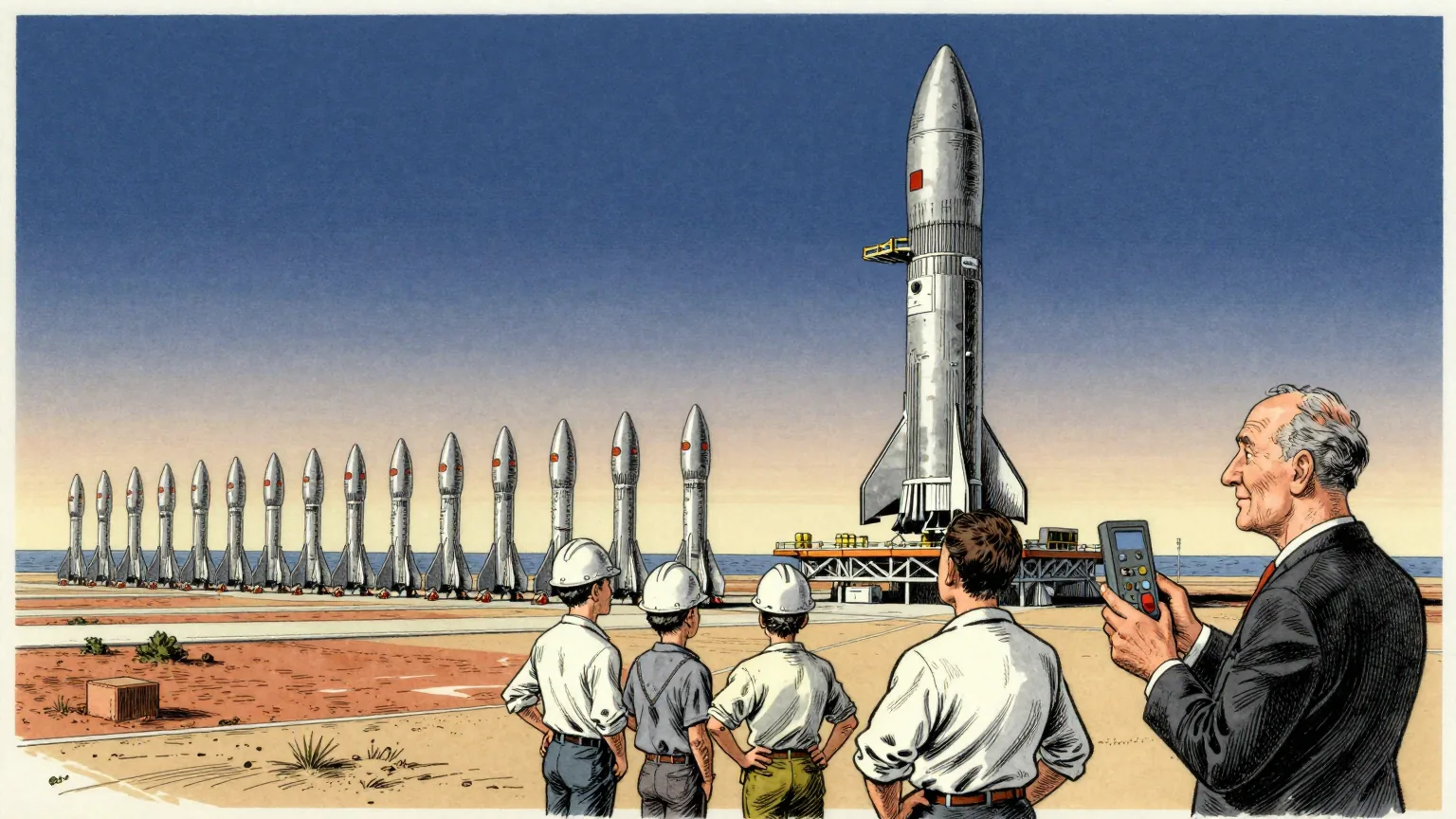
The number of rocket launches needed to put astronauts on the Moon and return them to lunar orbit now stands at about 22, according to NASA's own safety panel.
The figure emerged on Thursday at the quarterly meeting of the NASA Aerospace Safety Advisory Panel, where the panel member Charlie Precourt, a former NASA astronaut, spoke about the risks of landing humans on the Moon under the Artemis programme.
"With respect to Artemis IV, however, we've got a large number of firsts that reduce the likelihood of mission success," Precourt said. "We need to keep our eyes on numerous required fuelings for the lander. I think the last estimate is around 22 flights."
Precourt did not name a vehicle. Ars Technica, which reported the meeting, notes that he could only have meant SpaceX's Starship: NASA's other crewed lunar lander, Blue Origin's Blue Moon, does not use orbital refuelling in its initial mission design.
The mechanics are straightforward enough. SpaceX would launch a depot Starship into low Earth orbit and then fill it with liquid oxygen and methane carried up by a succession of tanker Starships, until the lander has enough propellant to fly to the Moon, land, and return to lunar orbit.
The estimate has a history. In 2023 the then director of NASA's Human Landing System, Lisa Watson-Morgan, told Ars: "We have a general idea, but I'm reluctant to say exactly what that is." She later put the number in the "high single digits to the low double digits", which suggests about a dozen: a depot plus eleven tankers. Other officials have since said "high teens".
The hope throughout has been the opposite movement. If SpaceX could raise Starship's lift capacity substantially, each tanker would carry more and fewer tankers would be needed.
SpaceX disputes the panel's figure. After the estimate was posted on X, the company's founder, Elon Musk, replied that it was not accurate. "That's way too high," Musk said. "Actual number will be more like 6 to 8."
Genuine uncertainty remains on both sides. Nobody yet knows precisely how much cryogenic methane and liquid oxygen will boil off while a depot waits in orbit, or how efficiently propellant can be transferred from one ship to another. What NASA can do is take Starship's current lift capacity and the propellant mass a lunar landing requires, and divide.
Flight rate is the other half of the problem. Even if SpaceX reaches the twice-weekly launch cadence it hopes for by the end of 2027, filling a depot would take about three months. NASA is still working towards a human lunar landing in 2028.
Precourt praised the agency's leadership for attacking the schedule. "With respect to schedule, I personally really appreciate the focus the administrator and the leadership team is putting on how to press schedule by bringing in resources to enable it to look for places where there are barriers," he said, referring to the NASA chief, Jared Isaacman, and his team.
Set the estimates out in order and a second trend appears. About a dozen in 2023. High teens. Twenty-two now.
The rocket did not change between those figures. No tanker lost capacity; no lander grew heavier. What rose, on each occasion that somebody looked, was the number required. That makes the number a property of the looking rather than of the vehicle.
It is also the best-behaved quantity in the programme. It has advanced from roughly twelve to roughly twenty-two in three years of sustained study, and the study continues. Nothing else in Artemis has moved that reliably in that direction.
The schedule has an awkward shape too. The fuelling campaign runs to three months for a mission measured in days, which means the longest stage of a journey to the Moon is now the part that never leaves Earth orbit.
The Department of Unnecessary Research therefore recommends that NASA publish the estimate quarterly in place of the mission. Only one number in the Artemis programme has met every deadline it has been given, and it is the number of launches.