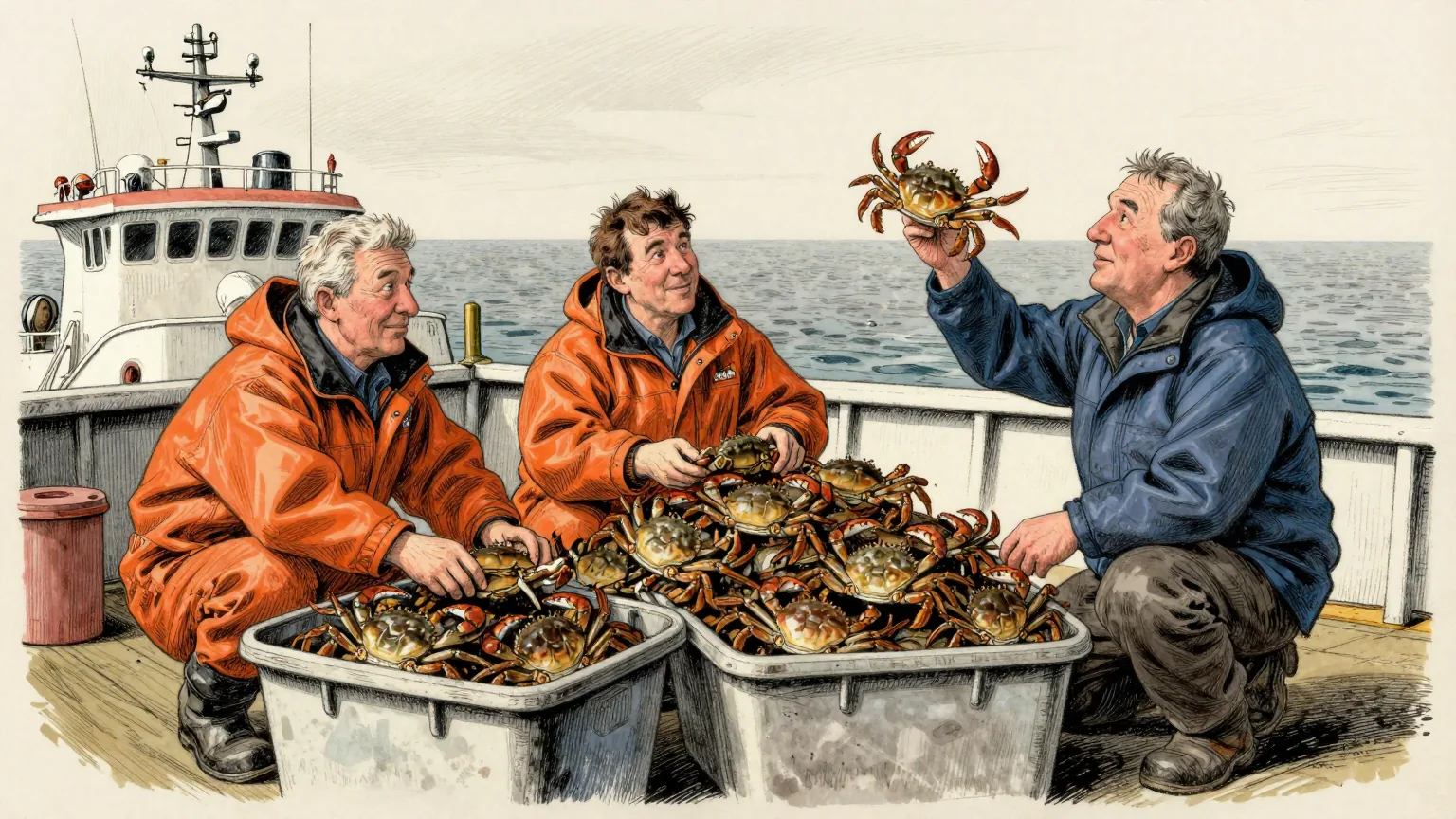
A once-rare hybrid crab has surged to record numbers in the eastern Bering Sea in the years following a marine heatwave, according to research published in Proceedings of the National Academy of Sciences.
Researchers at the Alaska Fisheries Science Center, part of the United States' National Oceanic and Atmospheric Administration, have trawled the bottom of the eastern Bering Sea in almost every year since 1982 to check the state of the ecosystem, which is home to commercially valuable species worth hundreds of millions of dollars a year.
When a marine heatwave rolled across the Bering Sea in 2018 and 2019, it set off one of the most significant marine mass mortality events on record. The heat drastically reduced winter sea ice and raised temperatures in the cold pool on the sea floor, setting off a chain reaction in which many snow crabs (Chionoecetes opilio) starved.
In 2018, before the heatwave, the snow crab population was estimated at about eight billion. In 2020 the researchers missed the annual trawl for the first time since it began. When they returned in 2021, they estimated that about one billion snow crabs remained.
The Alaska Department of Fish and Game banned commercial fishing of snow crabs for the first time. The ban lasted roughly two years, from 2022 to 2024.
In the meantime the nets began coming up with unusual numbers of hybrids: part snow crab, part Tanner crab (Chionoecetes bairdi). Such hybrids occur when the two species mate, and they have always been considered rare.
In 2025 their abundance was 13.4 times the historical average. Hybrids had typically never exceeded 10 per cent of the commercial-sized male crab population; in 2025, nearly half of the snow crabs available to catch were hybrids.
“Because snow-Tanner hybrid crab have historically been rare in the Bering Sea and very little is known about processes that influence their abundance and persistence, scientists and fishery managers hadn't expected hybrids to also benefit from these warmer waters,” the NOAA fisheries biologist Erin Fedewa told ScienceAlert.
Modelling by Fedewa and colleagues points to a sequence of events. “Our study provides evidence that decreased sea ice during the marine heatwave drove the snow crab population collapse, which subsequently triggered increases in hybrid crab abundance, likely through reduced competition and predation from snow crab,” she said.
Because the offspring of two species are sometimes unable to reproduce, hybrids are not considered a species in themselves. Fedewa said very little is known about the reproductive potential of snow-Tanner hybrids, and that it is unclear whether they can reproduce and become ecologically independent of the parent species.
There is an immediate consequence for fisheries management. Legal-sized male hybrids are technically harvested as snow crab, but because they have historically been rare, they have been left out of crab harvest quotas.
This is where the arithmetic becomes interesting. The hybrid is not a species. It is also, for the purposes of the catch, a snow crab. Both of those statements are true at the same time, and the quota has a box for only one of them.
The Questionable Times regards the result as a clarification rather than a problem. The Bering Sea snow crab quota is a limit on an animal that is, in nearly half of cases, something else, landed under a name it does not have.
The management options follow from this. Fedewa noted that it is within the purview of the Alaska Department of Fish and Game to increase the snow crab total allowable catch to reflect abundance increases in harvestable hybrids, while adding that the strategy is generally not ideal, as it risks increasing exploitation of a population that is still rebuilding.
Our analysts would put the position more plainly. A population that fell from about eight billion to about one billion may now be fished harder, on the strength of how many crabs in the sea are not members of it.
The Department of Unnecessary Research has one request before the quota is revised. Somebody should establish whether the hybrids can breed. If they can, the sea is producing its own replacements for a crab it cannot replace. If they cannot, the Bering Sea has solved its snow crab shortage with a crab that is not one and will not last.