
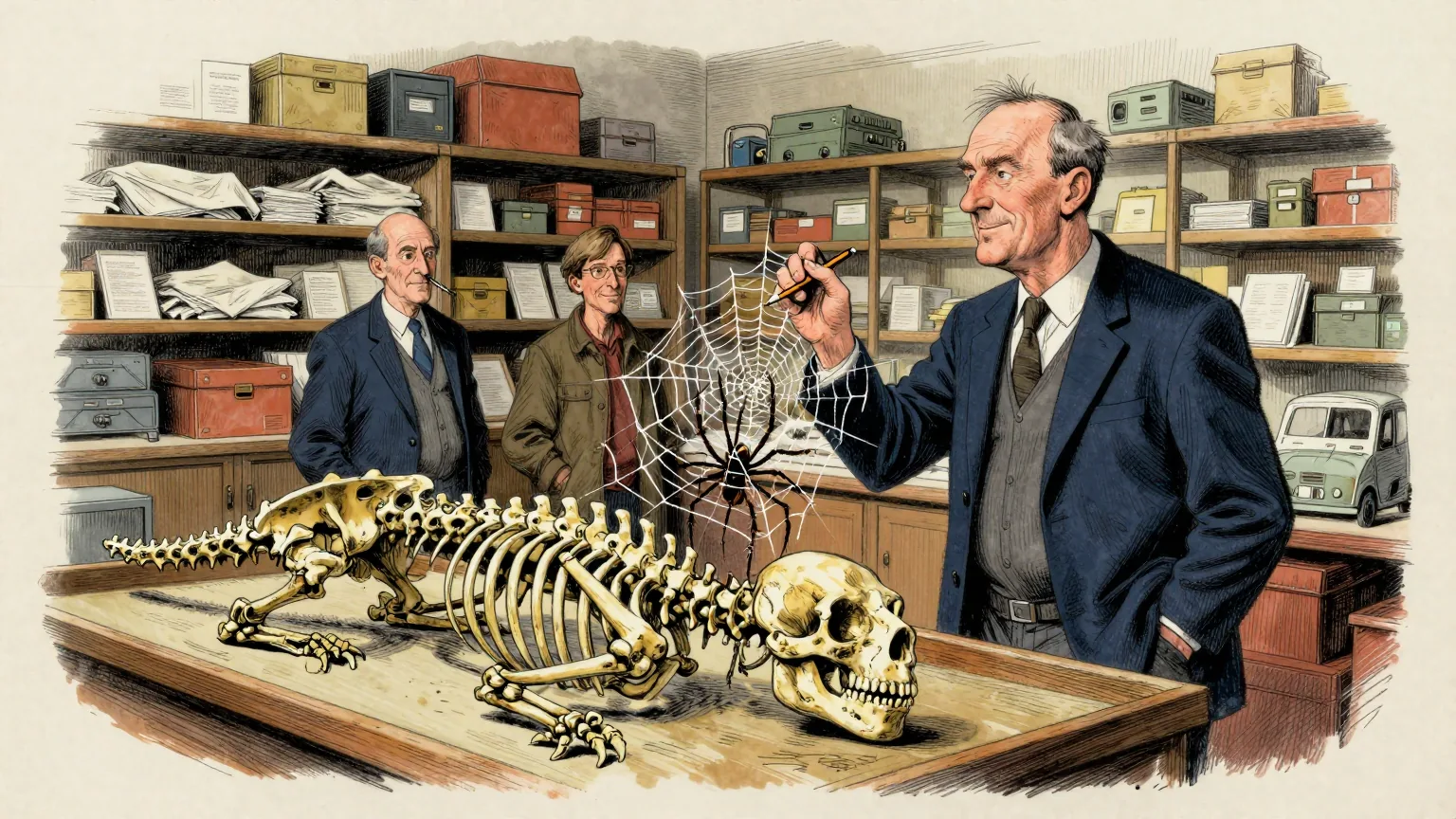
A prehistoric animal that lived in what is now Tanzania around 240 million years ago has been described as a species new to science, and may force a rethink of when and where the earliest dinosaurs appeared.
The new species, named Dinodontosaurus isiyavamanda, was described by an international team led by the University of Bristol in a study published in the Journal of Vertebrate Palaeontology. The species name refers to the land of the Wamanda people, who live in the region of Tanzania where the fossils were found.
The material is not new. More than 60 years ago, a British expedition in 1963 collected an extensive set of synapsid fossils, mammal-lineage vertebrates that flourished long before dinosaurs came to dominate terrestrial ecosystems. The fossils were housed at the Natural History Museum in London, but were only partly studied, leaving uncertainty about what some of them were and what they said about ecosystems 240 million years ago.
The team examined one of the undescribed associated skeletons, belonging to a herbivorous group of synapsids called dicynodonts, alongside a more recently discovered fragmentary skull. Both belonged to the genus Dinodontosaurus, which was a surprise: until now the genus had been confirmed only in South America.
That link matters beyond the naming of a species. The Tanzanian rocks that yielded Dinodontosaurus isiyavamanda are the same deposits that have produced fossils proposed as the oldest possible dinosaurs. Those rocks had previously been correlated with deposits in South Africa thought to be Middle Triassic in age.
Because the same genus is now known from Tanzania and South America, the two rock sequences can be treated as equivalent in age. New radiometric dates from South America suggest these early dinosaur-bearing sequences are up to 10 million years younger than the South African rocks, which strengthens the case that the Tanzanian deposits should no longer be regarded as preserving the oldest potential dinosaur fossils.
"Our discovery marks the first confirmed record of the genus Dinodontosaurus outside South America," said Hady George, a PhD student in the School of Earth Sciences at the University of Bristol and the study's lead author. "The finding links the Tanzanian and South American fossil-bearing rocks, showing they are of equivalent age."
Dr Mike Day, Curator of Non-Mammalian Tetrapods at the Natural History Museum, said the specimen "has been in our care for over 60 years, and it's wonderful that its identity has now been brought to light". He added that revisiting museum collections "can change our understanding of the past just as much as finding new fossils in the field".
The discovery also has an unusually long paper trail. Nigel Larkin, a palaeontologist and Visiting Research Fellow at the University of Reading and a co-author, studied the dicynodont skeleton decades ago and already suspected it was new to science.
"I studied this dicynodont skeleton for my MSc thesis at University College London back in 1994 and judged it to be a species new to science, but it took me nearly 30 years to start the process of writing it up for publication," he said. "I'm glad I waited, as the international team we put together, headed by Hady George, has done an amazing job."
Techniques have improved in the meantime, he noted, with micro-CT scanning allowing far more to be done with such specimens than was imaginable in the 1990s. Then he supplied the line that settles the matter: "And what's 30 years? It's the blink of an eye compared to the age of this prehistoric specimen."
This newspaper accepts the argument without reservation, and proposes that it be adopted as standard.
Thirty years is 0.0000125 per cent of 240 million. The sixty-odd years the skeleton spent in a museum drawer come to 0.000026 per cent. Measured against the object under study, as Larkin correctly measures it, neither figure is detectable.
The Department of Unnecessary Research therefore recommends that all academic deadlines be expressed as a proportion of the age of the thing being studied. A three-year doctorate on this specimen would occupy 0.00000125 per cent of it. A funding body's annual reporting cycle would be too small to print.
The system has obvious advantages and one incidental effect. Under it, no palaeontologist has ever been late.