The Nobel Prize in Physics for 2026 has been awarded to Francis Halzen "for decisive contributions to the IceCube Neutrino Observatory and the discovery of high-energy neutrinos of astrophysical origin".
Halzen, born in Tienen, Belgium, in 1944, took his PhD at KU Leuven in 1969 and is a professor at the University of Wisconsin–Madison. He first presented his vision for capturing neutrinos at the South Pole in 1988.
Neutrinos are everywhere but do not make themselves known. They pass all the way through the Earth, and through our bodies, without our noticing. Very rarely a single neutrino will interact with an atomic nucleus, which makes it possible for someone with the right equipment to discover it.
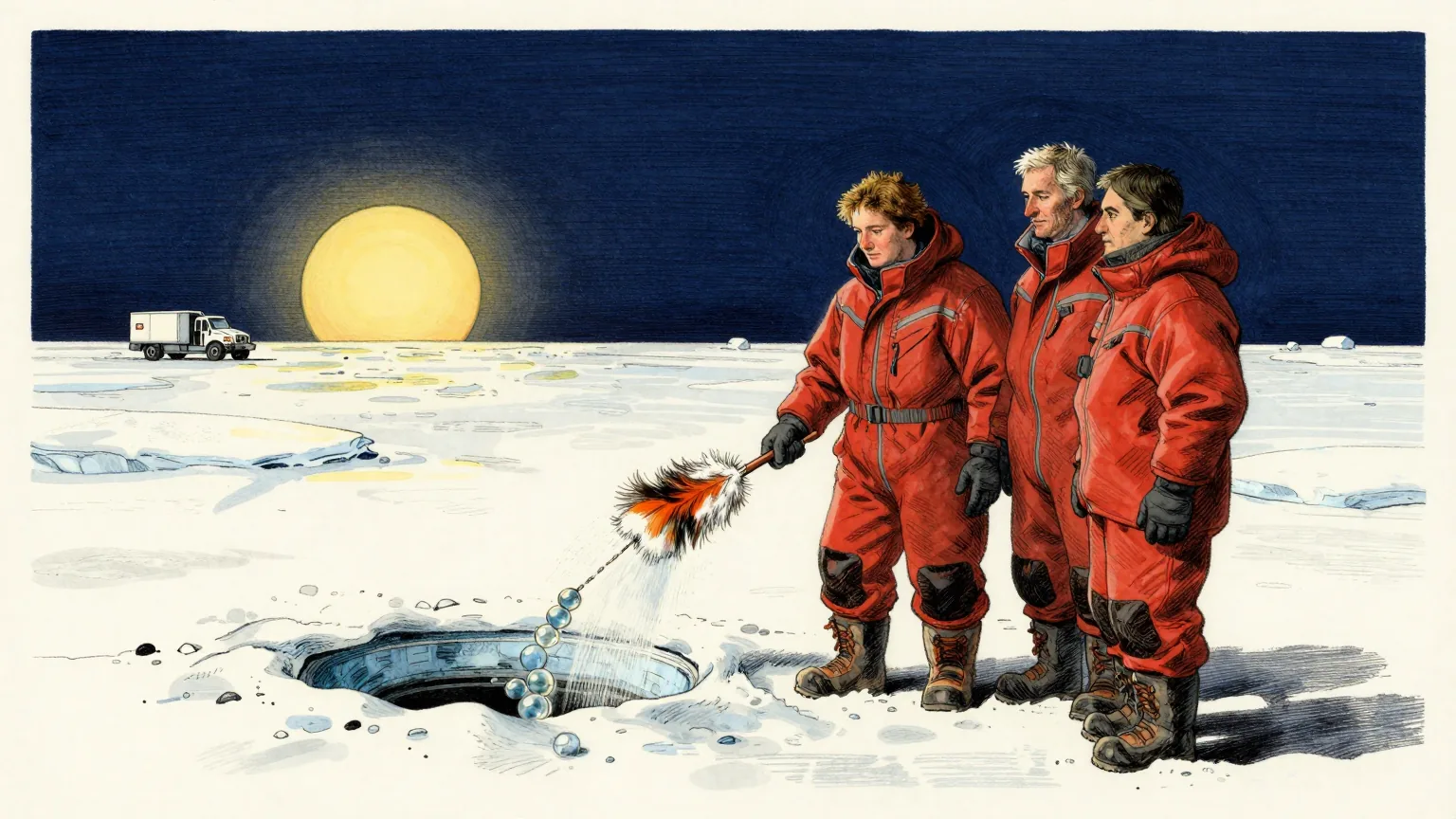
Halzen realised that the ice at the South Pole could be that equipment. When a neutrino collides with an atomic nucleus it produces a flash of light, and that flash can be tracked by sensors in the clear glacial ice.
The site has several advantages. The ice is free from various types of interference, and the area is geologically stable, with no earthquakes.
Because cosmic neutrinos with extremely high energies are very rare, an enormous volume of ice is needed to observe an adequate number of collisions. IceCube covers an entire cubic kilometre and was finished in 2011.
The science it enables is not available any other way. The cosmos contains natural particle accelerators that fire out particles with energies up to a million times greater than can be achieved in laboratories on Earth, and much about those sources remains mysterious. Unlike other particles, neutrinos reach us without changing direction or losing energy.
Halzen gained the support of other researchers soon after presenting the idea, and preliminary testing of sensors in ice followed within a few years. Researchers using the completed detector found the first high-energy neutrinos and, a few years later, published their discovery of neutrinos that must originate far outside our solar system.
"Francis Halzen has led an international team of researchers and engineers who have provided us with a fantastic instrument. His tenacity and scientific vision has paved the way for a new kind of astronomy," said Mark Pearce, chair of the Nobel Committee for Physics.
It is worth being exact about what the instrument consists of. There are light sensors, and there is a cubic kilometre of ice. The sensors were manufactured. The ice was not. It was already at the South Pole, where it had been accumulating without supervision, and the decisive step was to leave it there.
That makes IceCube the only major scientific apparatus whose principal component has a lead time measured in ice ages. The specification is demanding but not elaborate: be cold, be clear, be geologically still, and be undisturbed for a very long time. The South Pole has satisfied all four for most of human history, unprompted.
Our analysts note the resulting difficulty with credit. The citation honours decisive contributions to the observatory, and the committee praised tenacity and scientific vision, both of which were plainly required. But the detecting medium supplied a cubic kilometre, which on volume alone is the larger share, and supplied it passively.
The Department of Unnecessary Research has therefore asked the Royal Swedish Academy of Sciences to clarify the standing of the remaining Antarctic ice sheet, which meets the same specification across a very much larger area and has so far had almost no sensors put into it. The vision was presented in 1988 and the instrument was completed in 2011. The ice was ready well before either. It only needed to be noticed, and then not disturbed.