
More than 12,000 fossils of early complex cells, the oldest of them 1.75 billion years old, have been identified in mudstone drill cores held by the Northern Territory Geological Survey in Darwin. They are the oldest known eukaryote fossils in the world.
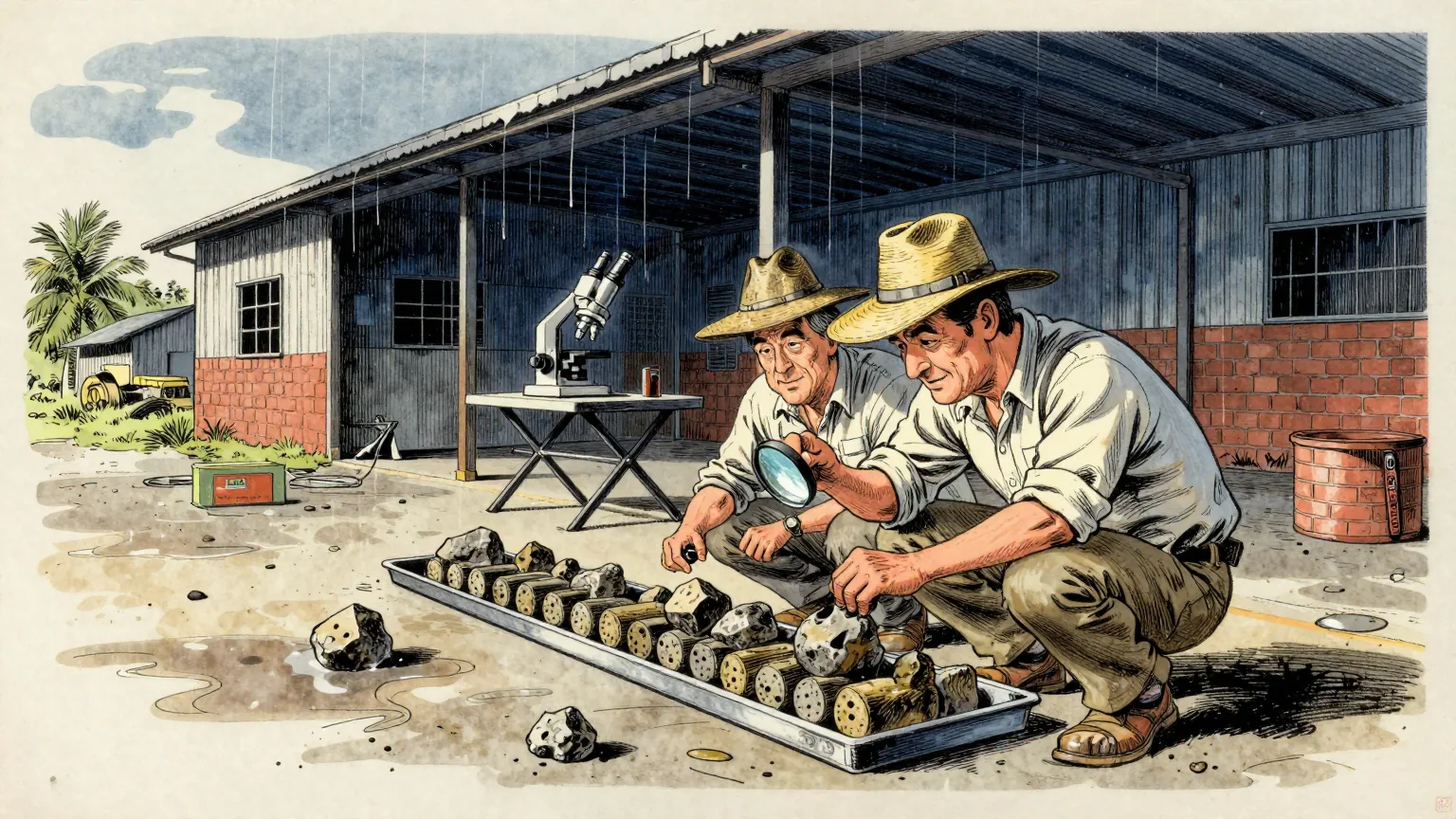
Stored in an open-air warehouse in tropical Darwin are dozens of trays containing cylindrical cores of rock. Some of them are mudstone, a sedimentary rock formed from hardened seafloor mud.
That mud was laid down on the floor of an ancient inland sea which once covered much of northern Australia. The fossils in it span 1.7 to 1.4 billion years.
The method was chemical rather than geological. The researchers dissolved the rock and worked through what was left: "We identified more than 12,000 fossils by analysing the organic residue left behind by this dissolution under a microscope."
The distribution is the finding. The eukaryotes turn up exclusively in oxygenated settings, from coastal mudflats to open sea. Oxygen-free settings in the same record hold only prokaryotes. The authors describe the organisms as benthic aerobes: bottom-dwelling, and oxygen-using.
That pattern points to oxygen having played a crucial role in the emergence of complex life, a question on which direct fossil evidence has until now been thin.
The work was published in Nature on 27 September. The authors include Maxwell Lechte and Leigh Anne Riedman, with Susannah M. Porter, Galen P. Halverson and Margaret Whelan.
The dating is not in question and the fossils are real. What has quietly changed is where the oldest known complex life on Earth was found, which is a shelf.
For 1.75 billion years these organisms were unknown to science. For an unspecified but very much shorter part of that, they were in Darwin, in trays, under a corrugated roof, in an inventory.
Our analysts note that a geological survey's core library is therefore the most productive site in early evolutionary biology, and that it requires no drilling, no permits and no sea. The Department of Unnecessary Research recommends the warehouse be assessed for its own fossil potential before anyone goes back to the field.
The oxygen finding follows the same logic and is harder to argue with. Complex cells appear where there was oxygen. Simple cells appear where there was not. On the evidence, the eukaryotes went where the air was and the prokaryotes stayed where they were.
The trays have spent their entire documented custody in a warehouse open to the air. On the paper's own criterion, the site remains suitable.