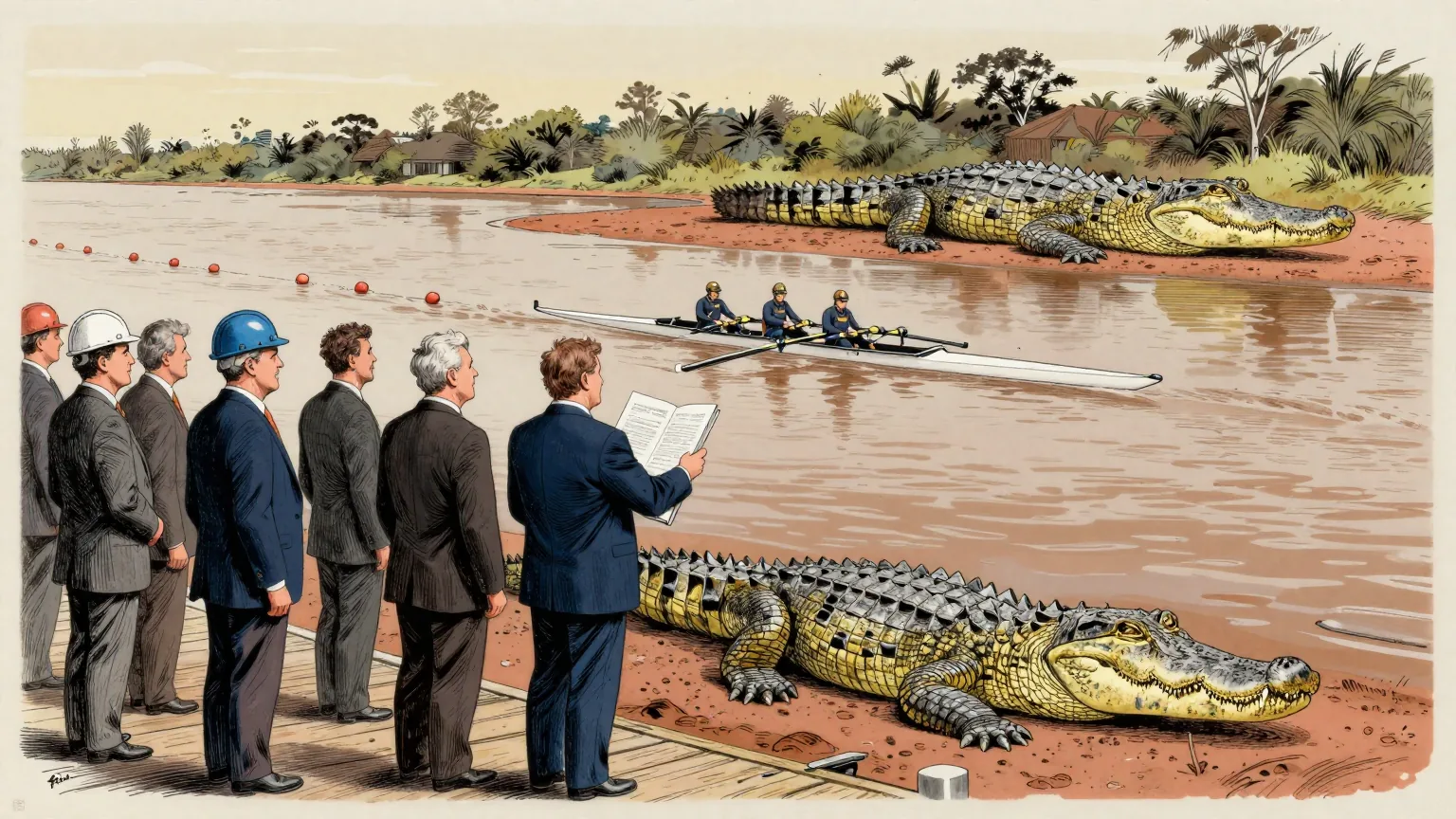
A stretch of Queensland river that is home to about 500 saltwater crocodiles has been given the go-ahead to stage Olympic and Paralympic rowing and canoeing events at the Brisbane 2032 Games.
The course on the Fitzroy River at Rockhampton has passed an independent technical assessment into its suitability, clearing the way for planning work to move on to venue design and delivery.
The assessment was commissioned by the Games Independent Infrastructure and Coordination Authority, known as GIICA. It did not consider the crocodiles, looking instead at "how the course would perform under a range of conditions, weather patterns, water levels and flood risk at both Games time and throughout the period leading into the Games".
GIICA noted that the Fitzroy River Flatwater Facility "is already a training and competition venue for flatwater sports, supporting school state championships, local regattas, and national team training camps", making it an established site rather than a new build.
Both international federations involved have endorsed the course. World Rowing and Paddle Worldwide, formerly the International Canoe Federation, signed off after reviewing the technical work.
"Based on the extensive analysis undertaken, we now know that the Fitzroy River is capable of providing fair competition conditions during the period of the Games, consistent with the requirements of Olympic and Paralympic Rowing," World Rowing President Jean-Christophe Rolland said.
Paddle Worldwide President Thomas Konietzko said: "The quality and depth of the technical work undertaken has significantly improved our understanding of the field of play and provides confidence to us and our athletes that the course can deliver fair competition for Canoe Sprint athletes."
Speaking on Thursday about the venue being given the go-ahead, Brisbane 2032 President Andrew Liveris said: "The endorsement provides additional certainty as we move into the next phase of venue planning and Games delivery, ensuring all future design and operational work continues to focus solely on Rockhampton."
Liveris had played down the crocodile question last year. "There are sharks in the ocean and we're still surfing... it's a can do, not a can't do - please change the mindset here," he said at the time.
Saltwater crocodiles, known locally as Salties, are the largest reptiles on the planet. They live in both freshwater and saltwater and can grow to be in excess of six metres long.
As a recognised rowing facility, the venue already has contingency plans for when crocodiles are spotted at events, and Olympic officials have previously been assured of rower safety.
It is worth being precise about what the assessment establishes. The river has been evaluated for weather patterns, water levels and flood risk; the crocodiles were not part of the technical scope. They have therefore not been declared safe. They have not been declared unsafe. They have simply failed to become an engineering variable.
The Questionable Times considers this an encouraging development. Once a six-metre reptile is excluded from a technical assessment, it ceases to be a venue problem and becomes, at most, an athlete-facing operational detail.
The governing bodies have also concluded that the venue can provide fair competition conditions. On that point the evidence is difficult to challenge. Every crew will race on the same river, under the same weather, at the same water level, with access to the same approximately 500 crocodiles.
No lane has been allocated additional crocodiles. No nation has been granted preferential reptile access. So long as the animals remain evenly distributed, competitive integrity appears secure.
Officials may yet need to decide whether a crocodile entering Lane 4 constitutes outside assistance, course interference or simply local conditions. The Department of Unnecessary Research has asked World Rowing to rule on the more pressing question first: whether a crocodile that crosses the finish line ahead of the field is entitled to the medal.