
Parliament has been told that the contract covering the upkeep of the homes it houses members and ministers in is worth R600 million over five years, and that it has never been told how that figure divides between them.
The number was given to an ad hoc committee on Friday by Simon Mashigo, head of Parliament's institutional support services division, as the committee works through a bill that would move responsibility for the villages from the executive to the legislature.
"The current contract the [department] has signed with the facilities management contractor is R600m over a period of five years, which covers all parliamentary villages but also includes the ministerial residences," Mashigo said. "They have not given us a breakdown in terms of how much relates to the three parliamentary villages. All in all, it is R600m for all the residences."
The three villages are Acacia Park in Goodwood, Laboria Park in Belhar and Pelican Park in Zeekoevlei. They accommodate members who do not live in Cape Town.
The committee's draft Parliamentary Villages Bill, published in the Government Gazette on 24 July, would scrap the 1998 law governing the villages and make Parliament, rather than the Department of Public Works and Infrastructure, responsible for managing and maintaining them.
The timetable is tight. Mashigo said the facilities management contract expires next year in May, and that a bus contract had already expired and been extended by a year. Transitional arrangements, he said, may require decisions on extending such contracts until the functions have been taken over by Parliament.
The department's position is that the handover is not straightforward. Mashigo told the committee it had raised concerns about the constitutional division of responsibilities, and that the disagreement might have to be settled higher up.
"It may come to a point where [President Cyril Ramaphosa] has to be engaged, or the leader of government business, so that that issue is resolved and it is not seen as Parliament encroaching on the mandate of [the department]," he said. "The issue of encroachment of the mandate as a constitutional provision seems to be a sticky point which needs to be clarified."
There is also a question of land. Mashigo said the City of Cape Town owns the ground Laboria Park stands on, which would limit what Parliament could do with the village even as its custodian. Any upgrade, he said, would require power of attorney from the city before planning could begin.
The committee received 13 written submissions on the draft bill, none of them opposed to it, and plans to adopt the final bill on 27 November.
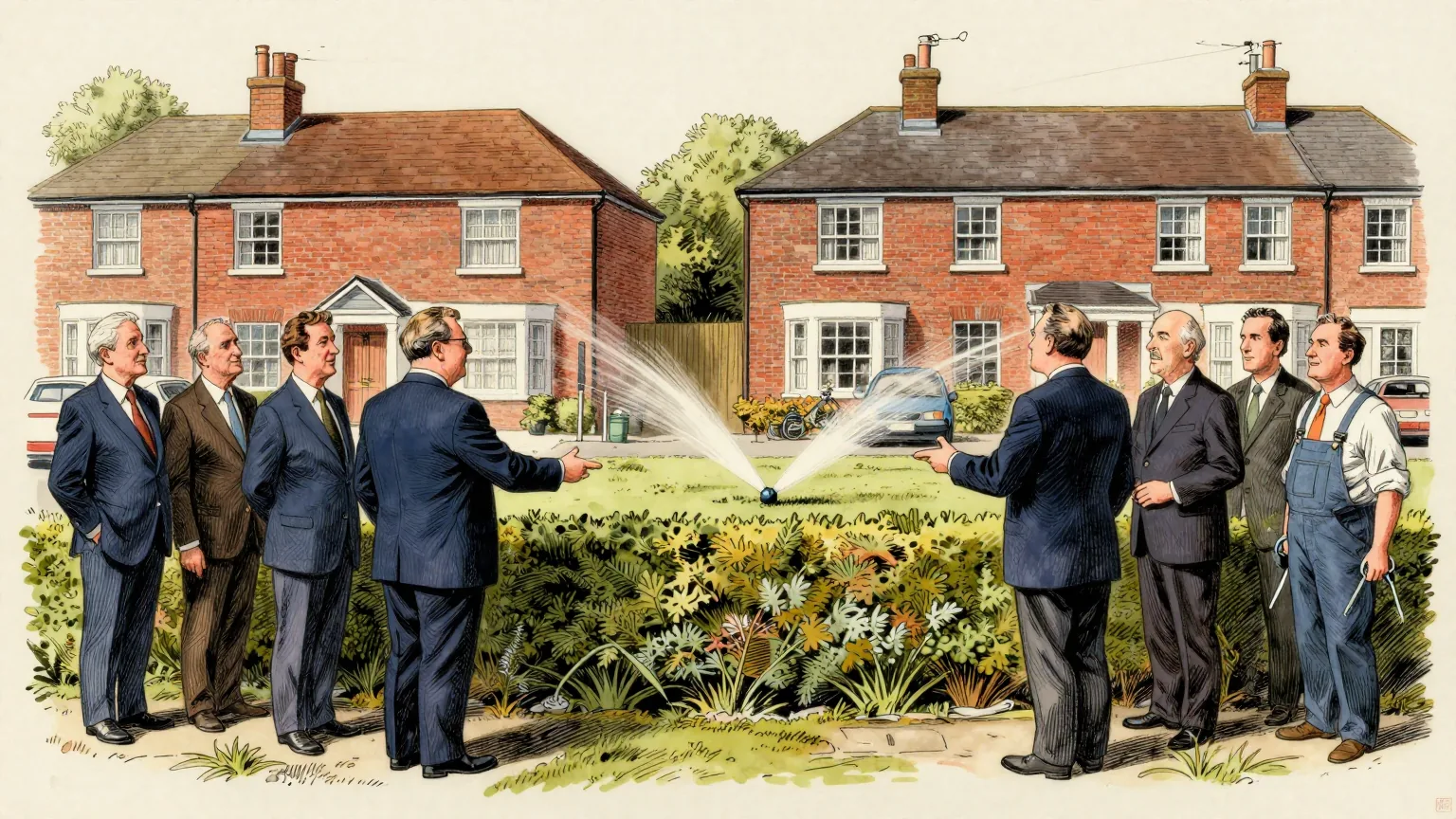
It is worth being exact about what is in contention. Nobody disputes that the grass at Acacia Park will be cut. The question is whose constitutional mandate cutting it falls under, and that is a different question, answerable only at a level of government considerably above the grass.
The Department of Unnecessary Research has attempted to establish the smallest unit of maintenance capable of raising a constitutional issue. A hedge, on the evidence before the committee, qualifies. Trimming it is a function; a function belongs to a mandate; a mandate is a constitutional provision; and a constitutional provision, once contested, goes upwards.
Our analysts see a tidy structure forming. Parliament would become the custodian of Laboria Park without owning the ground beneath it, and would need power of attorney from the City of Cape Town before planning any upgrade. Three tiers of government are therefore engaged before anything is built, and at least two before anything is mown.
The R600m figure survives all of this intact, because nobody has divided it. It is a single number covering the villages and the ministerial residences together, and while it remains undivided it cannot be attributed to any particular hedge.
This is the most durable arrangement in the paperwork. A cost that has not been broken down belongs to no mandate at all.
The committee expects to adopt the bill on 27 November. The grass will be cut throughout.