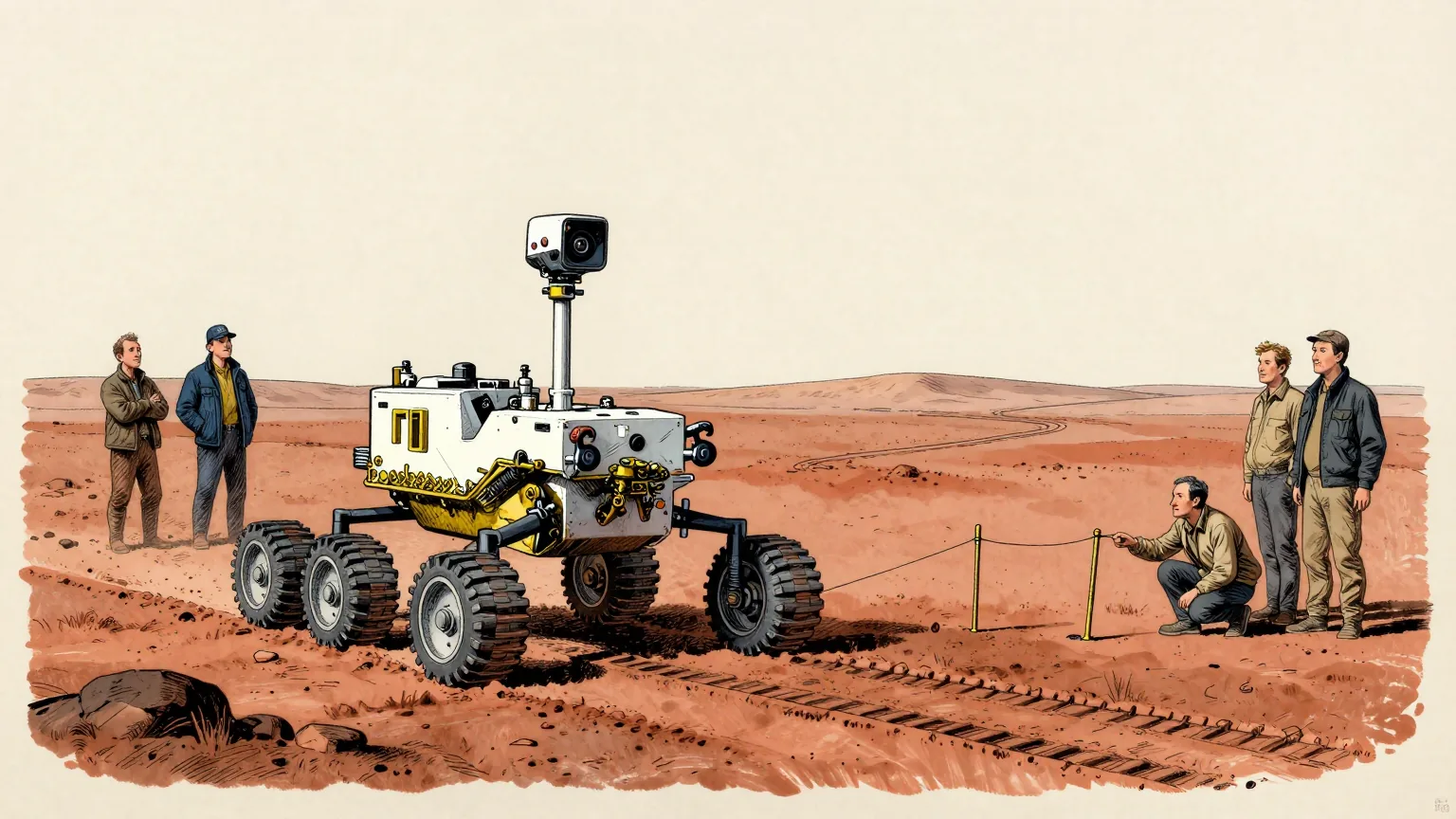
NASA's Perseverance rover has set the record for the greatest distance driven on another world, reaching 28.10 miles (45.22 km) on 11 October and passing the 28.06 miles (45.16 km) logged by the Opportunity rover.
The milestone fell on Perseverance's 2,006th sol, or Martian day. The drive that carried it past the record measured 299.6 feet (91.31 m).
Opportunity, which operated on Mars for 5,111 sols, needed almost fifteen years to cover the distance Perseverance has managed in about five and a half.
The rover has also passed the distances driven on the Moon. Apollo 17 covered 22.2 miles (35.7 km) in 1972 and the Soviet Lunokhod 2 covered 24.2 miles (39 km) in 1973. Curiosity, still working in Gale Crater after landing in 2012, has logged more than 23.65 miles (38.07 km).
Most of the mileage was not driven by people. More than 90 per cent of Perseverance's distance has been covered using AutoNav, the onboard system that images the ground while the rover is moving, builds a three-dimensional map of hazards and plots a route between waypoints chosen by planners on Earth. The team calls it "thinking while driving".
The capability has grown sharply. The first Martian autonomous navigation system, carried by Opportunity and Spirit, handled about 5 per cent of their driving. Sojourner, in 1997, assessed 20 measurement points at a time; Perseverance processes about 600,000 per look. Its best single sol is 1,351 feet (412 m).
Mark Maimone, deputy team chief for robotic operations on Perseverance, said: "Our newest software teaches Perseverance to steer less and roll more."
The driving serves the science. Perseverance has collected 29 rock and regolith samples and previously identified a potential biosignature in a rock named Cheyava Falls. It is now travelling toward a site called Idubi, near Lac de Charmes beyond the western rim of Jezero Crater, where the team hopes to find traces of ancient hydrothermal systems. Rainbow Falls, a 328-foot (100 m) block of ancient crust, comes after that.
NASA approved the mission's first extension this month. It runs through roughly the end of 2028.
Steven Lee, project manager of the Curiosity and Perseverance rovers at NASA's Jet Propulsion Laboratory, supplied the figure that puts the record in its proper light. "The original mission called for no more than 12.4 miles of driving," he said.
No more than 12.4 miles. The rover has driven 28.10. Read as a specification rather than an aspiration, the requirement has been exceeded by 126 per cent, and the record for the longest drive on another world is now held by a vehicle that was asked to stop at less than half of it.
The overrun is also widening. Every metre added to the odometer increases the gap between what Perseverance was commissioned to do and what it has done, and the mission has just been extended by two years to permit more of it.
Lee was asked about the outlook and did not hedge. "We expect Perseverance to keep adding to this record for many years to come," he said. The Department of Unnecessary Research notes that the agency has now committed to many further years of exceeding its own stated maximum, and that nothing aboard the rover is capable of telling it that it has gone far enough.