Physicists have transported antimatter by road for the first time, moving 92 antiprotons around the CERN campus in a purpose-built trap mounted on a truck and then keeping them alive, and under control, for more than a month.
The work was carried out by the BASE collaboration and led by Professor Stefan Ulmer and Dr Christian Smorra of Heinrich Heine University Düsseldorf. It is reported in Nature under the title "Road transport of trapped antiprotons", with doctoral researcher Marcel Leonhardt as lead author.
The point of the exercise is precision. Comparing protons with antiprotons is one of the most promising routes to finding a difference between matter and antimatter, and any difference in their mass or magnetic moment would bear directly on why the universe is made of something rather than nothing.
BASE has already measured the intrinsic magnetic moment of both particles to an accuracy of 0.3 parts per billion for protons and 1.6 parts per billion for antiprotons. No difference has shown up within that precision, which is exactly why the team wants more of it.
The obstacle is the building. Antiprotons at low energy can only be produced, stored and studied at CERN's Antimatter Factory, the only such facility in the world, and Smorra has explained that magnetic-field fluctuations there limit how accurately the measurements can be made. Moving the particles to a quieter high-precision laboratory elsewhere could improve the result by at least a hundredfold.
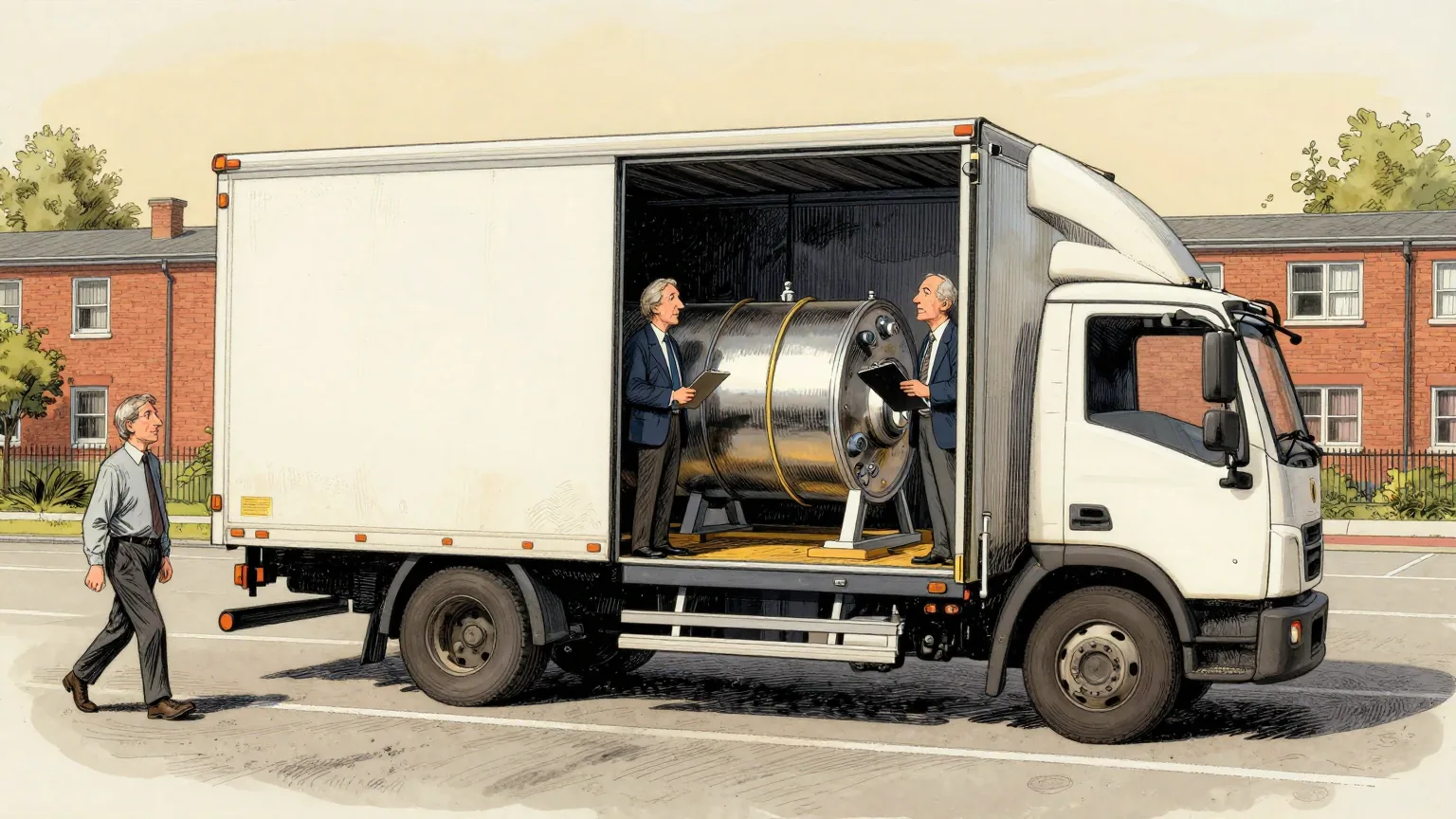
That requires a trap that can leave the site. The team's device, BASE-STEP, is an ultra-high-vacuum Penning trap built to travel. Having successfully moved ordinary protons in October 2024, the researchers extracted 92 antiprotons in March this year, loaded them aboard and drove roughly eight kilometres around the CERN campus over about thirty minutes.
Every particle survived the journey. "We then continued to observe the antiprotons," Leonhardt said. "We were able to store and manipulate them in a controlled manner for more than a month in total."
The technical achievement underneath all this is an absence. Collisions with ordinary matter destroy the particles, so the trap has to contain as close to nothing as physics allows. The team reported a vacuum better than 2.2 × 10⁻¹⁸ millibar sustained throughout the storage period in an open trap system, comfortably past their design target of 1 × 10⁻¹⁶ millibar.
Next, the group intends to make the roughly ten-hour run from Geneva to Düsseldorf, where Ulmer's team is building the high-precision laboratory in which protons and antiprotons will be compared directly. Ulmer has summarised the underlying question as: "Why does a universe filled with matter exist?"
Viewed from the loading bay rather than the laboratory, however, a different milestone has been passed, and it deserves recognition. On 24 March 2026, a vehicle at CERN set off carrying 92 particles and travelled eight kilometres without losing any of them. That is a delivery. It has a route, a duration and a consignment.
The Questionable Times' analysts have examined the manifest and believe it to be the shortest ever filed. The load was 92 items. The vehicle's single most valuable feature was that it contained nothing at all, to a standard of nothing unmatched by any other container on the European road network, including the ones that are empty.
The Department of Unnecessary Research therefore records the founding of a haulage sector whose entire competitive advantage is emptiness, whose cargo cannot be allowed to touch the lorry, and whose flagship route is a lap of a car park. The planned ten-hour run to Düsseldorf will extend the corridor to an international route, at which point the entire sector will still fit inside one steel cylinder, with room.