
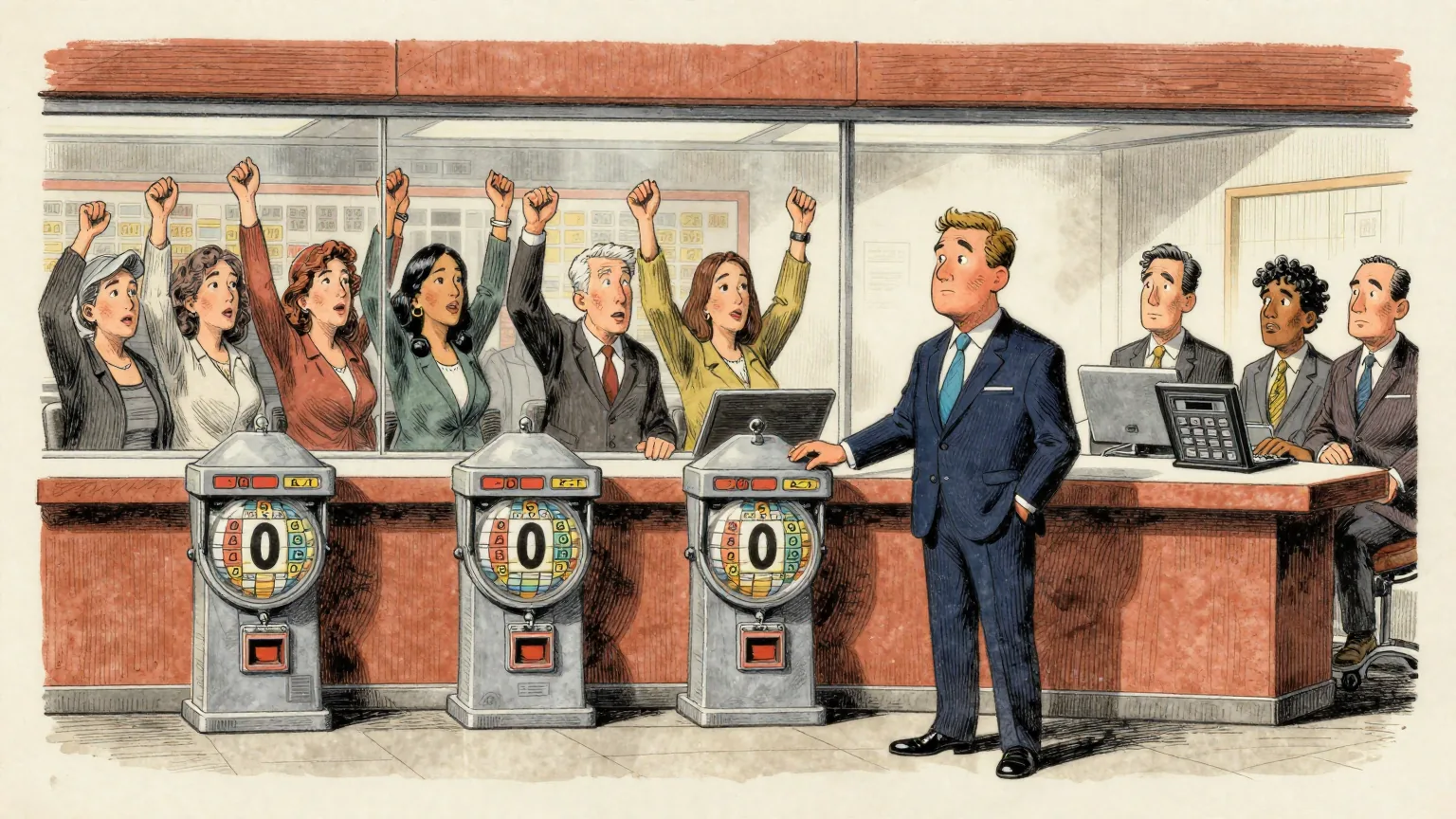
The North Carolina Education Lottery has said that 4,917 tickets won top prizes in Monday night's Pick 3 drawing, after the game produced the winning numbers 0-0-0.
Those tickets took more than $1.7 million between them, UPI's Odd News desk reported, drawing on the lottery's own account of the result, which was posted on Tuesday morning.
The prize depended on the stake. A ticket bought for 50 cents won $250, and a ticket bought for $1 won $500. Winners have 180 days to claim, and tickets are sold both at retailers and through the lottery's online play programme.
Pick 3 is drawn twice a day, in the daytime and in the evening. Players choose three digits, and on Monday evening the game returned three zeros.
In explaining the size of the payout, the lottery offered a point of vocabulary rather than of probability. "Trips are combinations of three of the same numbers," it said, adding that such sets are among the most popular with players.
The odds themselves did not move. The lottery states that matching all three numbers exactly is a 1 in 1,000 chance, and that the odds are the same for any three-number combination.
That is the whole of the mechanical story. Monday's result was not rarer than any other result. A drawing of 0-0-0 carries the same chance as a drawing of 4-9-2, and the machine has no view on which looks more deserving.
What differed was the number of people standing behind it. The lottery's bill on Monday night was not set by the draw but by the taste of its customers, and its customers like three of a kind.
This newspaper therefore records the evening as a triumph of public reasoning. Nearly five thousand people independently arrived at the same answer to a question with a thousand answers, and were collectively correct.
The commercial implications follow directly. Under the published odds, the cheapest possible evening for a lottery is one in which the machine produces a combination that nobody admires, and the most expensive is one in which it produces a combination that everybody does.
The balls are therefore no longer the variable. A number such as 4-9-2 has no constituency and costs almost nothing to draw. A number such as 0-0-0 has a following of thousands and costs $1.7 million. Both are 1 in 1,000.
The Department of Unnecessary Research has accordingly reclassified Pick 3 as an opinion survey with a cash prize, in which the state asks the public to nominate a number and then pays the people who agree with each other.
On the lottery's own figures, the only way for the house to have a bad night is for the public to be right about nothing in particular, all at once.