
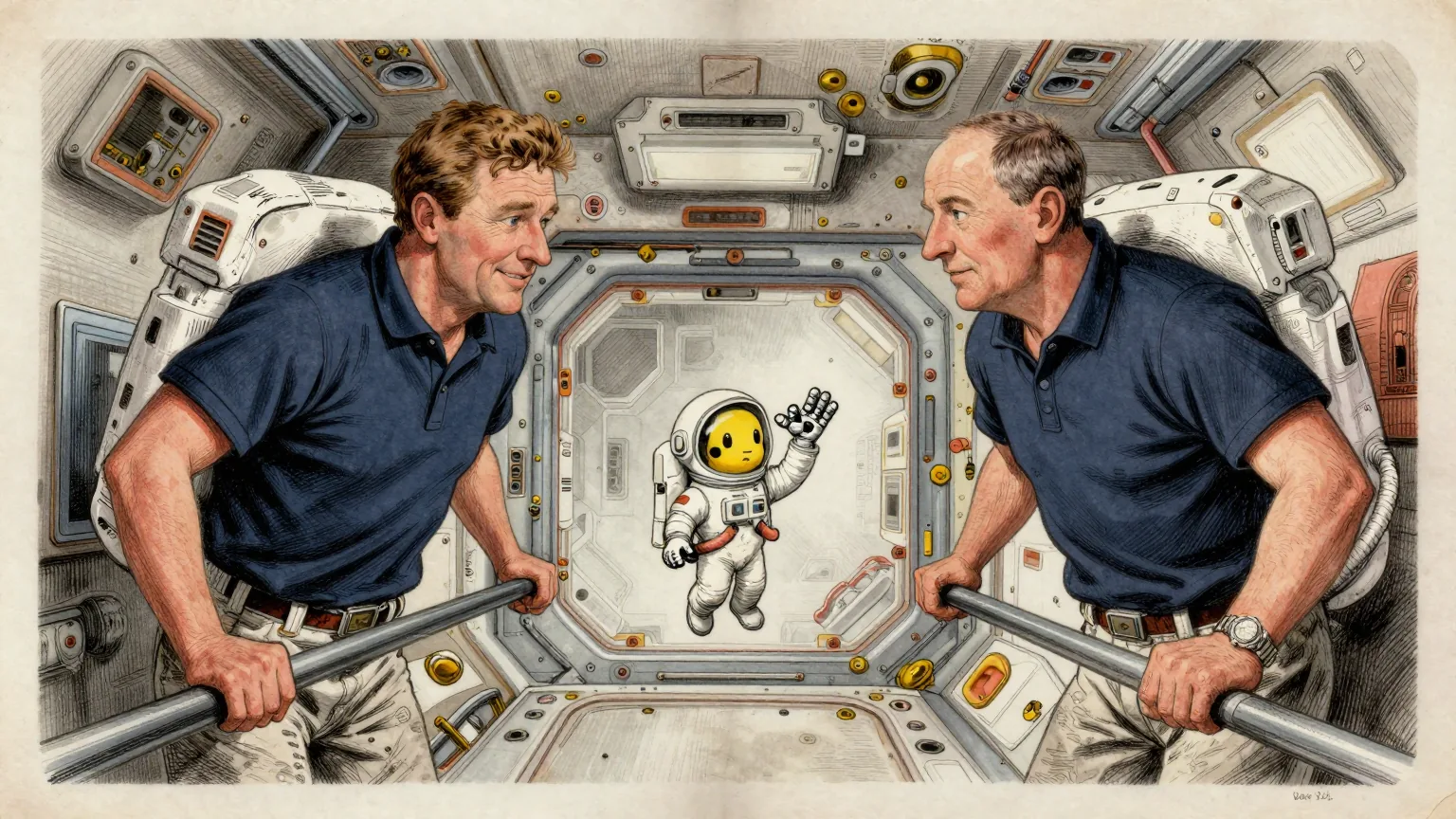
A spacesuit-clad plush toy has returned from the International Space Station after 67 days and 1,040 orbits of the Earth, and is now being toured around European museums to stoke interest in space exploration.
The yellow Astronaut Pikachu was aboard the orbiting laboratory from 11 April to 17 June with crew members from the European Space Agency.
A video posted on 6 October, since viewed more than a million times, shows the French astronaut Sophie Adenot giving the toy a tour of the station, taking in its water dispenser, its laboratory freezers and the crew quarters. Adenot closes by telling Pikachu that even in space "you have a tendency to hide everywhere", and adding: "Yeah, I know you like this game."
Adenot herself returned to Earth on 8 October, splashing down in the Pacific off California aboard a SpaceX Dragon capsule with three other Crew-12 astronauts after a 237-day mission, a record for the longest single spaceflight by a European astronaut.
The toy's flight is part of a wider ESA and Pokemon collaboration marking World Space Week, which ran from 4 to 10 October. It includes a travelling family exhibition combining space science with Pokemon storytelling, explaining how Europe launches spacecraft, supports astronauts, studies the sun and explores the solar system.
"Inspiring future generations is a key part of ESA's mission," said the agency's director-general, Josef Aschbacher. "Through this collaboration with Pokemon, we are unlocking new ways for people across Europe to connect with space through a unique and engaging experience."
For fans who prefer their outreach with something to catch, Pokemon Go offered an Astronaut Pikachu through one-star raids and timed research at six European science and space museums: the Science Museum in London, the Cite de l'espace in Toulouse, the Deutsches Museum in Nuremberg, the Museu de les Ciencies in Valencia, Space Expo in Noordwijk and the Euro Space Center in Transinne. The event ran to 10 October, and a rare shiny version was also available.
The toy joins a small group of plush space travellers that includes Snoopy, carried on NASA's uncrewed Artemis I lunar mission, and Grogu, the mascot on SpaceX's Crew-1 flight.
The figures attached to the flight are worth dwelling on, because they are real. The toy spent 67 days in orbit. It completed 1,040 circuits of the planet. Both numbers are recorded, and both belong to it.
They are also, this newspaper notes, the whole of its contribution. Orbits are accumulated by being present. Of everyone aboard the station between April and June, the plush toy reached the same orbital total as the professionals while conducting no experiments, operating no equipment and consuming nothing.
Our analysts have ranked the crew accordingly. Measured in orbits per unit of effort, Astronaut Pikachu is the most efficient occupant in the history of the International Space Station, and measured in orbits per kilogram it is some way clear of the field.
Hiding is the only discipline in which it was formally assessed. Adenot's verdict, delivered in orbit, was that the tendency persists in microgravity, which makes it the first behavioural trait confirmed to survive the journey and also the only one tested.
The Department of Unnecessary Research has filed the obvious follow-up. Nobody has yet flown an identical toy that stayed on the ground, so there is no way of saying the orbits made any difference.