
Thirteen book publishers have gone back to a New York federal court to ask for a $19.5 million default judgment against the shadow library WeLib.
The publishers sued WeLib in June, alleging that the site "was created after its operators copied the source code and most of the contents of" Anna's Archive, the larger shadow library that lost a near-identical case in May.
Anna's Archive had itself warned readers off WeLib last year, describing it as a new entrant that had mirrored most of its collection and used a fork of its codebase while sharing nothing back. "We recommend not using them," the team wrote at the time.
WeLib's anonymous operators never responded to the lawsuit. The court clerk entered a default in August, which opened the way to a request for final judgment.
On Monday the publishers, among them Penguin Random House, Elsevier and HarperCollins, asked US District Judge Victor Marrero to grant it. "Defendant WeLib is a pirate site whose sole business is the distribution of protected content in violation of the rights of Plaintiffs and other copyright owners," their brief reads.
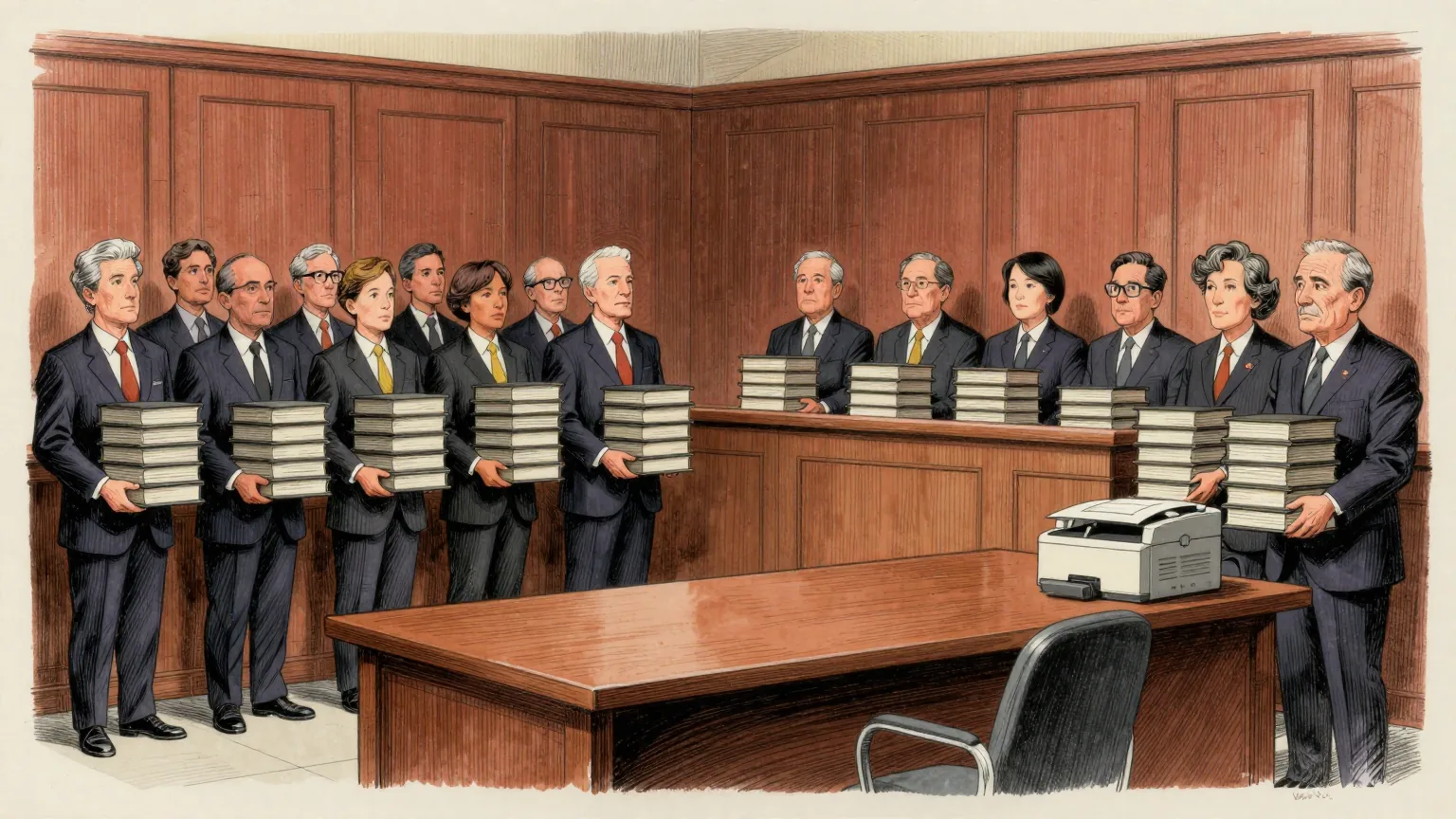
The arithmetic is worth following. The publishers request the maximum statutory damages of $150,000 for each of the 130 works listed in the complaint, ten per publisher. Thirteen publishers, ten works apiece, at the ceiling, comes to exactly $19.5 million.
That is the same figure Judge Jed Rakoff awarded in the Anna's Archive case.
The brief also puts a spotlight on WeLib's revenue model. The site can be used free but asks users for donations of up to $90 a month, which the publishers describe as payments for faster downloads.
Alongside damages the publishers want a permanent injunction requiring domain registries and registrars to disable welib.org, welib.st and welib-public.org, to block their transfer to anyone other than the publishers, and requiring hosting providers to stop serving the sites.
The proposed order names five intermediaries specifically: Public Interest Registry, Cloudflare, Tucows and two Njalla entities. The Anna's Archive judgment named more than twenty.
Reusing arguments between similar cases is ordinary practice, and large parts of the WeLib brief mirror the one the law firm Oppenheim + Zebrak filed against Anna's Archive in May for the same clients. TorrentFreak, which reported the comparison, found that not everything fits. The brief says WeLib diverts revenue from the publishers "at a scale made worse by their use of the viral BitTorrent protocol", a sentence that appears word for word in the earlier brief, where the complaint described a dedicated torrents page. WeLib's own complaint instead describes files served directly from its servers, through slow free downloads and paid fast ones.
A line about infringement continuing "despite this and several other cases against them" also comes straight from the earlier brief; TorrentFreak said it was not aware of any other lawsuits against WeLib's operators. A typo survived the transfer as well. Both briefs ask whether the court is "satified" that the default standards are met, and both argue that the defendants "cannot establish that they have not presented any meritorious defenses".
Whatever Judge Marrero decides, collection looks unlikely while WeLib's operators remain anonymous. Anna's Archive lost several domains to an earlier injunction obtained by music companies and is still online through registries and registrars outside the United States.
Set the reproduction aside, because reusing your own filing is lawful and routine, and look instead at where the $19.5 million comes from. It is not a measurement of anything on the site. It is the product of three decisions taken by the people asking for it.
The first decision was the rate, fixed at the statutory ceiling. The second was ten works per publisher. The third was how many publishers joined, and thirteen did. Multiply, and the harm is $19.5 million.
This newspaper regards the method as admirably stable. A fourteenth publisher listing ten works would have raised the harm to $21 million without a single extra file appearing on WeLib, and a twelfth would have lowered it to $18 million without a file being taken down.
The uniformity is the other striking feature. Thirteen companies of very different sizes, publishing very different books, were each damaged by precisely $1.5 million. The Department of Unnecessary Research can find no mechanism by which that would happen on its own.
Which leaves the one number that did not move. The sum sought from WeLib is the sum awarded against Anna's Archive. Between the two cases the collection changed, the brief barely changed, and the total did not change at all.