
About 1,800 scrolls and fragments carbonised by the eruption of Mount Vesuvius in 79 CE survive in collections in Italy, France and England. They cannot be unrolled, and for most of two centuries they could not be read.
A study published in PLOS One on 16 September reports a way to make some of them far easier to read. It required destroying a number of scrolls first.
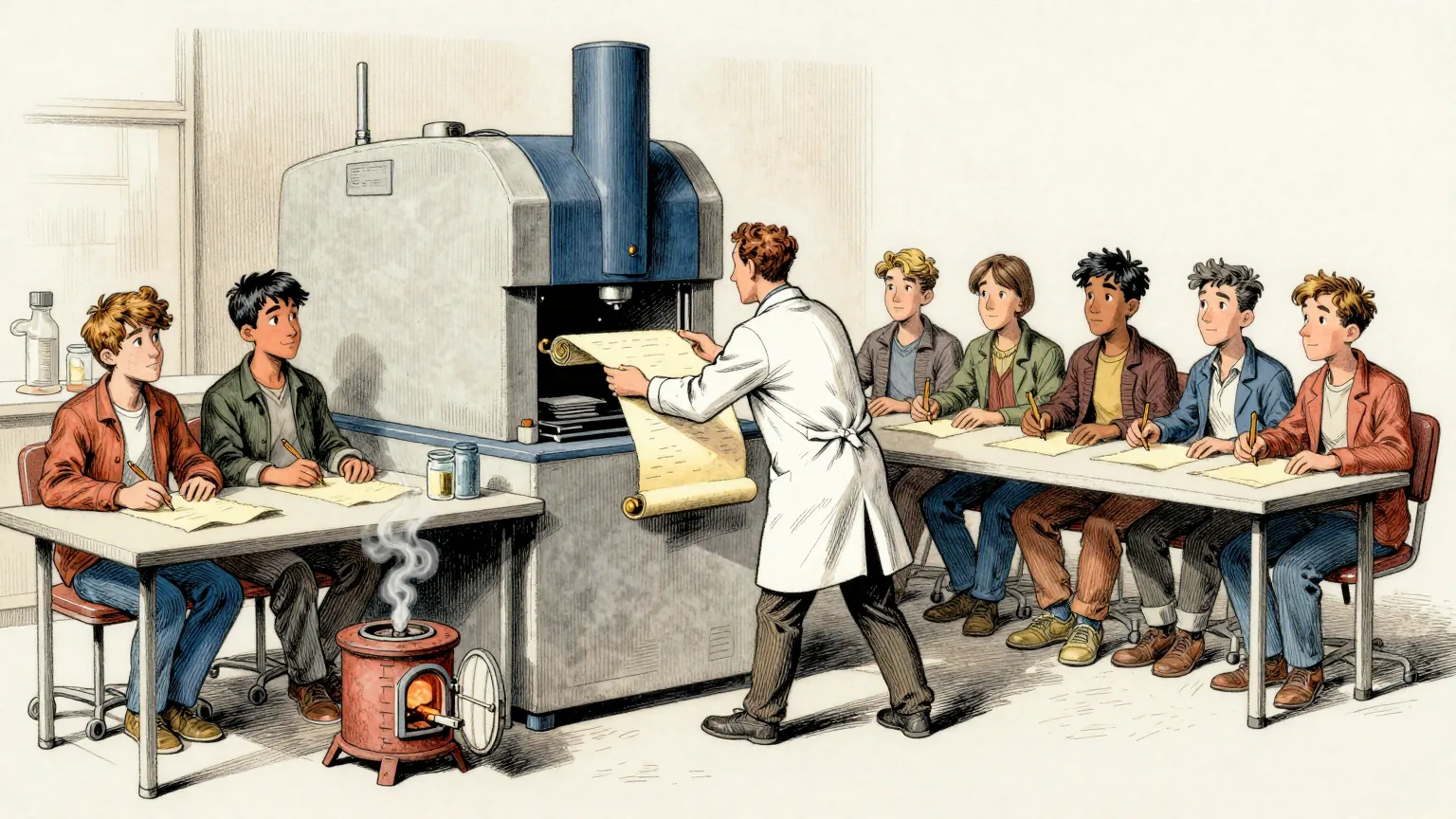
The scrolls destroyed were new. Douglas Seiler, an affiliate of Berkeley SETI and the paper's first author, obtained papyrus and reed pens from Egypt along with traditional Japanese lampblack ink, and had high school students copy out passages from the Bible, Star Wars and The Outer Limits.
The sheets were then carbonised in a low-oxygen furnace, producing objects of much the same kind as the Herculaneum scrolls, with the decisive advantage that the team knew exactly what was written inside them.
The variable under test was lead. The team mixed lead nitrate into the ink at a range of concentrations before the writing began, on the hypothesis that ancient inks sometimes contained traces of metal, and that metal would show up under X-rays where carbon ink does not.
It did. Scanned by X-ray computed tomography and X-ray fluorescence at the National Institute of Standards and Technology's Center for Neutron Research in Gaithersburg, Maryland, lead in the ink absorbed as much as 25 times more X-rays than the burned papyrus around it, making the writing stand out sharply. The technique picked up ink carrying as little as 25 micrograms of lead per square centimetre.
The author list is unusual. Alongside Seiler, who funded the work himself, it includes Jake LaManna and Michael Cyrus Daugherty of NIST, the Berkeley papyrologist Leah Packard-Grams, the retired Berkeley chemists David Kreimer and Elena Kreimer, Michael McOsker of University College London and Jens Dopke of the Rutherford Appleton Laboratory. Karl van Bibber, a Berkeley professor of nuclear engineering, advised informally.
There is a real limitation. The method works only where the ancient scribe's ink happened to contain lead, which is a fact about the first century rather than something a laboratory can supply.
The problem the study does solve is a problem of supply. To test a reading method you need charred scrolls whose contents are already known, and the only charred scrolls in existence are the ones nobody can read.
This is, on inspection, a complete reversal of the usual direction of the discipline. Archaeology waits for the ground to hand over an object and then works out what it said. Here the text was written first and the object manufactured around it.
This newspaper regards the method as sound and considerably underused. The scarcity of ancient documents has always been treated as a fact about the past. It is at least partly a fact about the furnace.
The escalation is straightforward. A scroll whose contents are known before it is burned is a calibration standard. A scroll whose contents are not known is data. The only difference between the two is when the writing happened relative to the fire.
Our analysts note that the high school students who copied out the passages have therefore produced the only Herculaneum-type scrolls in the world with a verified reading. Their transcription of Star Wars is, in the strict technical sense, better attested than anything in the original collection.
The Department of Unnecessary Research would like the principle extended. Where a discipline's limiting factor is the number of damaged artefacts available to it, the number of damaged artefacts is a budget line.
The team has established that the hardest part of reading a two-thousand-year-old scroll is obtaining one. That part is now a matter of procurement.