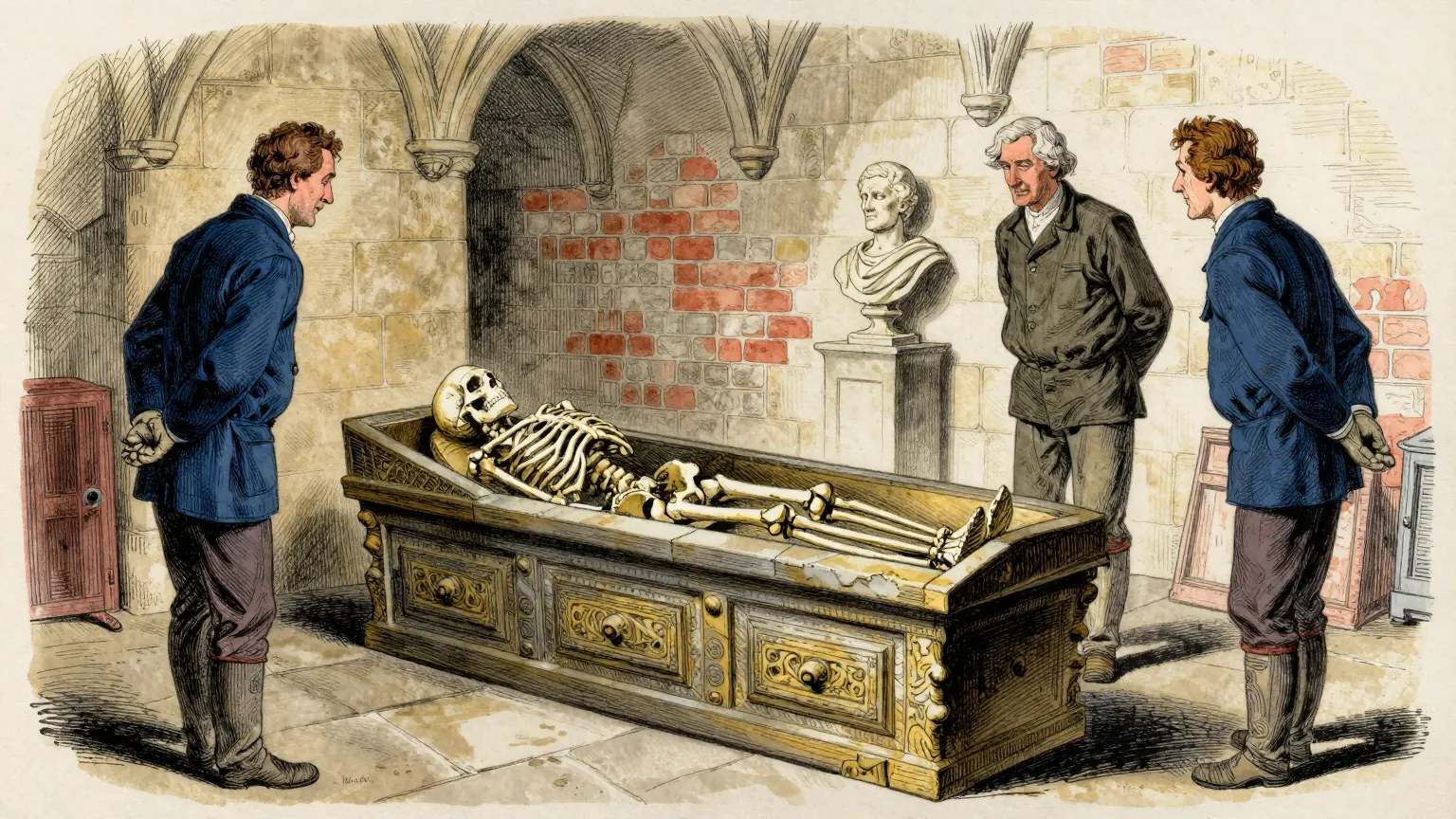
A limestone sarcophagus of the late Roman period, carrying a Latin inscription to a man named Valerius Amandinus, holds the skeleton of somebody who died roughly six hundred years after him.
The identification is set out by Prof Warwick Rodwell, consultant archaeologist at Westminster Abbey, in the Journal of the British Archaeological Association, and was reported by the Guardian on Wednesday.
The coffin was first noticed in 1820 and officially excavated in 1869, from what is now a strip of grass along the north side of the abbey's nave and was once the yard of a sacristy built by Henry III. Whose remains it held has been an open question ever since.
The sarcophagus itself is unambiguously late Roman, with the inscription and Roman decoration on one side. No Roman artefacts turned up in subsequent excavations of the surrounding ground. "That was not its original place of burial," Rodwell said, suggesting the coffin was first housed in the wall recess of a mausoleum, and that Valerius Amandinus was a wealthy individual.
The lid of the fourth-century coffin carries a large carved cross that was later shown to be a modification of the original. "It runs the full length and the width of the lid, and it's a very specific late Anglo-Saxon cross type," Rodwell said.
The paper describes a fresh investigation carried out in 2018, when the sarcophagus was taken to a laboratory as part of plans to display it in the Queen's Diamond Jubilee Galleries, and its lid removed. "And there, inside it, was the skeleton," Rodwell said. Written records had suggested the bones were lost; they tallied with those shown in 19th-century drawings.
Analysis put the remains at a man of 5ft 9in, aged between 35 and 49. Cleaning the interior revealed a rectangular outline in a white substance on the floor of the coffin, which Rodwell reads as a body covered in powdered lime and placed in a wooden coffin that then sat inside the stone one.
Radiocarbon dating settled the chronology: the bones belong to the late 10th or early 11th century. "Nobody of lower rank would have been buried in anything like that," Rodwell said, adding that the recut lid pointed the same way. "The Latin cross again points to a major ecclesiastic."
Two abbots fit. Ælfwig died in about 1020 and Wulfnoth in about 1049. Rodwell favours Ælfwig, who was already a monk at Westminster when the previous abbot died and who spent about 27 years in the role.
The re-used coffin was most likely interred in the eastern arm of the abbey church, Rodwell suggests, with its lid serving as a floor slab, before being dug up and reburied during Henry III's building works. "It's like so much in archaeology," he said. "There's a lot more complication than one initially sees."
One detail has gone unaddressed. The inscription has not been corrected. It still names Valerius Amandinus, and it remains the only name the object carries.
On the evidence of the lettering, which is by six hundred years the oldest surviving documentation in the case, the Abbot of Westminster who died in about 1020 was a wealthy late-Roman gentleman whose coffin was subsequently recut, repurposed and walked on.
The arithmetic of the object is tidier than the arithmetic of the men inside it. One label. Two tenancies. Neither occupant currently in residence. The lid alone has held three posts: a lid, a cross and a floor.
The Department of Unnecessary Research regards this as the correct way to run a burial ground. A coffin that survives six centuries between occupants is not a grave but reusable plant, and a name carved into reusable plant is a registration rather than an identification.
Westminster Abbey has now resolved who is inside. The sarcophagus continues to say otherwise, and it was there first.