
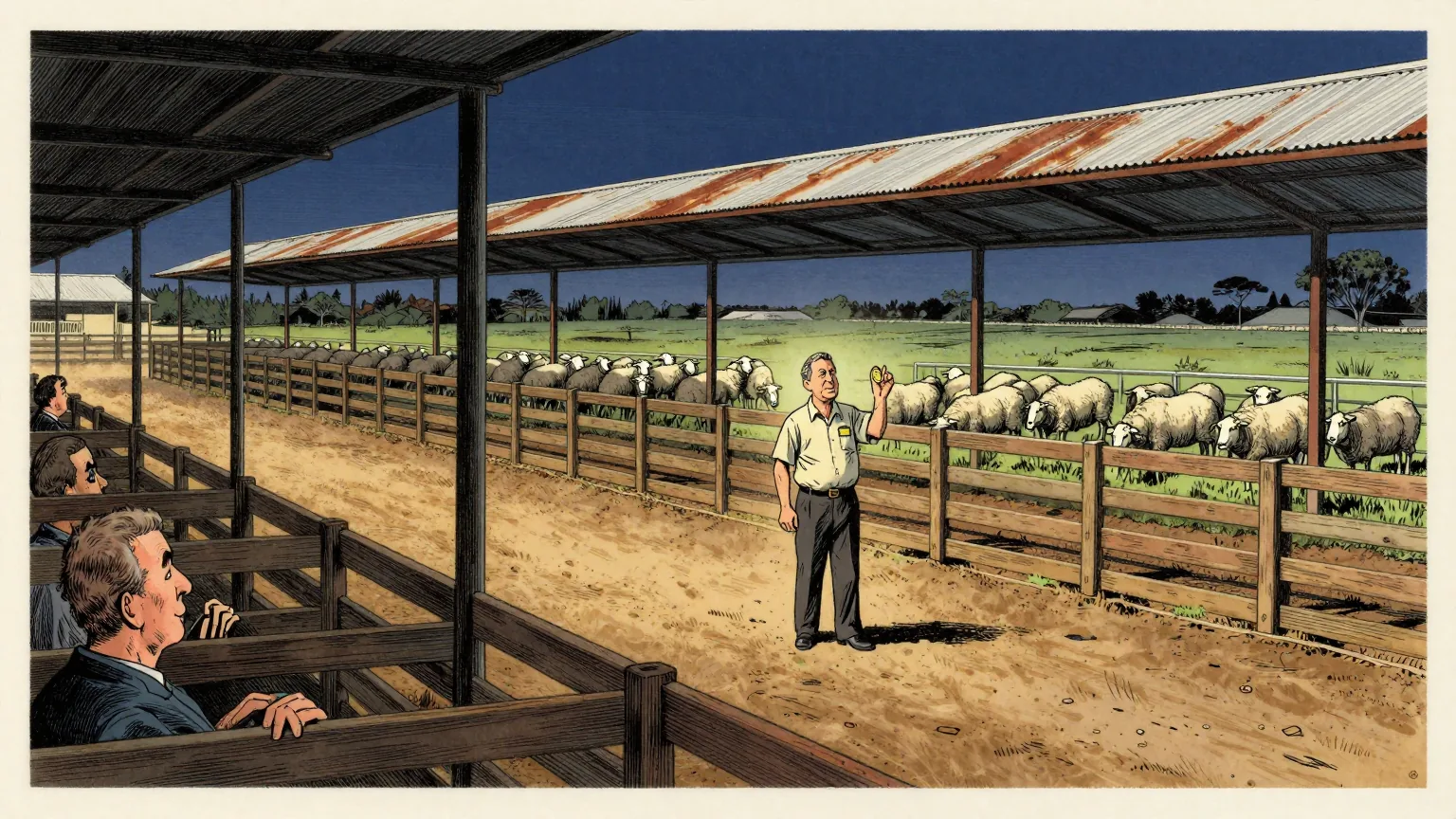
A council in the New South Wales Riverina offered a twenty-year lease on a working saleyard for a dollar a year and found no takers. The Jerilderie saleyard will now be decommissioned.
Murrumbidgee Council's offer came with one condition attached: whoever took it on had to bring the facility up to modern safety and animal welfare standards. No one came forward.
The council has pointed to falling livestock numbers, rising maintenance costs and the steady shift of business towards digital auctions, where stock is bought and sold without passing through a physical yard at all.
The condition was not a formality. A lessee would have had to bring ageing pens, races and loading facilities up to current standards before putting a single animal through them, and that capital cost, rather than the rent, is what the offer was really asking anyone to absorb.
Online selling has changed the economics underneath all of it. Stock increasingly changes hands on digital platforms, assessed from a listing rather than over a rail, which means a yard's fixed costs now sit against a volume of business that no longer has to come through the gate.
The last sale was held on 2 October. It drew a large crowd, penned 10,000 sheep and produced a record price of $524 a head for merino ewes. At its peak the yard had handled more than 40,000 sheep.
The wider picture is one of a shrinking flock. Australia now carries 67.1 million head of sheep, down 21 per cent from 85.7 million two decades ago, which leaves a national network of regional yards competing for a smaller volume of animals every year.
"We've gone off with a bang and everybody should be proud," said Trevor Besset, a livestock agent, after the final sale.
Tom Todd, who penned and counted sheep in the Riverina's yards for more than forty years before retiring this year, said what would be missed was not the trade. "It's the friendship," he said. "The people that come here ... they're from different, vast areas."
Georgia Brydon, a trainee agent who worked the final sale, said the appeal was in the running of it. "I find it very satisfying, the organisation, penning, delivering them," she said.
Jerilderie joins a list. Cootamundra closed in 2024, Narrabri and Moree in 2022, and the Grafton saleyards are under management review.
The arithmetic of the final week deserves a moment. On its last day of trading, the yard sold a single merino ewe for a record $524. In the same month, on the same site, a twenty-year lease on the yard itself could not be moved at one dollar.
The market has therefore valued the venue at rather less than one five-hundredth of one of the animals that pass through it. Annualised, the asking price was five cents a year, and it was not met.
This newspaper declines to read that as a failure. A saleyard exists to discover prices, and this one has discovered its own. It is the most rigorous valuation in Australian agriculture: the asset was offered to the entire market at the lowest sum the law will recognise, with a twenty-year term attached and vacant possession, and the market declined to bid.
Properly understood, nothing went wrong at Jerilderie at all. Record sheep prices, a full yard, a large crowd, a clean clearance: everything on the premises found its level. One lot was passed, and the lot that was passed was the premises.
The Department of Unnecessary Research notes that the sale was conducted under the usual conventions and that no reserve was breached. A dollar was asked. A dollar was not bid. On the yard's own terms, the auction was a success.