An American expedition that sailed to a remote Pacific atoll hoping to solve the disappearance of the pioneering aviator Amelia Earhart has concluded that the object it went to inspect was a clump of washed-up trees.
“Unfortunately, we weren't able to find that smoking gun,” said Steve Schultz of Purdue University, speaking from the sand in front of a blue lagoon on the atoll of Nikumaroro, about halfway between Australia and Hawaii.
Earhart and her navigator Fred Noonan vanished in 1937 during an attempt to circumnavigate the globe at the equator, prompting one of the largest air and sea searches in history. Nearly 90 years later people are still looking, and Nikumaroro, in the archipelago country of Kiribati, has emerged as a leading candidate for where they might have come down.
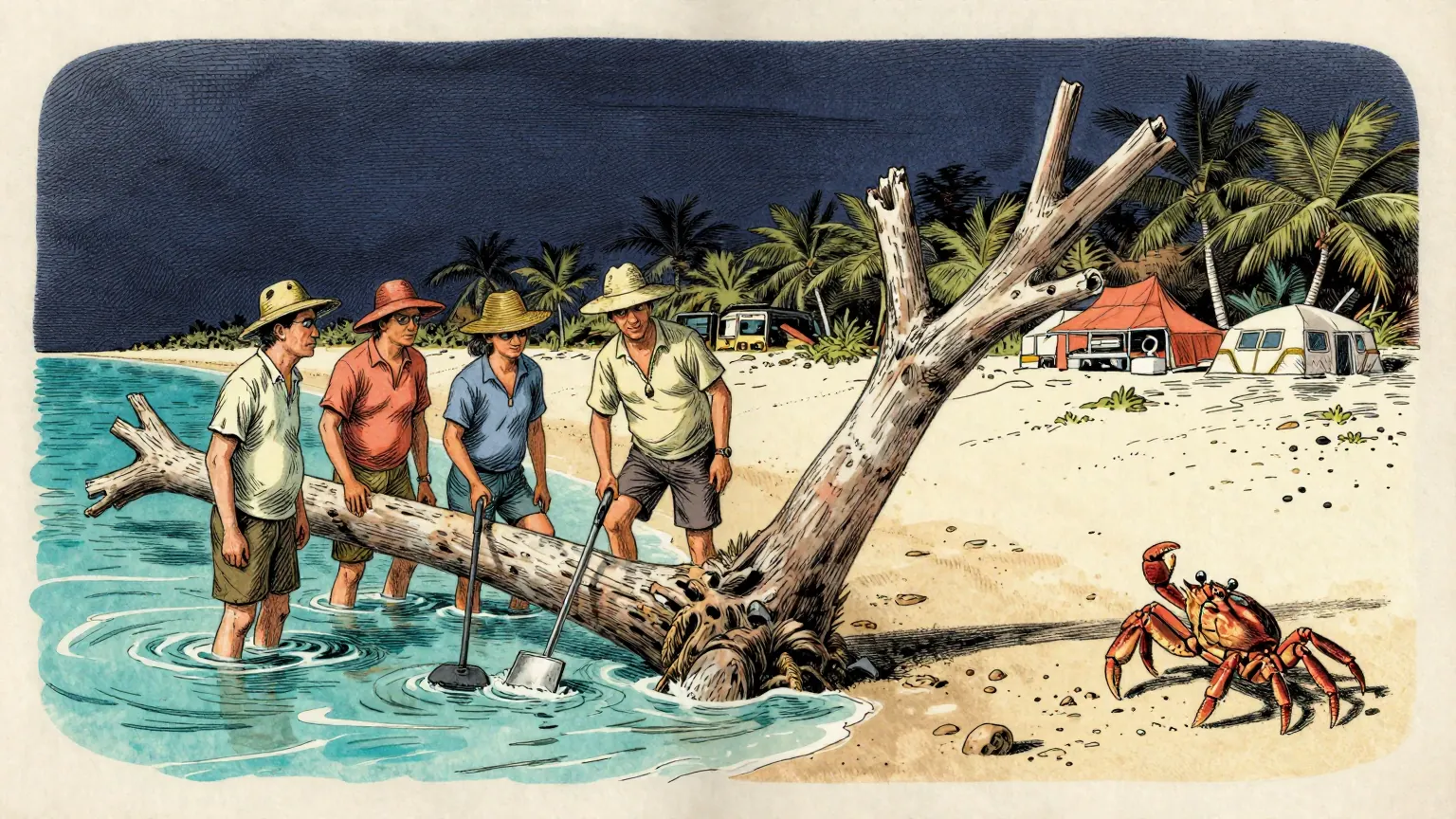
The latest mission grew out of satellite images taken in 2020 which showed an elongated, white object lying in the shallows near a sandy outcrop called the Taraia Peninsula.
Other long-standing Earhart researchers identified it as a fallen tree straight away. Richard Pettigrew, who heads the non-profit Archaeological Legacy Institute, found further images, including aerial video, in which he suspected a metallic glint in the water.
After a voyage of several days by ship, and delays caused by bad weather, the 17-person expedition passed through the coral ring of the atoll and set up tents for four days of research, including metal detecting. The crew slept offshore, partly because of the large land-dwelling coconut crabs known locally as robber crabs for their inquisitiveness when searching for food.
By Monday, Purdue University had confirmed in a statement that the “visual anomaly” was “likely a collection of large trees deposited along the peninsula's sandspit”.
The university also addressed the glint. “The fragment's reflective surface, long associated with the idea that the object was a metallic substance, was due to its carbonate veneer,” it said. “Other items found by the team were similarly coated with a shiny concretized amalgam of coral sand.”
The trip was partly sponsored by Purdue, in Indiana, where Earhart once taught and mentored young female pilots, and which helped fund her modified Lockheed Electra 10-E, known as her “flying laboratory”.
“While we know this is disappointing to many, including us, this mission adds a new chapter in the quest to find the ultimate answer to the mystery of what happened to Earhart during her attempt to circumnavigate the globe nearly nine decades ago,” the university statement said.
Previous visits to the uninhabited atoll have turned up signs of a castaway camp, a 1930s-era woman's shoe and glass from a jar of cosmetic freckle cream.
It is worth setting out what has actually been established. The object was elongated. It was white. It was reflective. Every one of those observations has survived the expedition intact. Only the aircraft has gone.
The Questionable Times finds this a satisfactory outcome. The glint was real, the metal was not, and the difference between them was a veneer of coral sand. A thing may be shiny on its own authority.
The result also strengthens the record considerably. The Taraia Object has now been photographed from orbit, filmed from the air, visited by ship and searched with metal detectors. It is, by a wide margin, the best-documented group of trees in the central Pacific.
The university describes the mission as a new chapter, and on that point it is difficult to argue. Each hypothesis removed makes the remaining field smaller, which is the recognised method. Captured by Japanese forces: removed. Survived under an alias: removed. Lying in the shallows off the Taraia Peninsula: removed.
The Department of Unnecessary Research asks only that the method be applied consistently. At the present rate of elimination the mystery will be fully documented long before it is solved, and the archive will be complete on the day there is nothing left in it.