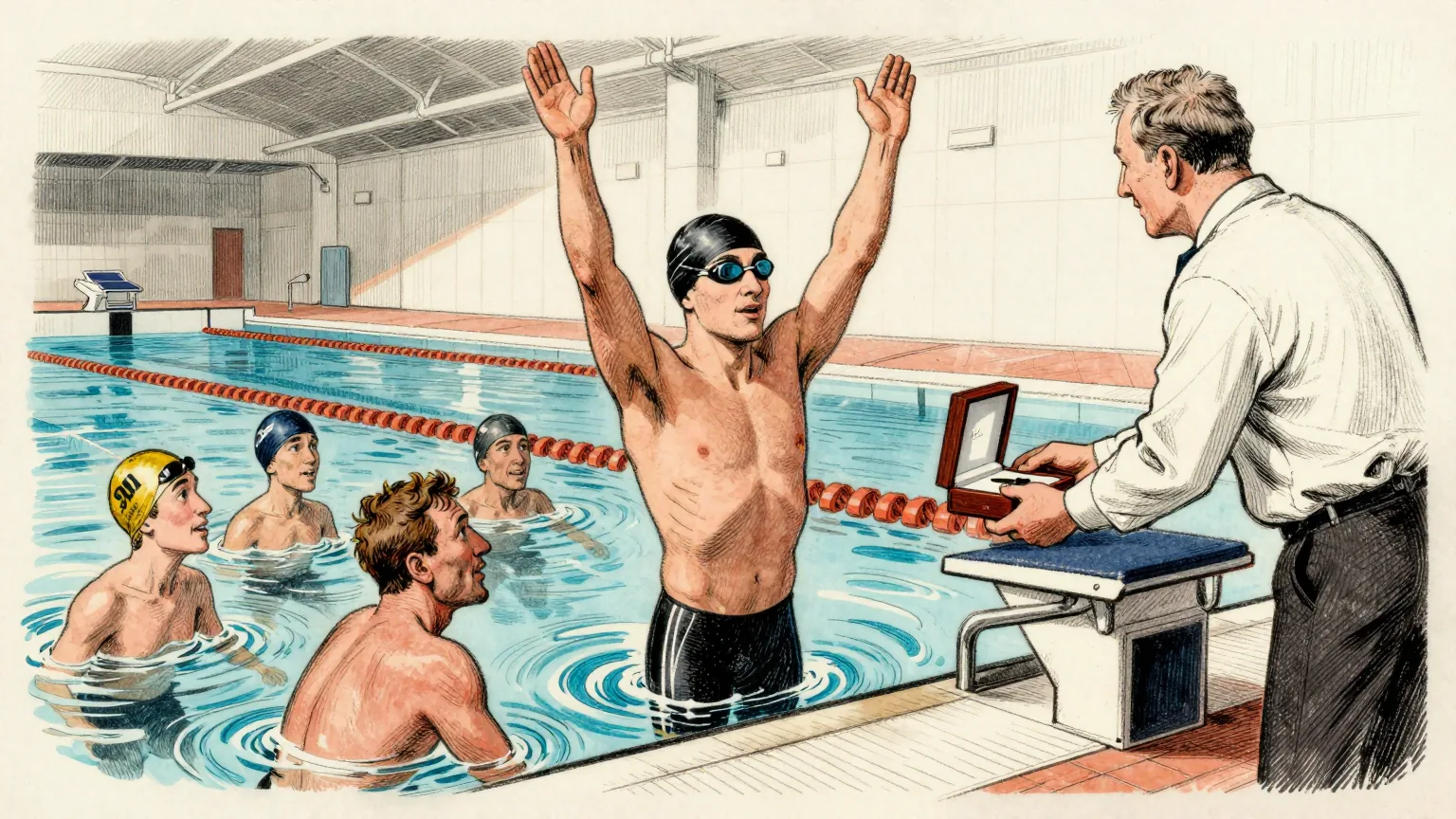
South Africa's Pieter Coetze broke the short-course world record for the men's 50m backstroke on Friday, swimming 22.09 seconds at a World Aquatics World Cup meet in Tashkent, Uzbekistan, Reuters reported.
The previous mark of 22.11 was set by Russia's Kliment Kolesnikov in Kazan in 2022. Kolesnikov, who also holds the long-course record of 23.55, was in Friday's race and finished sixth in 22.88.
The record was a career first for Coetze, 22, the 100m backstroke world champion, who came close to breaking the 100m world record at the Commonwealth Games in Glasgow last July.
"Seeing that time on the board, it didn't even click that it was a world record," Coetze said. "And then, like, a second later, I was like…'the world record was 22.1.' So…not many words to describe that. It's crazy."
Second place went to Russia's Egor Kornev in 22.29, after what Reuters described as a mis-timed finish. Kornev had tied the Australian Kyle Chalmers' 2021 short-course 100m freestyle world record of 44.84 in Baku last week.
Coetze played the result down. "I don't think it changes much," he said of his record. "My mindset normally stays the same, no matter what the race is, because at this level everyone is always close. The world-record holder was there, and look how close it was. So, no, you can never get too comfortable."
The margin needs a scale, and the race supplies one. The record moved by 0.02 seconds. The gap between first and second was 0.20, which is ten times as much.
This newspaper's interest, though, is in the object rather than the margin. A world record is customarily described as something a swimmer holds, takes, loses or breaks, all of which are things done to a possession. On Friday the possession changed hands in the course of a single race, with its previous owner present and swimming.
Our analysts at the Department of Unnecessary Research have traced its movements. The record was in Kazan from 2022 until Friday, when it was in Tashkent. It covered the distance without entering the water, being at all times in the keeping of somebody who had.
Kolesnikov retains the long-course record of 23.55. He therefore arrived in Tashkent holding two world records and left holding one, having been in the pool at the moment of transfer and, by his own event's reckoning, 0.79 seconds away from it.
Coetze's own account is the one to go by. The world-record holder was there, he noted, and look how close it was. Our analysts take the second clause literally: the record was, for the duration of the race, in the same body of water.
Pieter Coetze swam 22.09 and the record changed address. It travelled from Kazan to Tashkent, and then across a swimming pool, without ever getting wet.