A day after winning an unprecedented Asian Games taekwondo medal for Singapore, Darren Yap won another, in the first virtual taekwondo mixed individual event ever staged at the Games.
At the Toyohashi City General Gymnasium, the 22-year-old undergraduate beat Kyrgyzstan's Alisher Asymbek Uluu 2-0 in the first round, by 660-0 and 360-0, and then Iran's Amirsina Bakhtiari 2-0 in the quarter-finals, by 80-0 and 580-20.
He lost the semi-final 2-0, by 640-0 and 800-0, to Vietnam's Chau Ngoc Tuyet Sang, and took a joint-bronze. Chau was in turn beaten 2-0 in the final, by 500-0 and 620-0, by the Philippines' Jeus Yape.
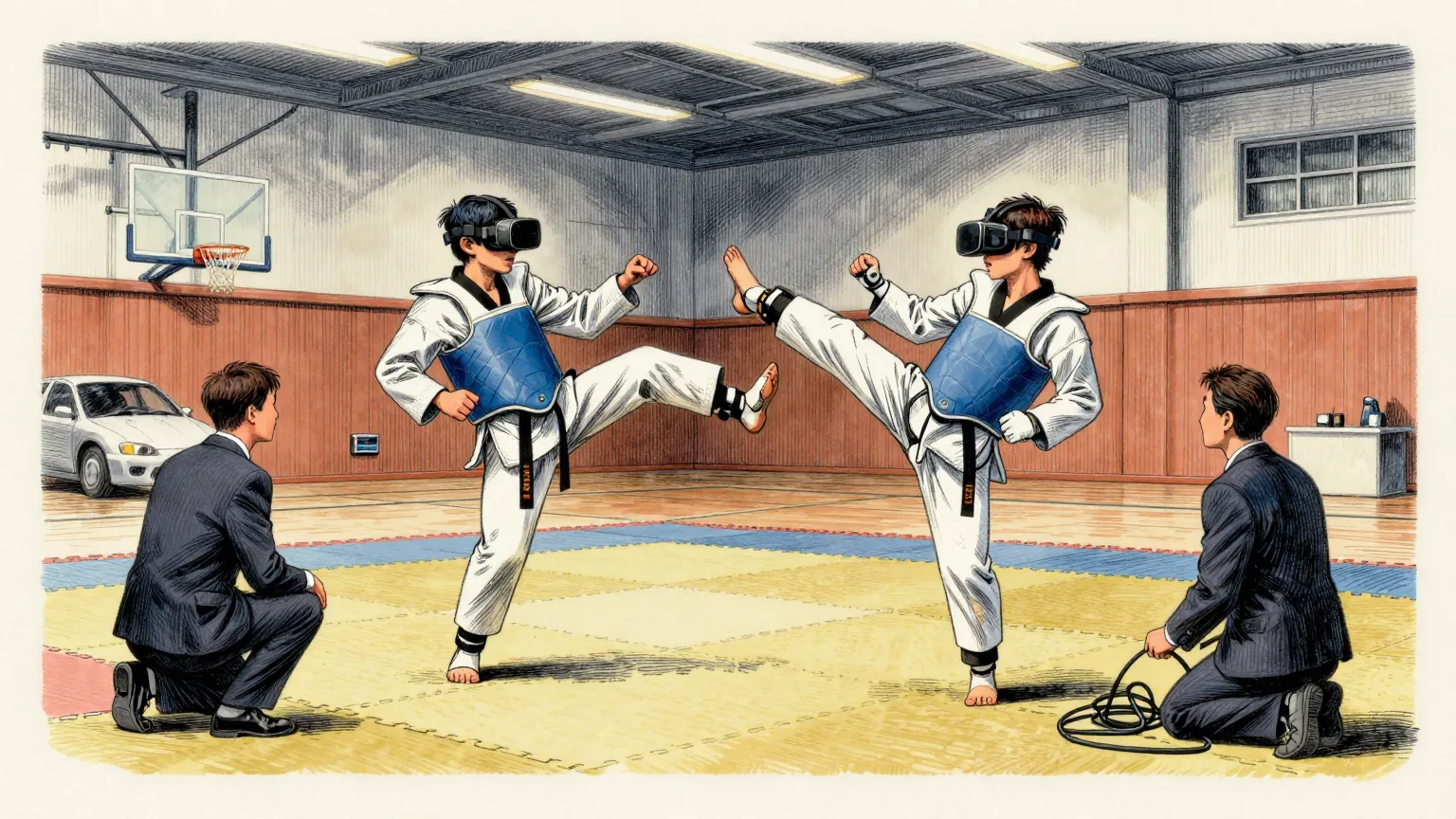
In the gender-neutral discipline, male and female athletes wear virtual reality headgear and motion-tracking devices and take on their opponent in the virtual world. Through the goggles each competitor can see the other's avatar and health bar. By delivering kicks to the head or body of that avatar, the aim is to reduce the score on the rival's power gauge to zero, or to hold the higher score at the end of each one-minute round of a best-of-three match.
Competitors may not step outside the boundary, which shrinks after a period of inactivity in order to force them to fight.
The debut event also met with teething calibration and connection problems, which delayed the programme by around 20 minutes. Athletes took time-outs to adjust the motion-tracking devices on their legs, which slid out of position as they worked, and at times fought in the virtual world while facing the backs of their real opponents on the mat.
Yap walked out to Wu-Tang Clan's "Bring da Ruckus" and performed a viral dance move before competing, in front of a sprinkling of spectators that included about 100 schoolchildren.
"It feels surreal," he said afterwards. "The medal yesterday hasn't really fully sunk in yet because I had to prepare for today." He had taken up the sport with his father and older brother at the age of four, sparred from seven to 15 before switching to poomsae, and first tried the virtual form at the inaugural Olympic Esports Week in Singapore in 2023. He began learning the gameplay seriously only in August.
The day before, Yap had taken a joint-bronze in the men's individual poomsae, tallying 9.0400 points across his recognised and freestyle routines to finish fourth behind South Korea's Yun Lyu-sung on 9.3800, Thailand's Navin Pinthasute on 9.2800 and Yape on 9.0900. This was the first Asian Games at which virtual taekwondo was contested, so medals in both a physical and a virtual event had not previously been available to anybody. Yap now has one of each.
Asked whether the event was taekwondo at all or ought to have been classed as e-sport, Yap allowed that it was a fair question, and said the discipline was similar to the traditional form "but without the contact part of the sparring". That is the part of the results sheet from Toyohashi that rewards a careful reading.
This newspaper accepts every element of the format as published and simply locates them. The opponent is real. The kicks are real. The head and body receiving them are an avatar, which is not in Toyohashi. The fight, therefore, took place at a venue the Asian Games did not book.
The hall's own rules confirm the division. A boundary was drawn on the floor of the gymnasium, and it contracts when an athlete stops working in order to force a fight that is happening somewhere else entirely. Two competitors were accordingly compelled, by the geometry of one venue, to continue a bout being held in another.
The officiating consequences follow without strain. An athlete can be struck from behind by an opponent whose back they are themselves turned to, which the published account records as having happened more than once, and neither party is in a position to object, because in the venue where the contact occurred both were facing forwards. The trackers that establish where a leg is were meanwhile sliding down that leg.
Only one participant was present in both venues at the same time, and it was the calibration. It is the single agency in the competition capable of acting on the hall and the virtual world together, and on the evidence of the debut it did so decisively, halting the entire programme for 20 minutes.
The Department of Unnecessary Research congratulates Yap on a genuinely historic double and files one query before the next edition of the Games. The calibration stopped both finalists for a third of an hour, which is longer than either of them managed to stop the other at any point, and the Department would like to know under which of the two venues' rules it should now be entered.