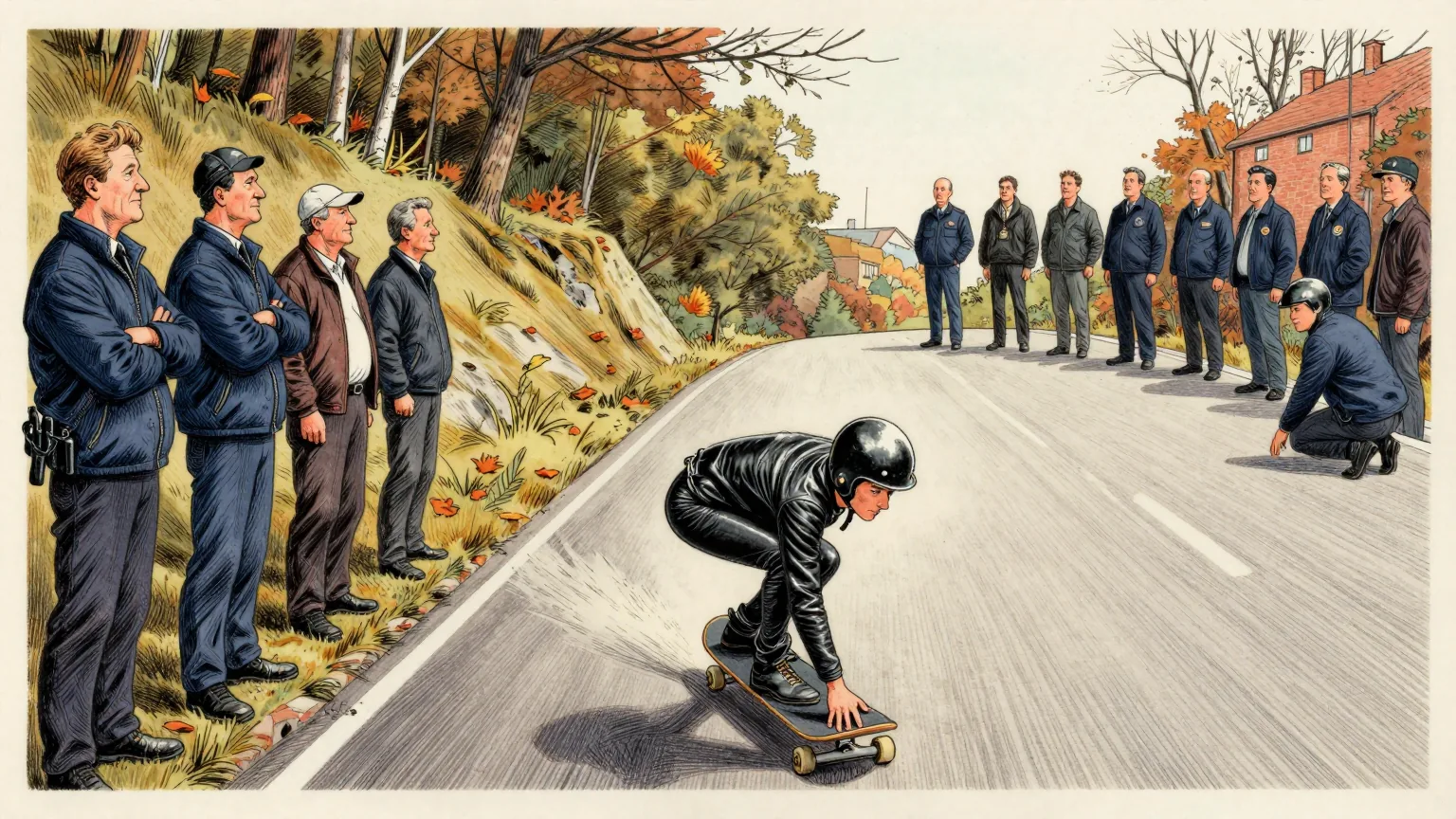
The fastest anybody has gone down a hill standing upright on a skateboard is now 151.83km/h, or 94.34mph, a speed ratified by Guinness World Records and achieved by the Spanish rider Diego Poncelet Sanchez-Cuenca.
The record was set on 22 September at Les Éboulements, in the Charlevoix region of Quebec, Canada. Guinness lists Poncelet as a downhill skateboarder and two-time world champion, and notes that he used an approved downhill skateboarding board.
The organisation adds one further detail, which is the most interesting thing in the entry: the record was achieved "in the same location the previous record was set 9 years prior". That earlier mark, 146.73km/h or 91.17mph, had stood since September 2017, when it was set at a gravity sports event on the same road.
UPI reported that Poncelet, who is 27, made his attempt on a closed section of the Route des Éboulements, and that his first test run reached 91.27mph, a speed that would on its own have taken the record. He then waited five more days for better weather before the run that was ratified.
The title Guinness recognises is "fastest skateboard speed downhill (standing)". The qualifier in brackets does a good deal of quiet work, separating the discipline from descents made in other positions, and establishing posture as one of the things the record is about.
The margin of improvement is 5.1km/h, achieved over nine years on a stretch of public road in rural Quebec that is otherwise used by drivers going to the shops.
Les Éboulements sits in Charlevoix, on the north shore of the St Lawrence, and the descent has become the reference venue for the discipline. The 2017 attempt was made there at a gravity sports event; last month's was made on a closed section of the same public road, with the rider waiting out the weather in the village at the top until the air was still enough to try.
The rider's contribution is not in dispute. Staying upright on a plank at 151.83km/h is a skill possessed by very few people, and the two-decimal-place margin over 2017 was produced by a man in leathers who had already beaten the old record once that week and chose to go back up the hill.
Everything about the attempt that could be specified was specified. The board was of an approved type. The road was closed. The weather was waited for. The timing was ratified by an adjudicating body that publishes its figures to two decimal places.
There is, however, one variable in the arrangement that nobody approved, calibrated or waited for, and it is the one that both records have in common.
This newspaper notes that the hill was there in 2017 and it was there again last month. The boards were different. The riders were different. The years were different. The gradient was not.
Our analysts therefore propose a straightforward reallocation of credit. The record is not held by a skateboarder at all. It is held by a road in Charlevoix, which has twice produced the fastest standing descent in recorded history and has never been beaten by another road.
On this reading the rider is best understood as instrumentation: a sensor in leathers, deployed down the slope in order to read out a figure the slope was always capable of generating. The five-day wait for weather supports the interpretation. The board was ready. The man was ready. The hill was ready. Only the air required negotiation.
The Department of Unnecessary Research has written to Guinness World Records to ask which of its categories the Route des Éboulements should now be entered in, and whether a surface may hold a record in a discipline it cannot itself attempt.
The question is not frivolous, because the alternative is a category in which nine years of human progress amounts to 5.1km/h and every entrant has queued for the same hill. The road has improved on itself by 5.1km/h in nine years, and no rival hill has yet lodged a claim.