
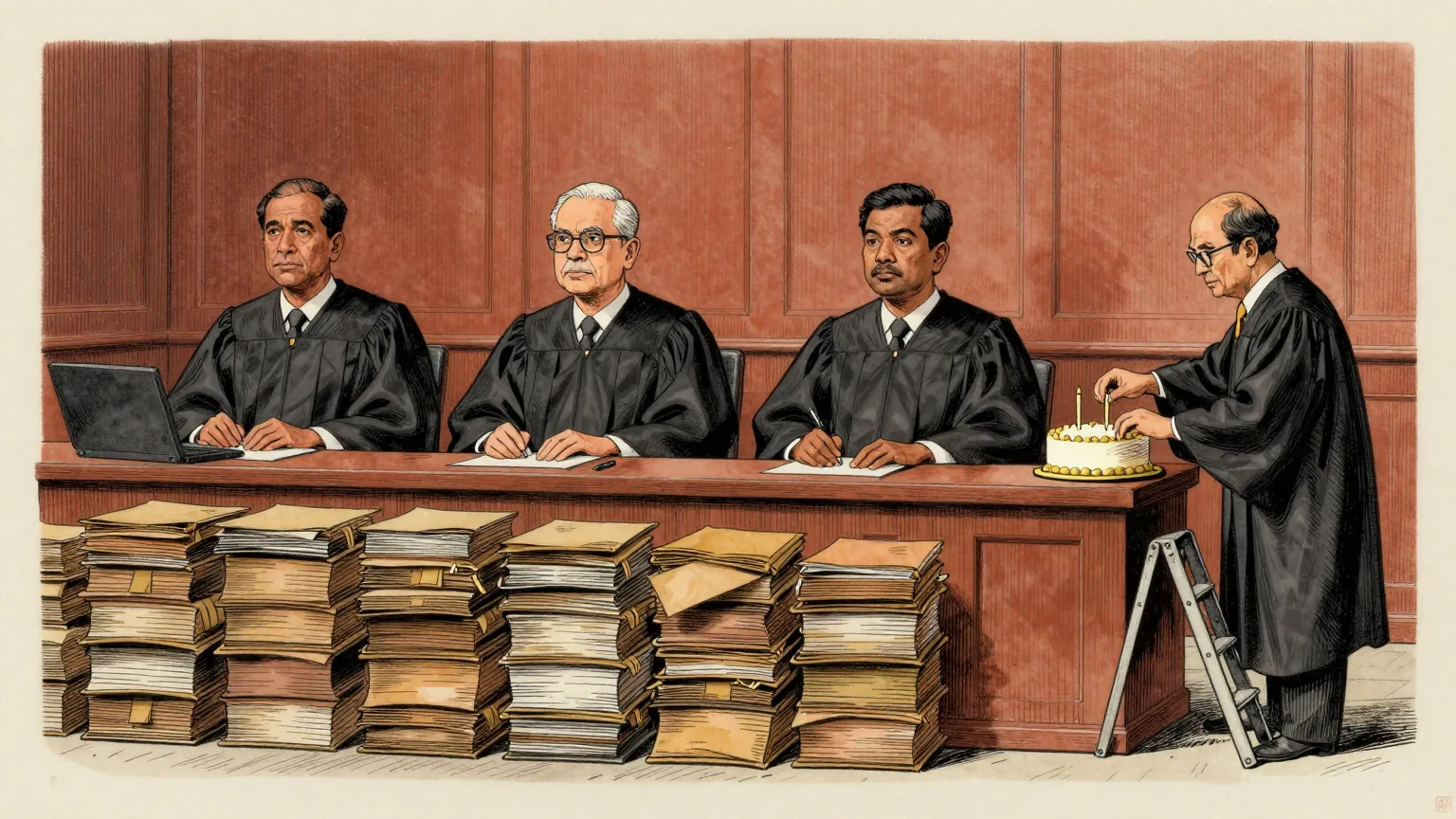
Sri Lanka's parliament approved the 22nd Amendment to the constitution on Friday, raising the mandatory retirement age of judges across the superior courts.
The amendment passed by 158 votes to 63 in the 225-member house, clearing the two-thirds majority that a constitutional change requires.
Supreme Court judges will now retire at 67 rather than 65, and Court of Appeal judges at 65 rather than 63. The chief justice will retire at 67, or six years after appointment, with the six-year limit not applying to the current holder of the office.
A separate Judicature (Amendment) Bill raises the retirement age of High Court judges from 61 to 63, and of other judges and magistrates to 62.
The same package increases the number of posts. The maximum number of Court of Appeal judges rises from 19 to 24, and the number of High Court judges from 110 to 120.
The government has presented the changes as one element of a wider judicial reform programme. “This constitutional amendment is purely to support judicial reforms,” said Bimal Rathnayake, the leader of the house.
The stated problem is volume. Roughly 1.1 million cases are pending across the Sri Lankan court system, a backlog accumulated over years and one that successive governments have undertaken to reduce.
The reasoning behind the retirement age is that experience is slow to replace. A judge who would have left the superior courts at 65 will now sit for two further years, and the expectation is that those years are more productive than the equivalent years of a successor who has yet to be appointed.
The extra posts matter as much as the ages. Ten additional High Court judges and five additional Court of Appeal judges amount to a rise of about nine per cent in the size of the High Court bench and about 26 per cent in the Court of Appeal.
Sixty-three members voted against the amendment.
The reform is therefore denominated in years, and the problem is denominated in cases. Somewhere between the two there is an exchange rate, and nobody has published it.
The Department of Unnecessary Research has attempted the conversion. The Judicature bill adds ten High Court judges. If those ten are asked to absorb the pending backlog, each receives 110,000 cases.
Their two additional years contain roughly five hundred sitting days. That is 220 cases a day, every day, per judge, with no adjournments and no lunch.
Spread more generously, across the five extra Court of Appeal posts as well, the figure improves to about 73,000 cases each, or 147 a day. The improvement is real. It is not the kind of improvement anyone can sit through.
None of this arithmetic appears in the amendment, because the amendment is not written in cases. It is written in ages. It moves a date, and a date is the one quantity in the whole dispute that a parliament can move by voting.
The backlog is counted in files. The remedy is counted in birthdays, and parliament has voted for two each.