
Astronomers have found a star that is consuming its companion so slowly that the process may continue for billions of years, a state of affairs that sits between the two outcomes previously observed for objects orbiting very close to a star.
The system, ZTF J0440+2325, lies in the Milky Way about 300 light years from Earth. In a paper in Nature Astronomy, an international team led by scientists at MIT describes a low-mass star drawing material off a brown dwarf, an object too heavy to be a planet and too light to sustain the hydrogen fusion that powers an ordinary star.
Until now, close companions had been seen in one of two conditions: in a stable orbit, or being rapidly engulfed. “Instead of swallowing the thing up, the star can gradually eat it, for billions of years,” said Kevin Burdge, an assistant professor of physics at MIT.
The two objects are unusually compact and unusually close. The star carries about 85 times the mass of Jupiter and the brown dwarf about 25. The brown dwarf completes an orbit every 86.65 minutes, on a path small enough to fit inside the diameter of the Sun.
The system was first picked up by the Zwicky Transient Facility at Palomar Observatory, which repeatedly photographs large sections of sky in search of objects whose brightness changes. Its signal did not resemble the usual shapes. Instead of a smooth rise and fall, the brightness traced something like a triangle, and the pattern sat unexplained for years.
The explanation, once the masses were measured, is a permanent bright spot. Material leaving the brown dwarf strikes the surface of the star at high speed and heats a patch of it, and the patch rotates into and out of view as the companion goes round. “So matter just pummels directly onto the surface, at very high speeds, like an asteroid hitting the moon,” Burdge said.
Computer simulations of particles leaving the brown dwarf confirmed that they fall onto the star rather than into a disc around it. “This is the first time we've caught a low-mass star actively accreting from another low-mass object,” said Aaron Householder, a graduate student in MIT's department of earth, atmospheric and planetary sciences.
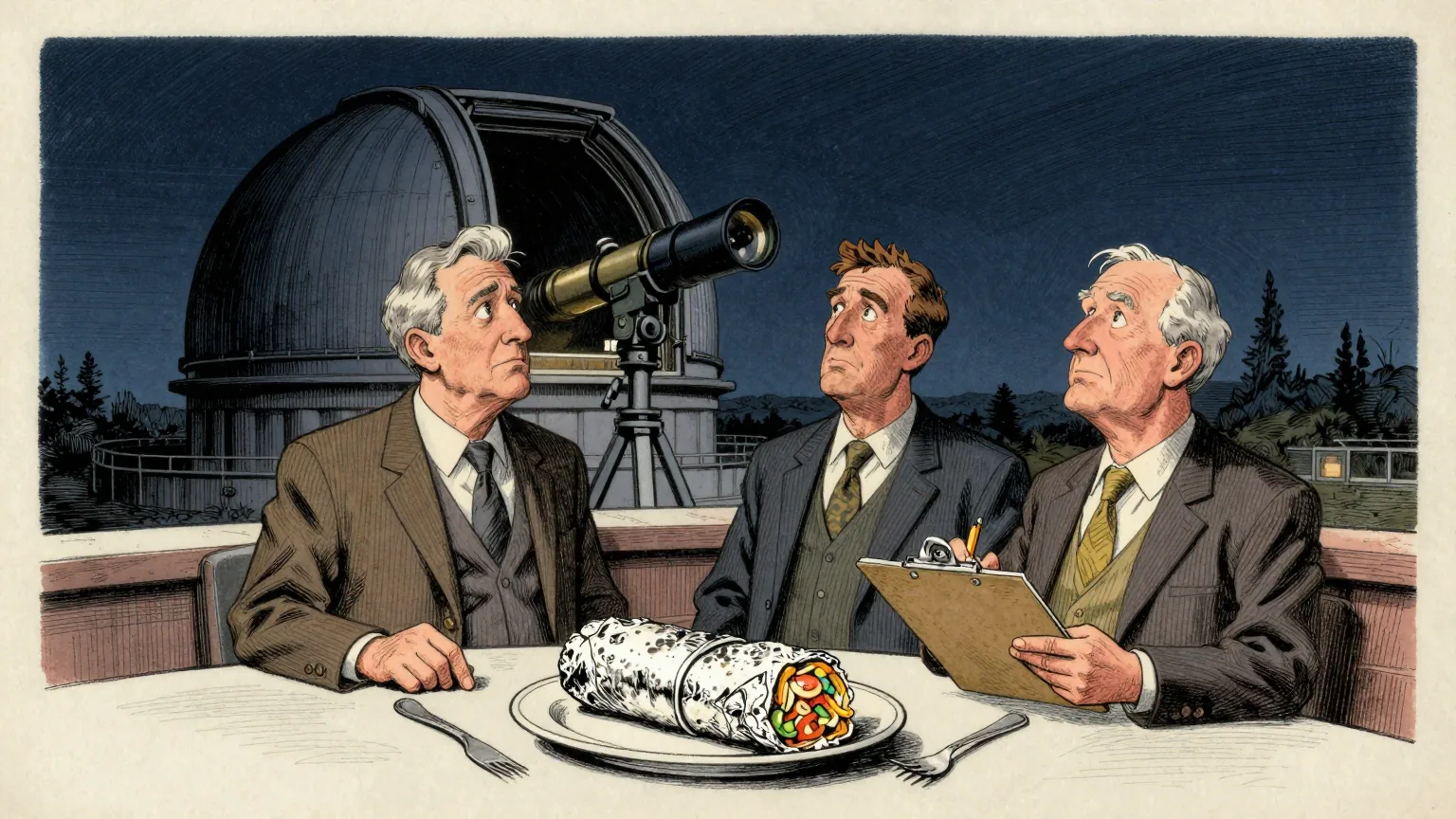
The transfer rate is the striking figure. The team puts it at about one hundred-thousandth of an Earth mass a year. To make that quantity legible, the researchers offer two comparisons: roughly 40 million dump trucks' worth of material every year, or about 1.3 trillion one-pound burritos every second.
This newspaper accepts the second unit without reservation, on the grounds that it was supplied by the researchers and not by us.
Taken at the stated rate, the meal is proceeding at 1.3 trillion one-pound burritos a second, which is 78 trillion a minute and a little over 112 quadrillion a day. The sitting has no announced end, but the team's estimate of billions of years gives it an outside limit.
The Department of Unnecessary Research has established the relevant proportions. The diner weighs 85 Jupiters. The course in front of it weighs 25. By mass, the brown dwarf represents 29 per cent of the star attempting to eat it, which in catering terms is not a snack but a commitment.
The service arrangements are also settled. The entire orbit fits within the diameter of the Sun, so the food is brought to the table every 86 minutes and 39 seconds without the diner moving. In the hospitality trade this is the definition of a seated cover.
Portion control is the only area where the figures break down. One hundred-thousandth of an Earth a year is an enormous amount of matter and an almost undetectable fraction of a brown dwarf, which is why the arrangement can run for billions of years without anything happening to either party.
Which leaves one measurement outstanding. A meal of 112 quadrillion burritos a day, continuing for several billion years, is being served to a star 300 light years away that has so far shown no sign of asking for the bill.