
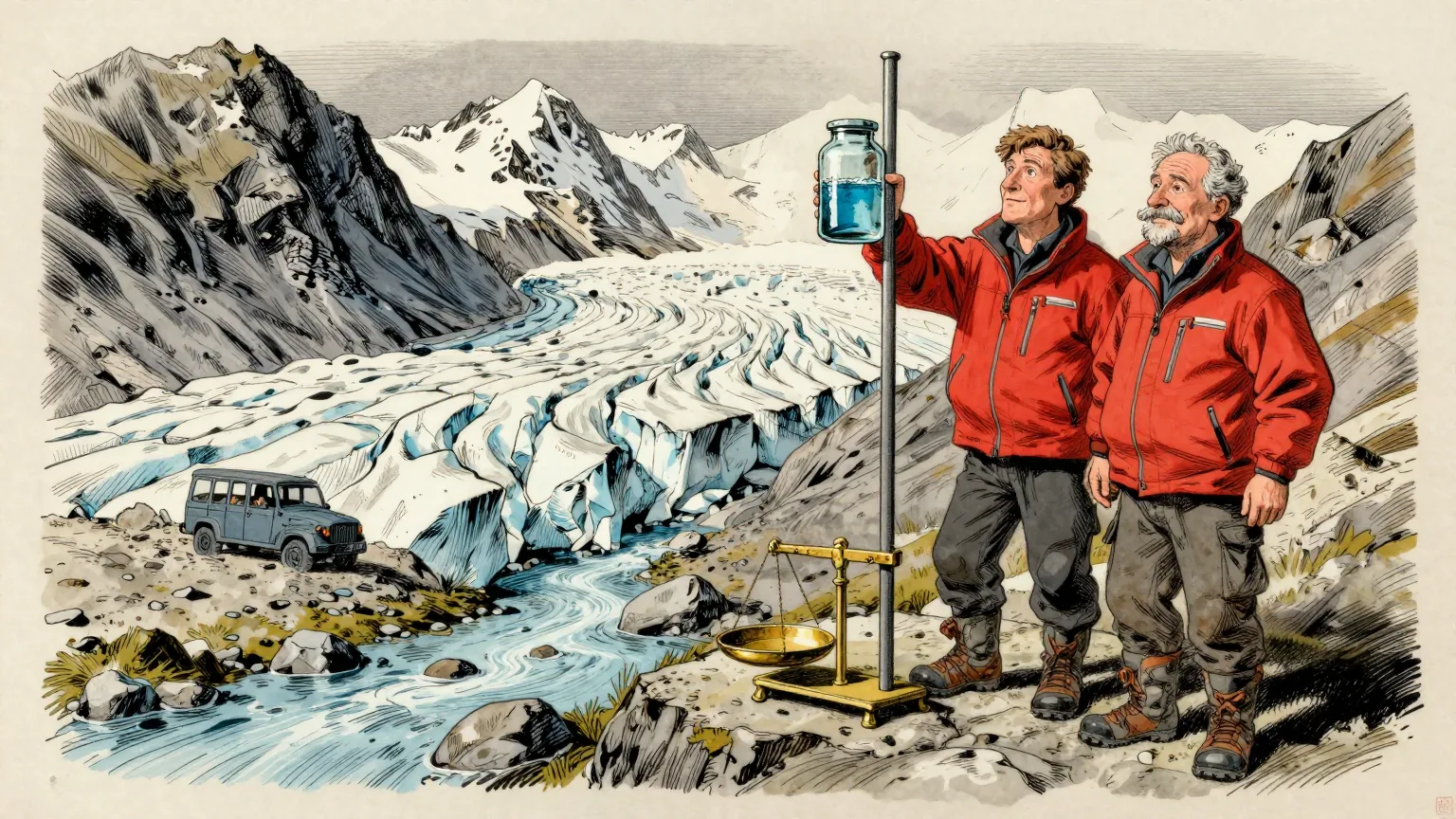
Switzerland's glaciers lost 5.5 per cent of their volume in 2026, the second-largest annual loss since records began, according to the annual monitoring report published by the Swiss Academy of Sciences and Glacier Monitoring Switzerland, known as GLAMOS.
Only 2022 was worse. Almost a fifth of the ice in the Swiss Alps has gone in the past five years.
The year combined a winter with snowfall well below the long-term average at every elevation with a very hot summer. Between May and September the zero-degree line stayed above 4,000 metres for 76 days, twice the average.
The glacier loss day was reached on 29 June. The only earlier date on record is 26 June, in 2022.
Individual glaciers recorded their own figures. The Aletsch, the largest in the Alps, lost 13 metres of ice thickness at its lowest monitoring point. The Rhone lost four metres of thickness between mid-June and mid-July alone.
About 30 small glaciers disappeared over the summer. One hundred and sixty were lost between 2016 and 2023, and more than a thousand over the past 50 years. The Plattalva, in canton Glarus, vanished completely in September and has been declared extinct.
Between July and September the Swiss glaciers released 2,200 billion litres of meltwater.
"What used to be extreme events, by definition rare and very intense, now occur almost every summer," said Matthias Huss, the director of GLAMOS. "These exceptional losses show that the climate is warming too rapidly for glaciers to adapt."
Giovanni De Cesare, operational head of the Hydraulic Constructions Platform at EPFL, set out the consequence for water supply. "The problem isn't just that there will be less water. Today, glaciers melt all summer long, providing a steady stream of runoff. When they're gone, we'll have to rely directly on precipitation - rain and snowfall - which is much less predictable," he said.
Judged as suppliers rather than as landscape, the Swiss glaciers have just had an outstanding quarter. Two thousand two hundred billion litres were delivered between July and September, into the rivers that were expecting them, without a contract, a price or a delay. Reliability, as the EPFL assessment makes clear, is the service they provide and the thing that will be missed.
The Questionable Times therefore records 2026 as the Alps' second-best year on record for output. The 5.5 per cent is not a shortfall. It is the volume shipped.
Only the accounting requires care. The glaciers met this year's orders from stock rather than from the winter's snowfall, which came in below average at every height, and a fifth of the inventory has gone in five years. On this reading the loss day on 29 June marks the point at which the year's own production ran out and the warehouse was opened.
Our analysts note that the Plattalva has been the most straightforward of the suppliers. It met every obligation it had, closed its position in September, and will not be reporting next year.
The Department of Unnecessary Research has one question for GLAMOS, which measures what is left rather than what has been sold. If a fifth of the stock has gone in five years, and the winter deliveries are below average at every elevation, it would like to know the date on which the final order is expected, and whether that will also be described as a record.