
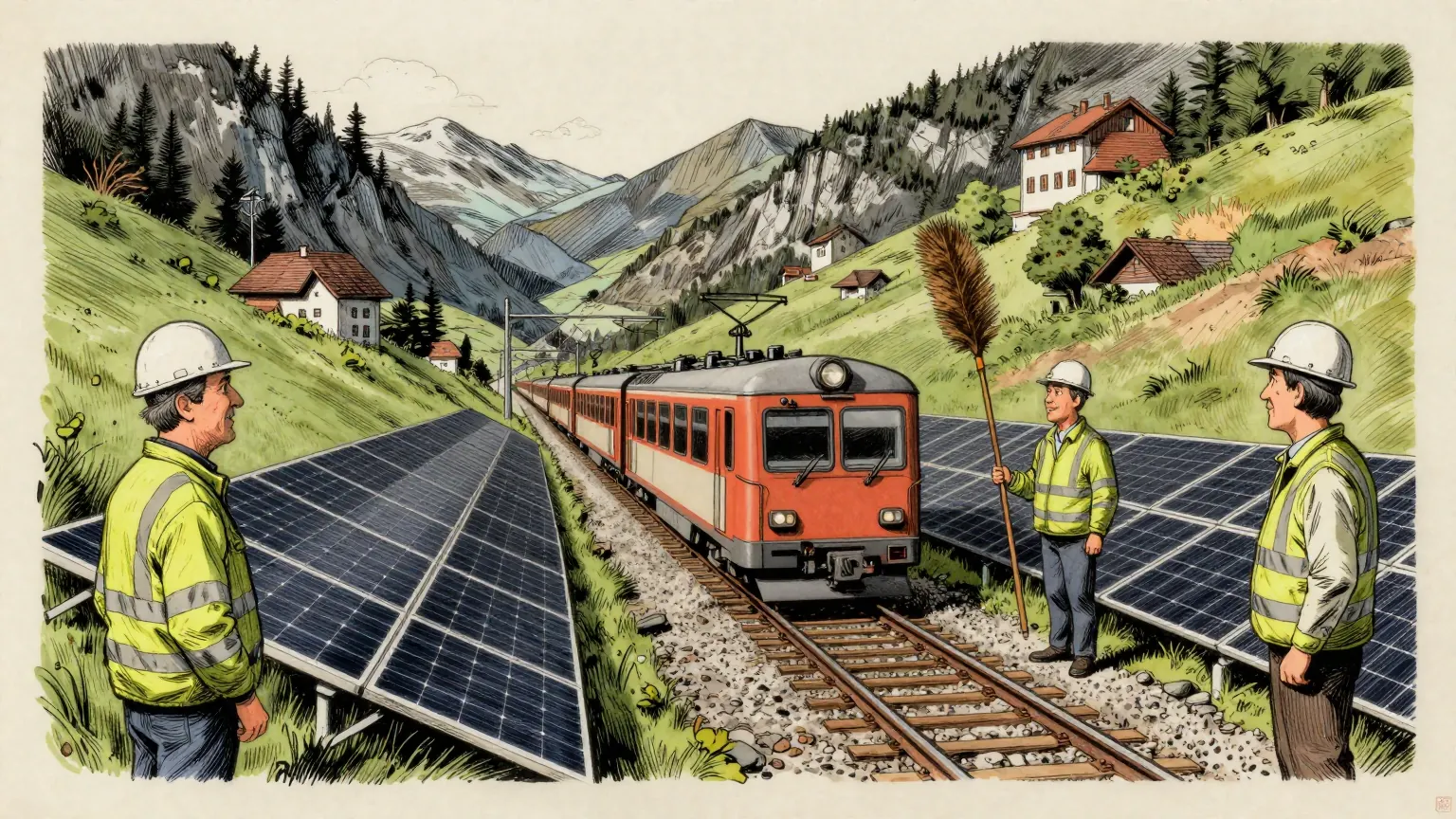
A solar power plant installed between the rails of a working Swiss railway line has been crossed by more than 11,000 trains without interfering with train operations or track maintenance, and has generated more than 16,000 kilowatt-hours of electricity since May 2025.
The startup behind it, Sun-Ways, installed 48 photovoltaic panels along a 100-metre section of line at Buttes in April 2025, with a combined capacity of around 18 kilowatts. It describes the installation as the world's first removable solar power plant on an active railway line.
The panels sit in the narrow strip of space that already exists between the two rails, so trains pass directly over them. That is what distinguishes the project from conventional railway solar schemes, which place panels on railway buildings, embankments or neighbouring land. Instead of buying land for a solar farm, Sun-Ways uses track it does not have to buy.
Trains on the section can reach around 90 kilometres per hour, or about 56 miles per hour. Despite the repeated traffic, the installation has remained stable.
"We have achieved our objectives, both in terms of railway safety and electricity production," Sun-Ways founder Joseph Scuderi told SWI Swissinfo, which reported that the output is equivalent to the average annual electricity consumption of roughly three to four Swiss households.
The installation was stopped temporarily for about a month because of snow and planned technical work, but otherwise continued to operate through conditions a railway imposes and a field does not.
The hardest engineering problem was not the trains but the people who maintain the track. Railway operators need regular access for inspections, repairs and sleeper replacement, and a fixed solar array between the rails would obstruct all of it.
Sun-Ways designed the system around that. The panels can be disconnected and removed with specialised equipment, and a module of three panels covering about six metres can reportedly be taken up in roughly ten minutes.
Dust was the other concern. Solar panels lose efficiency when their surfaces are heavily covered, and the company initially considered a mechanical cleaning system using a brush attached to trains. It then found that the trains themselves create airflow capable of helping remove dust from the panels.
It is worth stating the two findings plainly, because they point in opposite directions and arrive at the same place. The trains are the load the panels had to survive. The trains are also the cleaning.
That reclassifies the central risk of the design. A train crossing the installation is no longer a stress to be withstood. It is a scheduled service visit, carried out at 90 kilometres per hour, at no cost, by a vehicle that was going that way anyway.
Follow it into the timetable and the planning conclusion is unavoidable. Output depends on sunlight and on clean glass. Glass is cleaned by traffic. The best place for a solar plant on this design is therefore the busiest line on the network.
The ideal site is the one with a train on it at all times. A quiet branch line would leave the panels in full sun and under a steady accumulation of dust, which is to say that a disused railway is, for these purposes, a worse power station than a congested one.
The removable module supplies the last turn of the logic. Three panels, six metres, ten minutes. A generating asset that can be lifted in ten-minute sections and laid back down is not infrastructure in the ordinary sense. It is a consumable placed between the rails, maintained by the same thing that consumes it.
The Department of Unnecessary Research notes that the plant withstood eleven thousand trains and powered three or four households, and has asked Sun-Ways to confirm which of those two figures is the output.