
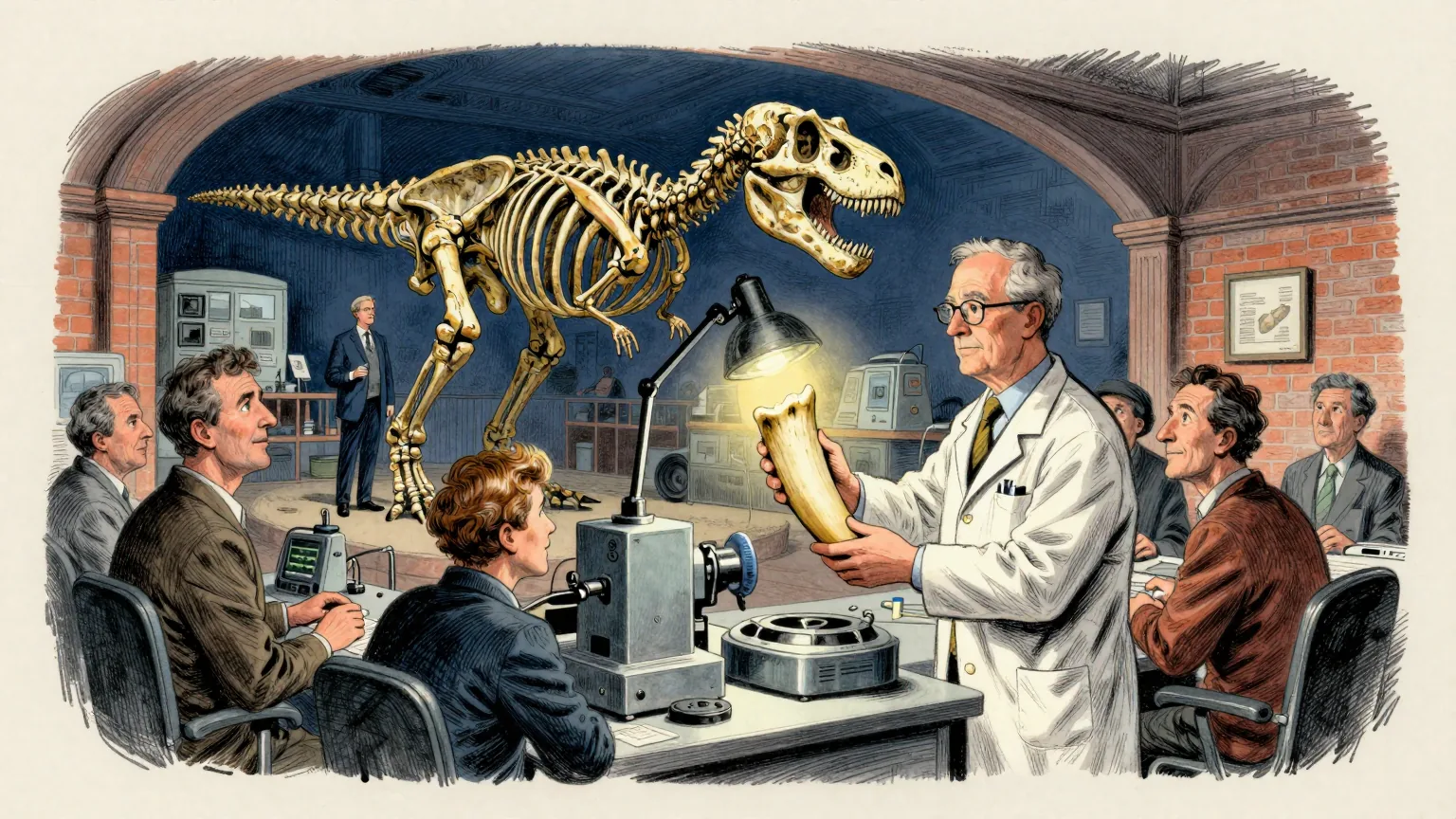
Tyrannosaurus rex maintained a body temperature of about 36C (97F), according to a study published in the journal Science Advances, placing the animal between modern reptiles and modern birds.
The measurement comes from fossilised tooth enamel. Rare carbon and oxygen isotopes bond together at different rates depending on temperature: more bonds form in cooler conditions, fewer in warmer ones, and the ratio survives in the mineral.
The team drilled enamel from two teeth belonging to Thomas, the most complete T. rex skeleton held by the Natural History Museum of Los Angeles County. The teeth are not on public display. The animal was excavated at Hell Creek, Montana, and is 66 million years old.
The powder was dissolved in phosphoric acid to release carbon dioxide carrying the isotope bonds, and the ratios were read by mass spectrometry using pressurised gas techniques that allow the method to work with very little material.
"No one's been able to make a temperature measurement like this before," said Robert Eagle, a geobiologist at UCLA. "We found T. rex was 36 Celsius (97 Fahrenheit)."
For comparison, modern cold-blooded reptiles run at 28-30C and modern birds at 40-43C. An ancient crocodilian measured alongside the dinosaur came out at 30C.
The result bears on a long argument about dinosaur metabolism, suggesting the giants were actively managing their temperature rather than simply taking it from their surroundings. The paper was led by Randy Flores, with Alessandro Chiarenza of University College London and Luis Chiappe, a curator at the Natural History Museum, among the co-authors.
The finding has been reported as showing that Tyrannosaurus rex ran at roughly human warmth, and this newspaper accepts the comparison without reservation. It simply follows it a little further than the authors have.
Body temperature is now a measured quantity, available for fossils and living animals alike, expressed on one scale. Any two organisms can therefore be assigned to the same category on the strength of it. Tyrannosaurus rex and the reader belong together at 36 degrees. Birds, at 40 to 43, do not.
This is awkward for the conventional tree of life, in which birds are dinosaurs and the reader is not. Under thermal classification the arrangement is corrected: the reader is a closer relation of Tyrannosaurus rex than a pigeon is, by a margin of four to seven degrees.
The scheme has the considerable advantage of being testable on anything. Membership is settled at the moment of measurement, which means an animal may change group over the course of an afternoon, and a crocodilian warming itself on a rock is free to join a hotter clade for as long as the sun holds.
It also resolves the dispute about the dinosaur's metabolism, which ceases to be a question about physiology and becomes a question about the reading. The animal was actively managing its temperature, which is to say it was actively managing its taxonomy.
The Department of Unnecessary Research has begun the reorganisation and reports early progress. The 36-degree group so far contains humans, Tyrannosaurus rex and a well-run bread proving drawer. The pigeon remains outside it, at temperature, where it has always been.