
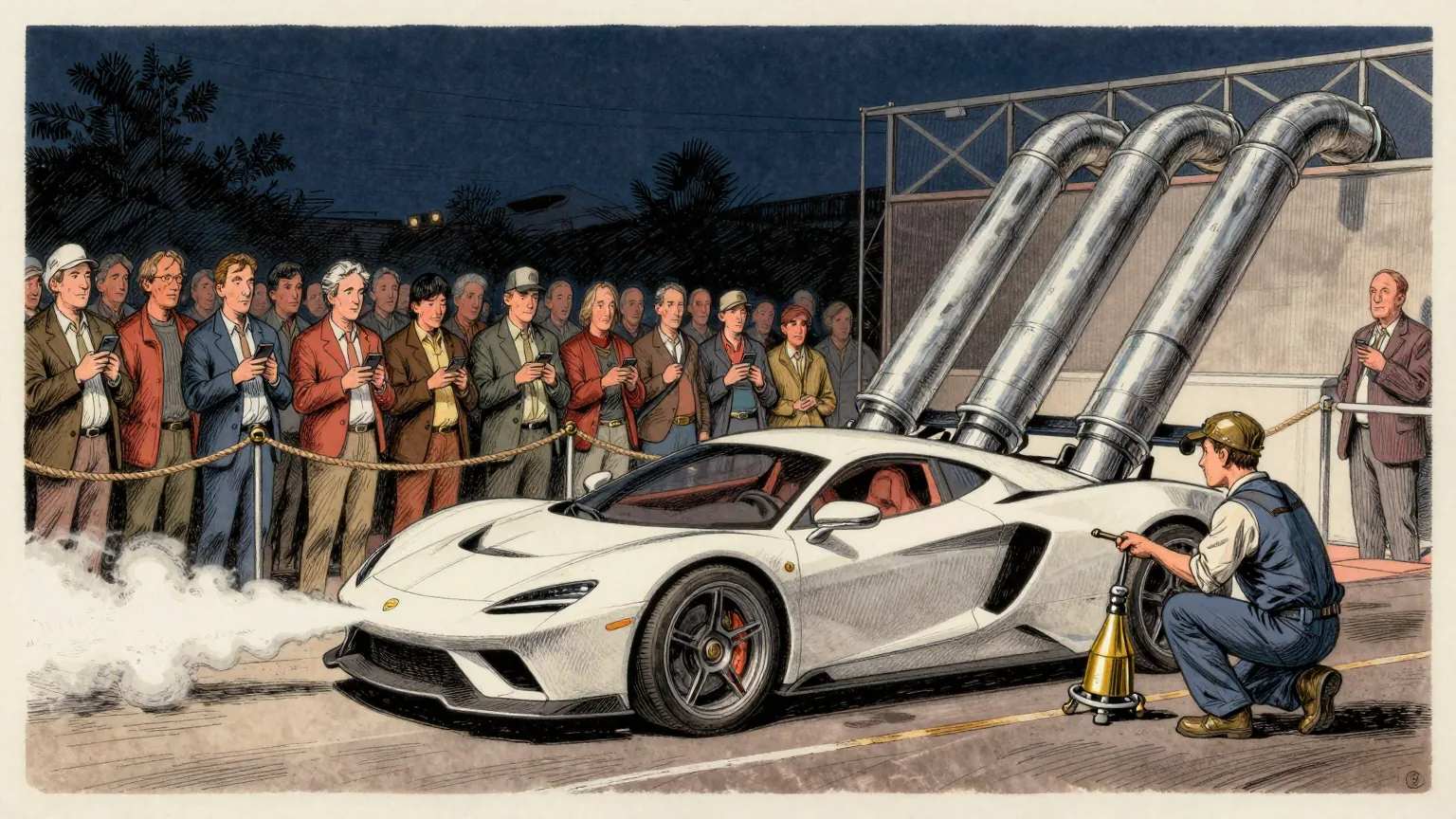
Nine years after first trying to resurrect the Roadster, Tesla is trying again. The company returned to California's showbiz industry to demonstrate the car, using decades-old stunt technology to make a show car do tricks in the air.
The styling is angular and wedge-shaped. Ars Technica noted that it owes more than a little to Giorgetto Giugiaro's original Lotus Esprit, as well as to the more recent Lamborghini Gallardo. At the rear are four giant exhaust pipes.
These do not signal any embrace of hydrocarbons. They are where 100,000 psi jets of compressed nitrogen shoot out.
The publication's reporter added that the Federal Motor Vehicle Safety Statutes are dense reading, and that he had yet to find the section explaining how and when it is legal to use such a thing on the road.
Unusually for the company, Tesla says it has stuck with rear-wheel drive. The battery pack uses the 4680 cells it has been trying to scale up in-house, and the company says it has developed a special battery chemistry just for this model.
The performance claims are more grandiose than they were nine years ago. Elon Musk claims a planned top speed of 383mph, or 616km/h, with a 0-60mph time of 0.8 seconds. For lateral grip, the best Tesla claims is 2 G.
Cars already on sale do better. The McMurtry Spéirling is capable of generating up to 3.5 lateral G, and will drive upside down. It has set a faster lap of the Top Gear test track than an F1 car and took the Goodwood Hill Climb record, going faster up the hill in 2022 than anyone else, including an F1 car. McMurtry has sold at least 24 of a planned 100-car production run.
Musk says the Roadster will go into production by 2028. At the previous launch, in 2017, he told attendees: "We are making it now."
Ars Technica also observed that there is not much of a market for very expensive, very fast electric cars, on the grounds that hypercar buyers want noise and an emotional connection and do not get either from an EV.
It is worth being precise about the pipes. An electric car has been fitted with four working exhausts. They do not carry combustion products, because there is no combustion; they carry nitrogen at 100,000 psi. The Roadster is therefore the first electric vehicle to be sold with a functioning exhaust system, and the exhaust is the only part of it that has been demonstrated.
Emissions are measured at the tailpipe. This car has four tailpipes, and what comes out of all four of them is nitrogen. It will not merely pass. It will pass four times, and the test equipment will record the cleanest reading of any vehicle fitted with pipes.
The statutory position is stronger still. The clause governing road use of a 100,000 psi nitrogen jet could not be found, and on the evidence available it does not exist, which places the Roadster's rear end in the most comfortable regulatory category there is: silent, cold and lawful by omission. The Department of Unnecessary Research has asked for a ruling on whether a pipe that emits nitrogen is an exhaust, an attitude-control thruster or a trim level, and notes that the answer determines the emissions standard, the noise standard and the insurance class. Tesla has four of whichever it turns out to be.
Tesla says the car will reach production in 2028. The exhausts already work.