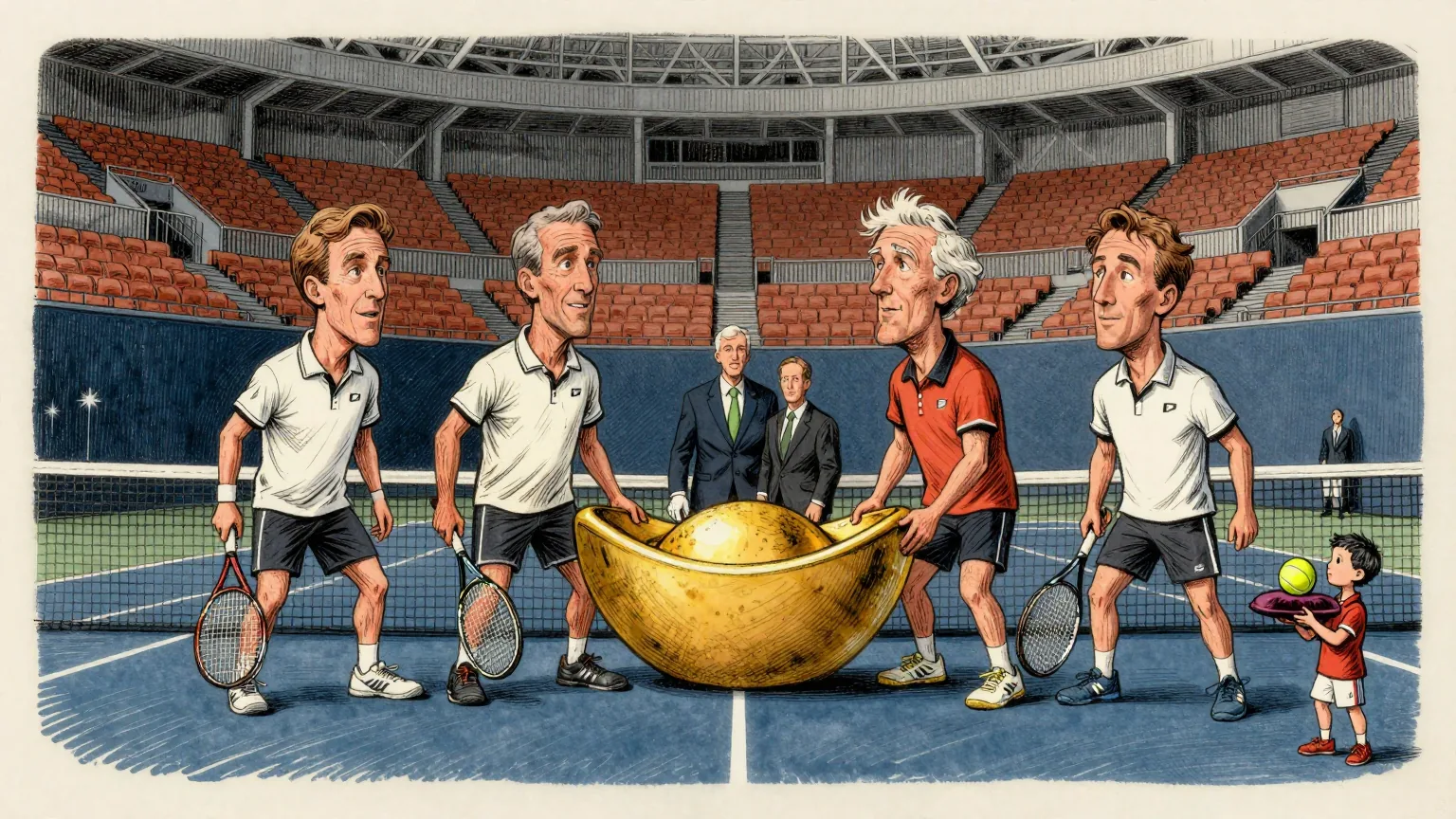
The Australian Open's 1 Point Slam will again have star power in January, with Carlos Alcaraz, Coco Gauff, Naomi Osaka and Jannik Sinner among the players set to compete against professionals, amateur qualifiers and wild cards for a $1 million prize, according to an Associated Press report.
At the Australian Open launch, organisers said qualifying events for the 1 Point Slam were already under way at clubs across the country, with a further two days of qualifying to be held during opening week.
The final will be played at Rod Laver Arena on 13 January, ahead of the first grand slam tournament of the year, which runs from 17 to 31 January.
Every match in the knockout bracket lasts a single point. The bracket includes men and women, professionals and amateurs.
Last January the prize was won by Jordan Smith, a little-known amateur from a tennis-mad Sydney family, who beat Sinner on the way to the title. Smith won on the third stroke of the final, when Joanna Garland, the women's world number 117 from Taiwan, sent a two-handed backhand wide.
The bracket also included celebrities. The Taiwanese pop star Jay Chou was knocked out without hitting a ball, after an ace from Petar Jovic.
“At the heart of the creation of the 1 Point Slam is our desire to even more deeply connect the Australian Open to every tennis community in the country,” said Andrew Abdo, Tennis Australia's new chief executive.
More than 1.3 million fans attended the 2026 Australian Open, and organisers are planning to increase viewing capacity and seating, and to offer more shade across the Melbourne Park precinct next year.
The format repays close study, because tennis is a sport built out of nested containers and the 1 Point Slam has removed all but the smallest of them.
A point ordinarily sits inside a game, which sits inside a set, which sits inside a match, which sits inside a tournament. Here the point is the match, the match is a round, and the rounds are a title. Nothing has been added to tennis. Four layers have been taken out.
The resulting rates are without equal in the sport. A final settled on the third stroke, for a prize of $1 million, values a stroke at roughly $333,000, and on the official account of the 2026 final the deciding stroke belonged to the player who lost.
This newspaper notes that Jay Chou's exit establishes the format's purest line. He was eliminated without touching the ball, which means the 1 Point Slam can be lost without being played, and that the optimal preparation is therefore not to be served to.
The Department of Unnecessary Research has followed the logic as far as the serve. If a point is a match and an ace is a point, then an ace is a match, and a player with seven aces in them holds a grand slam title and six rounds in hand.
Tennis Australia says the aim is to connect the tournament to every tennis community in the country. Qualifying is already under way at clubs, where the entire competitive requirement is to win one point, once.