
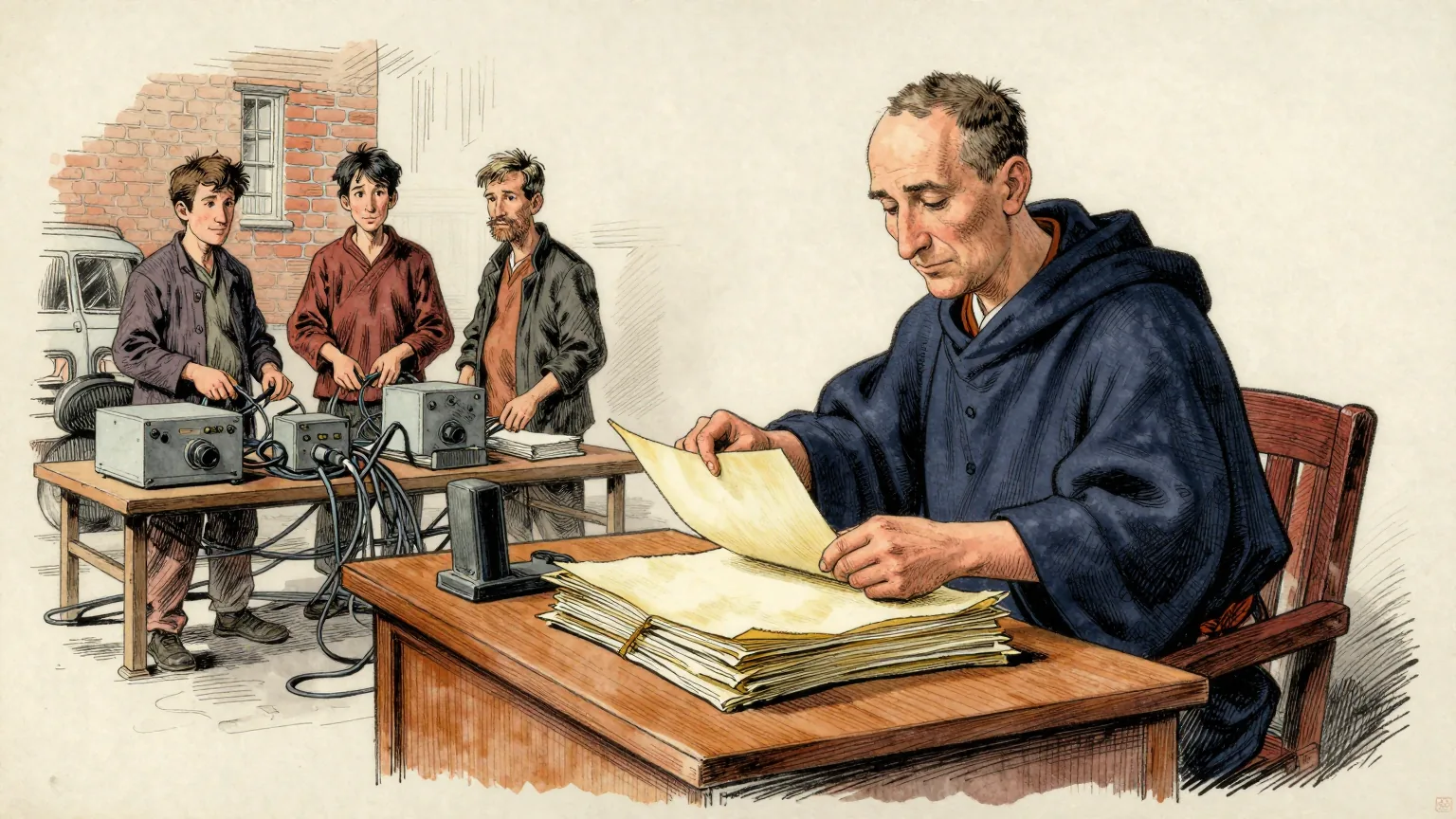
Forty years after publication, the BBC Domesday Project has been marked at the Centre for Computing History, which brought together the people who made it and the people who keep it running.
The project was conceived as a modern Domesday Book: a snapshot of life in the United Kingdom to sit beside the survey of 1086. It was compiled between 1984 and 1986 and released at the end of 1986.
More than a million people contributed, a great many of them schoolchildren, who surveyed their own areas and sent in the results. Sixty people reported directly to Mike Tibbetts and Peter Armstrong, with another sixty working in subcontracted teams.
The result shipped on two LaserDiscs, a Community Disc and a National Disc, in a format called LV-ROM, short for LaserVision Read Only Memory. Reading them required a BBC Master computer paired with a Philips VP415 LaserVision player, navigated with a Marconi RB2 trackball, which had been chosen over a mouse on accessibility grounds.
It was sold to schools, libraries and universities at about £5,000 a system, or around £3,000 after subsidy. It was not, in the words of the retrospective, a roaring sales success.
The hardware then went out of production, and with it the only way to read the discs. The project became the standard example of digital obsolescence: a national record that outlived its reader.
It survives today through preservation work. The discs are in the Internet Archive and emulation efforts continue. "Anyone can go to the Internet Archive and download a Domesday Disc. This is, like, groundbreaking stuff," said Simon Inns of the Domesday86 project.
Tibbetts put the comparison plainly. "The vellum pages of the original Domesday have been preserved for 940 years so far, and it's likely to continue to exist well into the future," he said.
This newspaper accepts the comparison and proposes extending it. Two data points are now available on the durability of a national record. Vellum has lasted 940 years and is still read without equipment. LV-ROM has lasted 40 years and is read by emulator.
The trend is unambiguous. Across a single technological generation the readable life of a national record has fallen by a factor of more than twenty. Projected forward on the same slope, the medium that replaces LV-ROM should remain legible for about twenty months, and its successor for under a month.
Our analysts note that the relationship appears to be proportional rather than coincidental. The 1086 survey holds a fraction of the information and requires no equipment at all. The 1986 survey holds vastly more and requires a BBC Master, a Philips VP415 and a trackball that is no longer manufactured. Capacity and legibility look increasingly like the same quantity, counted in opposite directions.
On that measure the Internet Archive is a mitigation rather than a solution, since a copy of an unreadable format is an unreadable format in a second location. The only storage medium in the comparison that has never required an emulator remains the sheep.
The Department of Unnecessary Research has one recommendation for the BBC ahead of any further national surveys. The 1086 edition has needed no reader, no driver and no volunteer. It has needed a room.