
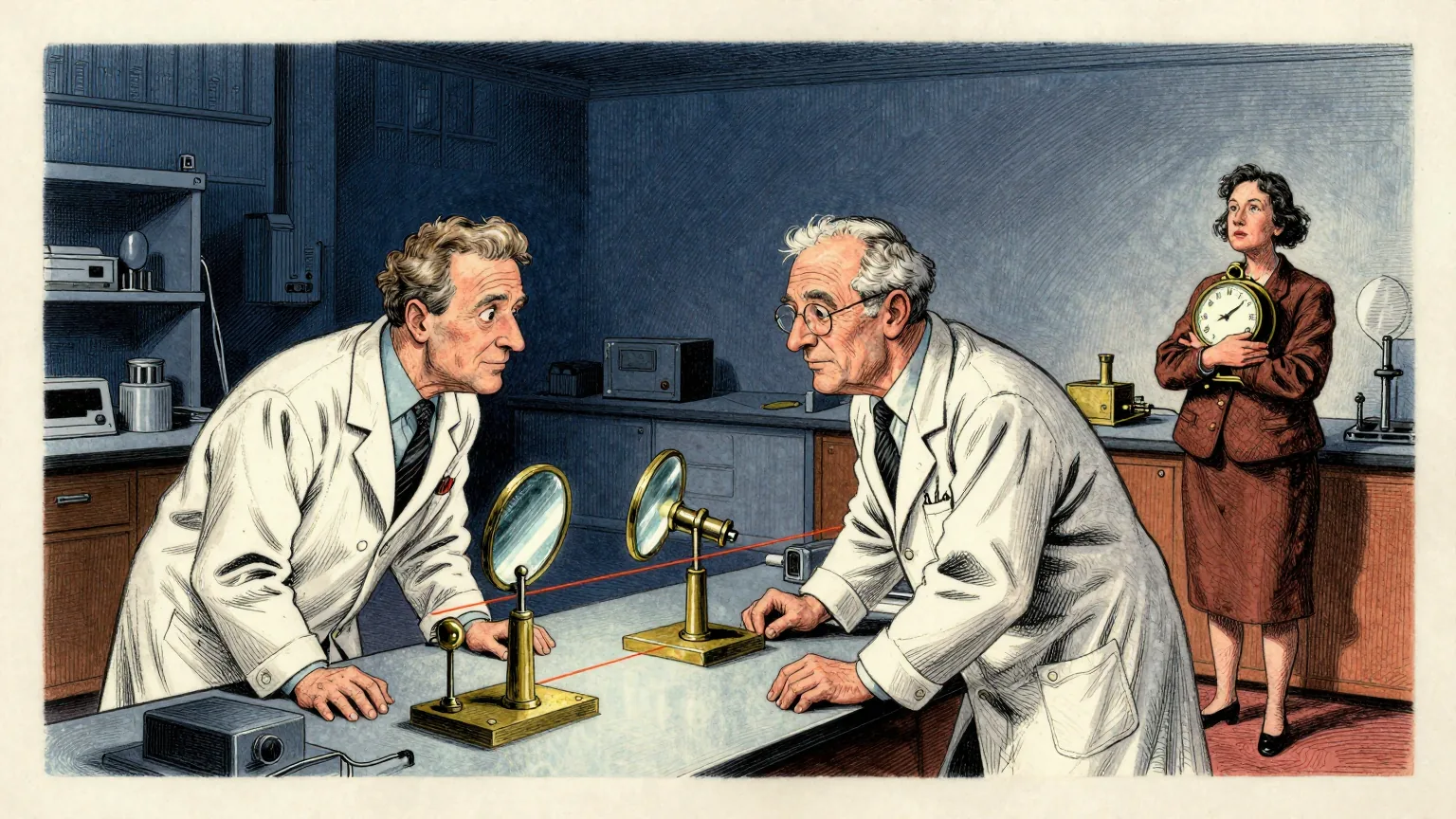
Separate time crystals formed inside a single semiconductor can fall into the same rhythm, physicists at TU Dortmund University have shown, synchronising across distances more than a thousand times larger than an individual oscillator.
A time crystal is an unusual physical system whose internal behaviour repeats in a regular rhythm over time, even though nothing is driving it with a repeating external signal. The same Dortmund group showed in January 2024 that a continuous time crystal could persist inside a semiconductor, with its oscillations remaining stable for hours.
In the new study, published in Nature Communications, Professor Alex Greilich and colleagues found that several time crystals can emerge within the same material and synchronise their electron-nuclear spin oscillations.
The crystals form inside a semiconductor made from gallium arsenide with small amounts of indium and silicon, which create localised electrons within the material. At temperatures close to -270C, each of those electrons interacts with roughly one million nearby nuclear spins.
To start the process, the researchers use a pump laser to align the electron spins. The electrons transfer their polarisation to the surrounding nuclear spins, and when a weak magnetic field is applied, that nuclear polarisation begins to rotate. Feedback between the electron and nuclear spins keeps the oscillation going, and a second laser lets the team watch it develop.
Because different regions of the semiconductor are not perfectly identical at the microscopic level, crystals forming in separate areas would normally oscillate at slightly different frequencies. When the researchers illuminate many regions at once with a broad laser beam, the separate oscillations lock together and run at the same frequency.
The team found that time crystals as far as 40 micrometres apart could still synchronise. Beyond that separation they no longer lock, and go on oscillating independently.
The effect recalls an observation made by Christiaan Huygens in 1665, when he noticed that two pendulum clocks attached to the same support gradually fell into step through the weak mechanical interaction passing along that shared structure. In the semiconductor the connection is not mechanical: the coupling is carried by the movement of spin-polarised electrons.
The findings demonstrate non-local coupling between spatially separated spin systems, and the authors suggest they could lay the groundwork for future networks of controllable spin oscillators.
It is worth being exact about what has been built. These are objects that keep a rhythm without being told one, and that agree with each other up to a distance of 40 micrometres.
Huygens's clocks agreed because they were screwed to the same beam. These agree because electrons carry the message between them. Either way the finding is the same: agreement travels, it weakens with distance, and its range is now a measured quantity.
Below 40 micrometres there is consensus. Above it, each crystal keeps its own time, correctly, and no procedure exists for establishing which of them is right.
Horology has spent four centuries trying to make separated clocks agree, and has been handed the opposite result: a system in which disagreement is not a fault but a distance. The Department of Unnecessary Research has asked TU Dortmund for the same figure from the other side, the shortest separation at which two clocks may be relied upon to differ. The paper has already supplied it.