
A decade-long experiment at the US National Institute of Standards and Technology has produced a new measurement of the universal gravitational constant, and it does not agree with the leading rival result.
Known to physicists as big G, the constant determines the strength of gravitational attraction throughout the universe. It keeps people anchored to Earth, guides planets around the Sun and shapes the cosmic web of galaxy clusters.
Scientists have been trying to measure it for more than 225 years, beginning roughly a century after Isaac Newton introduced his law of universal gravitation. It remains less precisely known than the constants associated with electromagnetism and the strong and weak nuclear forces, which are established to six or more significant digits.
The difficulty is that gravity is extraordinarily weak. A magnet the size of a pinhead can lift a paper clip against the gravitational pull of the entire Earth. Laboratory masses are about 500 billion trillion times smaller than the planet, so the forces being detected are correspondingly faint.
Modern instruments are sensitive enough to do it, but they keep producing slightly different answers. The disagreements run to roughly one part in 10,000 — small, but larger than ordinary experimental uncertainty should allow.
Stephan Schlamminger and his colleagues at NIST set out to clarify matters by carefully replicating a precision experiment carried out by the International Bureau of Weights and Measures at Sevres, France, in 2007. An independent team using essentially the same approach ought to settle whether the mismatch was real.
Schlamminger was also concerned about a different source of error: himself. Researchers can unintentionally influence how they interpret measurements when they know what answer to expect, so he asked his colleague Patrick Abbott to blind the experiment by subtracting a secret number from the measured weights of some of the masses. The correction needed to recover the real answer was sealed inside an envelope.
He nearly opened it in 2022, then realised the team had not fully accounted for a subtle effect involving air pressure, and went back to the analysis. The reveal finally came at three in the afternoon on 11 July 2024, during a presentation at the Conference on Precision Electromagnetic Measurements in Aurora, Colorado. He was anxious enough to skip the morning sessions. "I had really dotted all the i's and crossed all the t's of the experiment," he said.
Once the blinded data were restored, the NIST measurement did not agree with the French one. After two further years of analysis the team reported a value of 6.67387 x 10⁻¹¹ cubic metres per kilogram per second squared in the journal Metrologia, 0.0235% lower than the Sevres result.
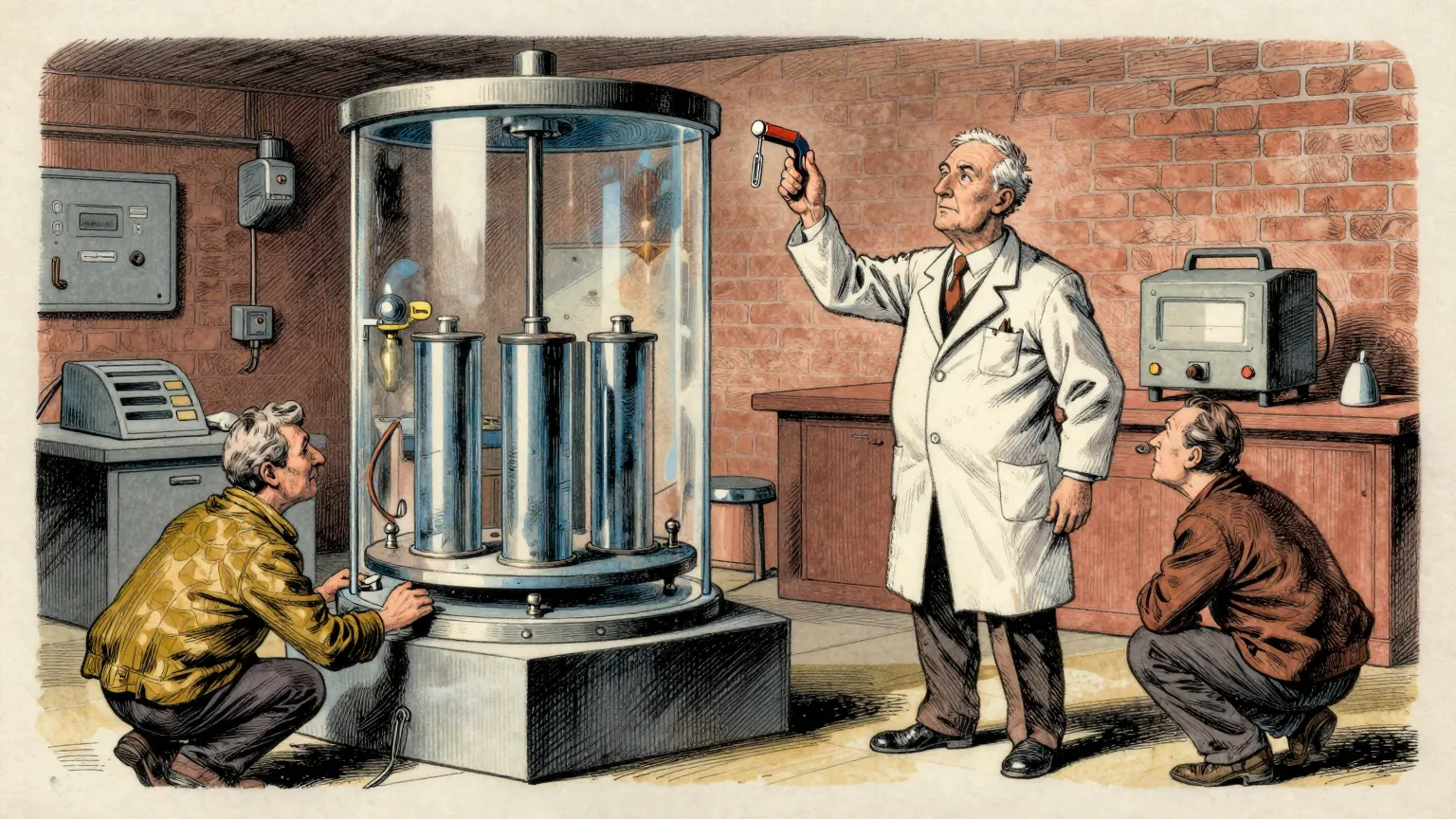
Both experiments relied on a torsion balance, an instrument that detects very small forces by measuring how far a thin suspended fibre twists. The basic idea dates to Henry Cavendish in 1798. The modern version used eight cylindrical metal masses: four larger ones on a rotating carousel, arranged like candlesticks on an old-fashioned chandelier, and four smaller ones on a disc suspended from a copper-beryllium ribbon about as thick as a human hair.
Experimental error remains the more likely explanation for the discrepancy. Some subtle effect has probably been overlooked.
There is, however, a simpler reading available, and this newspaper is prepared to put it forward. Two teams used the same method, the same arrangement of masses and the same class of instrument. One works at Sevres, outside Paris. The other works at Gaithersburg, Maryland. They obtained different numbers. The variable that differed between them was the address.
On that reading the results are not in conflict at all. Gravity in Maryland is 0.0235% weaker than gravity in France, and both measurements are correct locally. The 225-year problem dissolves: big G has resisted determination to six significant figures because it was never a single figure. It is a regional quantity, like rainfall, and physicists have spent two centuries averaging across jurisdictions.
The practical consequences are modest. A difference of that size will not show up on a bathroom scale, and it will not change how much peanut butter is required to fill a 16-ounce container. It does mean that a kilogram is very slightly less committed in Gaithersburg than at Sevres, which is unfortunate, because Sevres is where the weights are kept.
It also explains the blinding. A secret number had to be subtracted from the masses precisely because the masses were in the wrong country, and the envelope contained the difference between the two nations' gravity, which the team then spent two years attributing to air pressure.
The Department of Unnecessary Research has written to both laboratories proposing that the gravitational constant be published the way tide tables are: by station, revised locally, with a note on how far it may be relied upon elsewhere. Neither has replied, which is consistent with the letters being slightly heavier on arrival.