
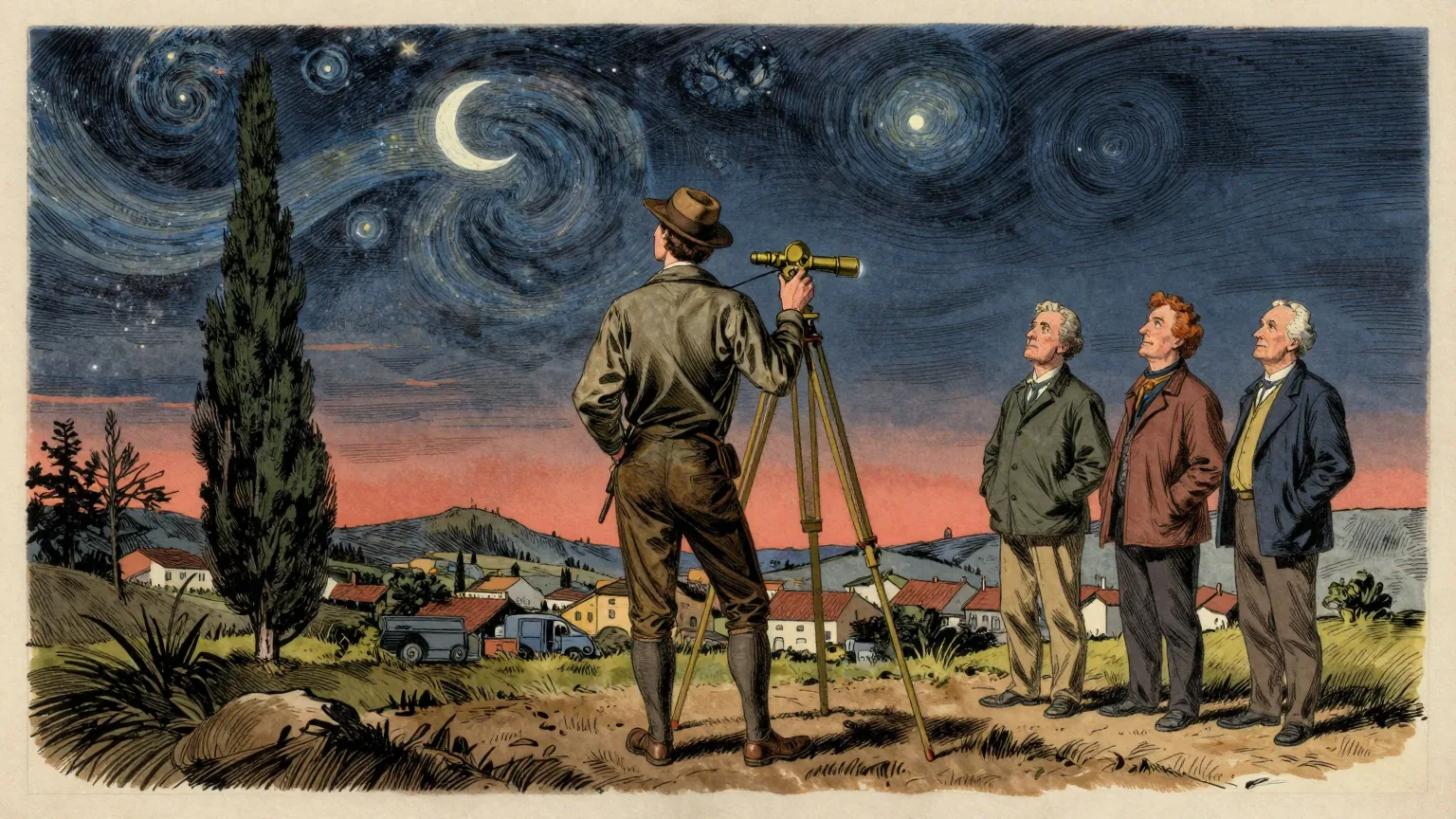
The swirling sky of The Starry Night, long read as an invention, matches a real pre-dawn sky over southern France on about 22 July 1889, according to a study published on Thursday in the journal Scientific Reports.
The work was led by Elijah Jeong-hyun Kim, chief executive of the South Korean robotic telescope company SLLAB and a doctoral candidate at Kyung Hee University's School of Space Research. The team reports that three features of the painted sky — a waning crescent moon, Venus and the Hyades cluster in Taurus — appear together in the sky above Saint-Rémy-de-Provence at that hour on that date, and that no other candidate satisfies all three conditions at once. Kim set out the method to Space.com, which reported the study.
The date is the awkward part. Art historians have long placed the painting in June 1889, and the researchers' sky falls roughly a month later.
The question is not new. The search began with the art historian Albert Boime and the astronomer George Abell at UCLA in 1984, and continued with the Harvard astronomer Charles Whitney. Those analyses did not agree with one another, and no consensus emerged about when the sky in the painting had existed.
"When they see a fragment of a starry sky, observational astronomers like me and amateur astronomers alike will want to solve the puzzle. I am simply someone who pursued that process a little more actively," Kim said.
The team worked along three lines at once. "We analyzed the painting astronomically, analyzed documents about his situation in July 1889, and then carried out ecological and meteorological investigations," Kim said.
The astronomical part borrowed a routine piece of observatory software. "Modern telescopes are equipped with a function called astrometry, which compares an image of the night sky with celestial coordinates stored in a computer and automatically extracts the coordinates of the image," Kim said. The team mapped the historical sky from the spot in Saint-Rémy where van Gogh is said to have worked.
It then treated the painted stars as a shape to be fitted. "We used Procrustes analysis, a method that compares only the 'shape' of two sets of points. After matching their position, size and rotation, it measures how similar the two shapes are from the differences that remain (the residuals)," Kim said.
"Because a star cluster on the canvas may be larger or smaller than in reality and slightly tilted, this method was the right fit. It allowed us to explain, in quantitative terms, what earlier studies had described only qualitatively as 'resembling a certain constellation,'" Kim added. Shape alone was not decisive, because several constellations fit to a similar degree.
The deciding tests were positional. "We also checked whether the stars were actually in that part of the pre-dawn sky on that date, whether they fall within the painter's field of view, and whether the appearance of the moon and Venus matches the painting. It was the Hyades that satisfied all of these conditions," Kim said.
The letters were read alongside the sky. One dated 12 April 1888 records the ambition: "A starry sky, for example, well — it's a thing that I'd like to try to do, just as in the daytime I'll try to paint a green meadow studded with dandelions." Another, from between late May and early June 1889, reads: "This morning I saw the countryside from my window a long time before sunrise with nothing but the morning star, which looked very big." Kim said the links drawn between those observations and the painting's timeline rested in part on "personal imagination", and so do not settle the history.
The researchers' own proposal is modest. "What our study shows is that the sky in the painting matches, in both observation and shape, the real pre-dawn sky around July 22. So, what we propose is the possibility that Vincent conceived the idea in June and completed the painting after July 22," Kim said, adding: "I think further research in art history and conservation science could shed more light on this question." The paper notes that leading art historians already read the picture as stylistically unlike van Gogh's other work from that June.
It is worth being precise about what has now been established. If the sky above the village is a real sky, correctly placed, correctly timed and correctly oriented, then the thing hanging in the Museum of Modern Art is not a painting of a sky. It is a record of one.
On that reading the fields are already filled in. Location: Saint-Rémy-de-Provence. Date: 22 July 1889. Time: before sunrise. Instrument: one painter. Aperture: one brush. The observation has waited 137 years for review.
The published figure overlays five painted stars on five real ones and marks what is left over in red dashed lines. Those lines are the residuals, and residuals are measurement error. Van Gogh's accuracy in recording the Hyades has therefore been quantified for the first time, by people who were not born when he recorded it.
The rest of the canvas falls into place around the same logic. The swirls are seeing conditions. The cypress is an obstruction in the field of view. The village lies below the horizon and does not affect the fit. The Department of Unnecessary Research has raised only one difficulty, and it is procedural: no astronomical catalogue currently accepts entries in oil.