
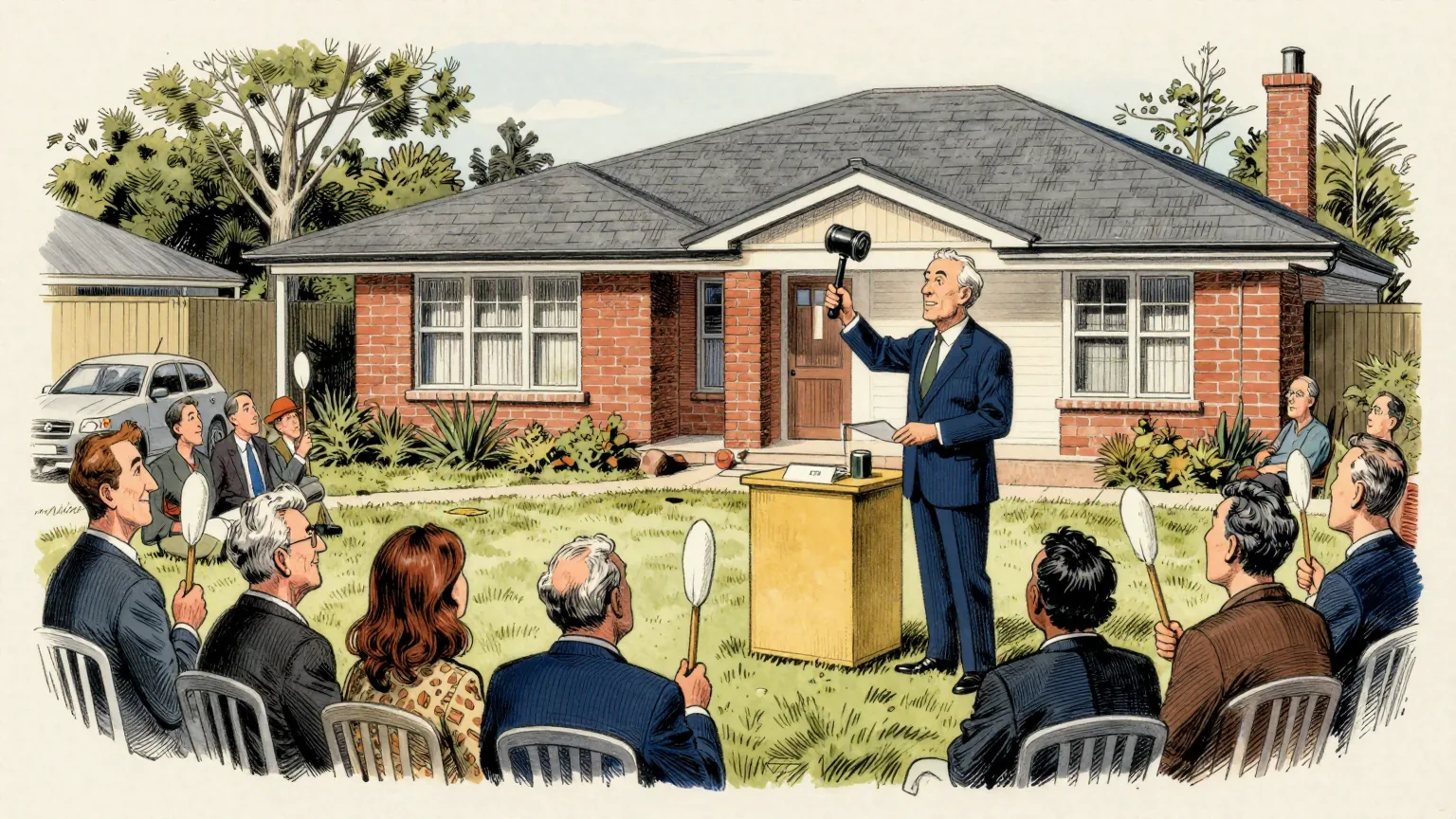
Victoria has introduced laws requiring real estate agents to disclose far more about what a house will sell for, in an attempt to stamp out underquoting.
The laws, which took effect at the start of the month, require the reserve price to be made public at least a week before an auction, and the sale price to be published for at least 18 months after the sale. They are being watched closely across Australia. The story was reported by the ABC business reporters Daniel Ziffer and Jasper Wells.
Underquoting is the practice of marketing a property well below its expected sale price in order to generate interest and draw bidders who are unlikely to be able to afford it. It is generally illegal in Australia.
"Victorians are sick of wasting their weekends chasing homes they were never going to get," said the state Minister for Consumer Affairs, Paul Edbrooke.
Parts of the industry accept the diagnosis. Toby Balazs, chief executive of the Real Estate Institute of Victoria, said the cost to buyers was real. "If you look at the problem that was trying to be solved, egregious underquoting, and the results - people wasting their time and money on getting things like building reports - that's a good thing," he said. "We just don't think this is the way to do it."
His objection is about timing. Most sales campaigns run for a month, and the reserve must now be published seven days before the auction, which he says leaves too little time to gather feedback from potential buyers. The institute's position is that buyers should be given a likely range rather than a precise figure.
"What you're probably going to get is overquoting ... because if I [quote] over, it's easier to come down," Balazs said. He also argued that a seller "has a right to manage what is the sale of, most likely, their biggest asset".
The independent property economist Cameron Kusher, who supports the campaign against underquoting, made the same point about the schedule. "Declaring [the reserve] on the morning of, or before the auction commences, is a much better solution than having to declare a week out," he said, because agents and sellers are still learning who the bidders are and what they will pay.
Dan White, managing director of the Ray White Group, said the laws were inconsistent and confusing, and that his company had received conflicting advice on whether a reserve could be changed once set. "The minister said you can change it, and the cabinet said you can't," he said. The government did not respond to ABC requests for clarification.
Cate Bakos, a buyer's advocate in Victoria, said agents would find a way around the rules, and that the expanded property price statement, which now lists details such as internal floor area and the number of car spaces, could mislead. "I'm concerned that buyers will have a false sense of security," she said.
The mechanism now deserves to be traced from one end to the other, because it closes.
A law was passed because the published number was too low. The number must now be published a week early. A week early, the industry says, the honest number is not yet known, so the number will be set high enough to be reduced.
Our analysts note what has been achieved. The reserve price is now disclosed, on time, in public, and selected for the property of not being the price. It is a precise figure chosen because it can be moved.
The Department of Unnecessary Research adds that the buyer is nonetheless better informed than before, holding the floor area, the car spaces and one number that has been published seven days in advance on the explicit basis that seven days is too early to know it.
The Department notes that the reserve is also both fixed and adjustable, the minister and the cabinet having taken different views, and that the government has not clarified which. Its remaining question is for the Minister for Consumer Affairs. Victorians were said to be sick of wasting their weekends. The Department would like to know which weekend has now been returned to them.