
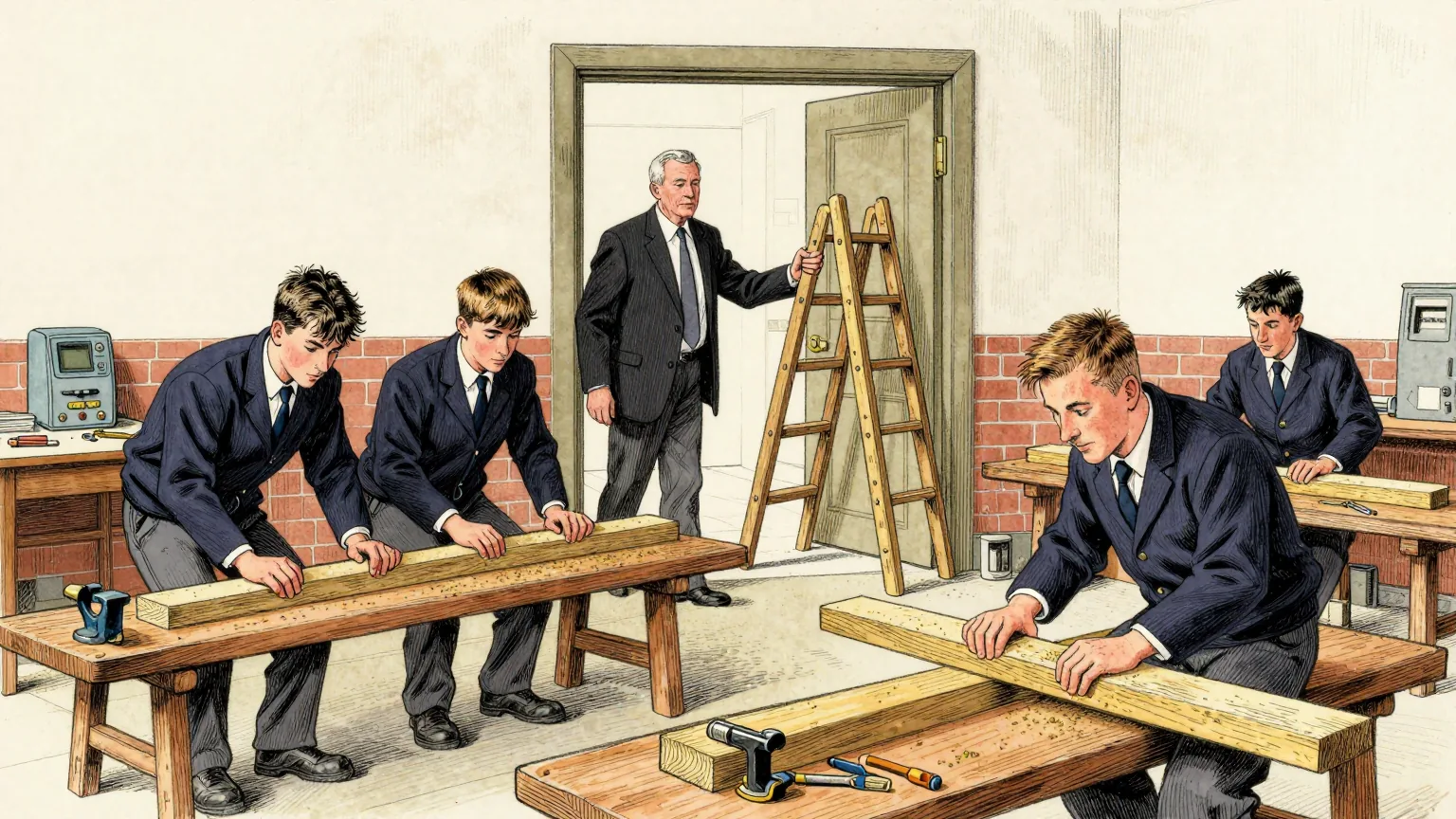
New vocational GCSEs will be introduced in England from 2029, taken by 14-year-olds alongside the existing core academic subjects.
The new subjects could include building and construction, business management and finance, and child development.
Education Secretary Lucy Powell said there was "no question" that academic learning was at "the core of any education system", but that there was "huge demand" for subjects with more practical elements as well.
Standards for the new qualifications will be set nationally by the regulator Ofqual, to keep grades in line with other GCSEs. They will gradually replace other qualifications at this level, such as BTec tech awards, whose standards are currently set by the examining organisations rather than by the regulator.
The vocational GCSEs are designed to let teenagers progress at 16 to similar courses at college, including the new V-levels, which schools and colleges begin teaching from autumn 2027, and T-levels. The stated aim is a clear pathway into different types of work through a ladder of qualifications.
Powell told BBC Breakfast that schools would be able to specialise in subjects relevant to the jobs available in their local areas, and said she wanted to improve the "esteem, respect and recognition" of the current qualifications.
Asked about dedicated funding, she said the government would "work with the sector to make sure this is absolutely deliverable", and that ministers would "make sure any funding needed is made available". New analysis by the Institute for Fiscal Studies shows the budget per pupil growing by 9% in real terms between 2025-26 and 2028-29.
Separately, Prime Minister Andy Burnham is setting a national target for employers to help create 200,000 work experience opportunities for under-16s. Statutory career guidelines for secondary schools in England already require "meaningful" work experience for 14 to 16-year-olds.
The Liberal Democrats warned that the new qualifications should not become a "pipeline" directing disadvantaged pupils away from more academic subjects. Powell said she was "not going to oversee a two-tier education system". Laura Trott, the Conservative shadow education secretary, said "ripping up the system" could mean "sabotaging young people's futures".
From the sector, Martin Haworth, executive head teacher at Wright Robinson College in Gorton, east Manchester, which already offers 10 practical or vocational subjects in Year 10, said any new qualification had to "add value" to what was on offer, and that labelling them as GCSEs "might help with credibility". Schools, he added, would need to recruit specialist staff and pay to convert classrooms.
The economist Luke Sibieta said there was a "big question mark" over whether enough people existed to teach technical and vocational subjects. Daniel Kebede of the National Education Union called for "sustained investment and resources", and Pepe Di'Iasio of the Association of School and College Leaders described the plans as "well-intentioned".
It is worth pausing on the mechanism the reform's own supporters describe. The purpose, ministers say, includes esteem. The head teacher's assessment is that the label may help with credibility. On that account, the credibility is a property of the letters, and the letters are the part being changed.
So it is worth auditing the stock. A pupil in England will by 2029 be choosing between GCSEs, vocational GCSEs, BTec tech awards on their way out, V-levels from 2027, T-levels and A-levels. A pupil in Wales will additionally have VCSEs, taught from September 2027, with 15 subjects to choose from including Animal Care, Nature Restoration and Motor Vehicle Maintenance.
Vocational subjects already account for 7% of entries for qualifications at 16. The timber, the vice and the child development module are all in the room already. What the reform supplies is a prefix, and a prefix is now the scarce input.
This is a supply problem of an unfamiliar kind. G, C, S and E are in continuous use and cannot be withdrawn. V and T are committed. A and B have been spoken for. The capacity of the English qualifications system to absorb further reform is therefore twenty-six, less those already allocated, and it is not being replenished.
The Department of Unnecessary Research has begun the inventory and reports that Q remains available.