The future of the Wales Office, the UK government department that has outlived most of its own functions, is under discussion again after the former Welsh first minister Mark Drakeford said it was time to consider abolishing it.
Asked on S4C's Y Byd yn ei Le whether he would be happy to get rid of the department, Drakeford, who led the Welsh government from December 2018 to March 2024, said: "Yes, I think the time has come for us to think about that."
He added: "Of course, [former Labour prime minister] Tony Blair thought of this too," and said the question "has been part of discussions in Westminster not only now but for more than a decade".
The post of secretary of state for Wales was created by Harold Wilson's Labour government in October 1964, with the Welsh Office opening the following April.
In 1999 the Welsh Office's powers over areas including health, education, environment, agriculture and transport were taken over by the Welsh Assembly, now known as the Senedd. What remained of the UK government department was given the title of Wales Office.
Its future has been debated more or less continuously since. Successive UK governments have considered whether its functions could be folded into a single department also covering Scotland and Northern Ireland, and under a previous UK Labour government Peter Hain combined cabinet responsibility for Wales and Northern Ireland between 2005 and 2007.
Earlier this year the then first minister, Eluned Morgan, said there remained "a role" for the Welsh secretary, but argued that the post should be "the voice of Wales at the cabinet table" rather than "the UK government's voice in Wales".
The present holder, Stephen Kinnock, was appointed Welsh secretary by Andy Burnham in July.
Not everyone in Drakeford's party agrees. Interviewed on BBC Radio Wales Breakfast on Friday, the Labour MP Ruth Jones dismissed the idea: "I've got tremendous respect for Mark Drakeford but, let's be honest, he's now retired and, therefore, let the politicians who are elected to get on with the job get on with the job."
She went on: "In terms of the Wales Office, the only person from Wales actually at the [UK] cabinet table is the secretary of state for Wales, and he is there fighting the corner for Wales. So I would say to disband that would be foolish." The exchange was reported by Adrian Browne, the BBC's Wales political reporter.
Two separate things are under argument here, and they are not the same thing. Nobody is disputing what the Wales Office does. The dispute is over which way it faces.
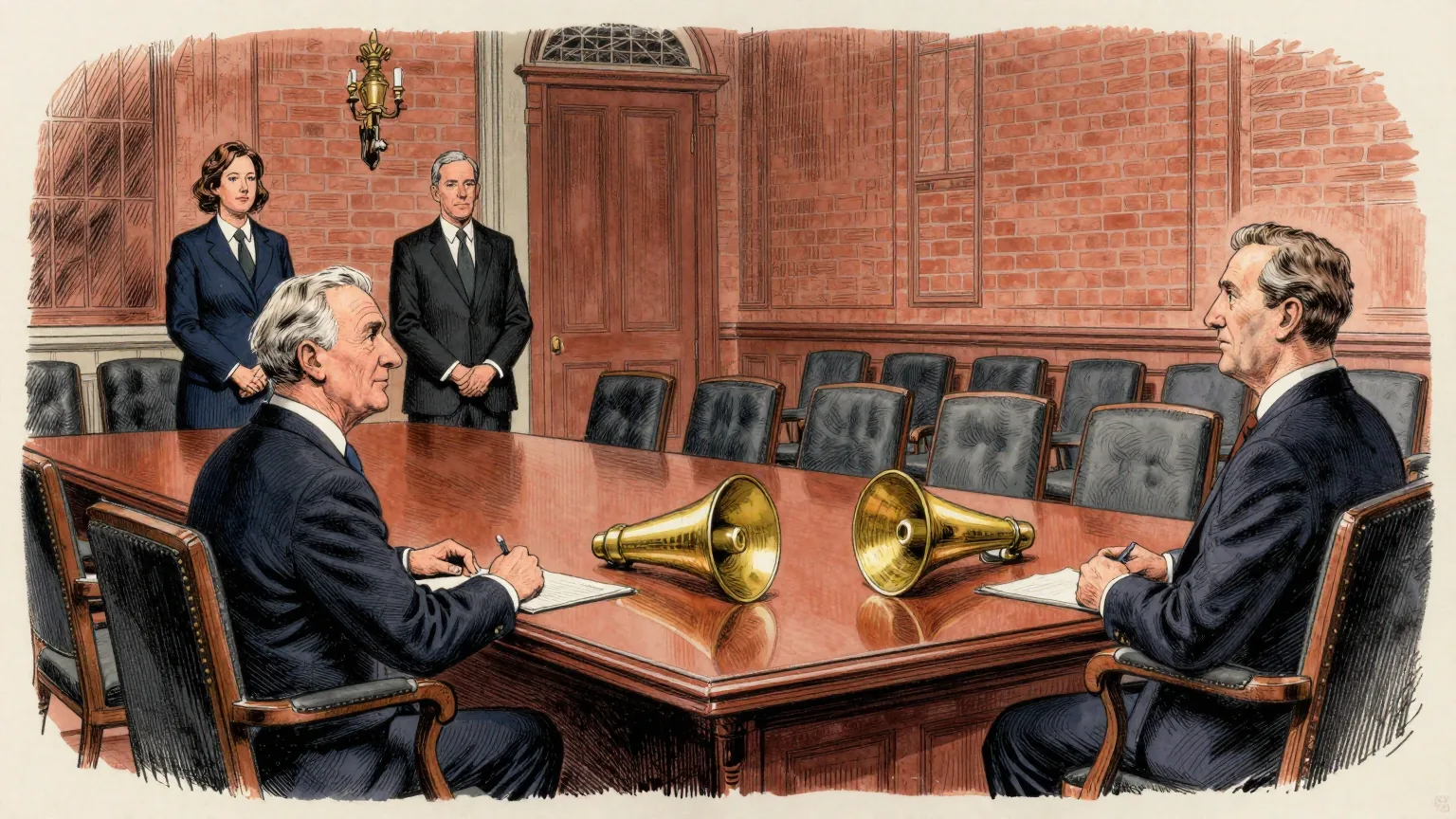
The department's powers went to Cardiff in 1999. What it retained was a seat and a voice. On Ms Morgan's formulation that voice should point inwards, towards the cabinet table; on the alternative it points outwards, towards Wales. The volume is not in question. Only the bearing.
This newspaper regards the matter as settled on the evidence. A department whose remaining output is a voice can be assessed only by direction, and a voice pointed in two directions at once is, by any reasonable standard, twice as loud.
The Department of Unnecessary Research has examined the other claim as well, the one about abolition. The office has been under consideration for closure for more than a decade on Mr Drakeford's own account, and intermittently since 1999. Consideration is an activity. It requires attention, submissions, interviews and, on Friday morning, a radio programme.
On that measure the Wales Office is not merely functioning. It is the only department in Whitehall whose workload rises every time somebody proposes shutting it, which makes abolition the one function it cannot safely be relieved of.
The post was created in October 1964. Sixty-two years later the question of whether it should exist has never once left its in-tray, which is more than can be said for the powers.