
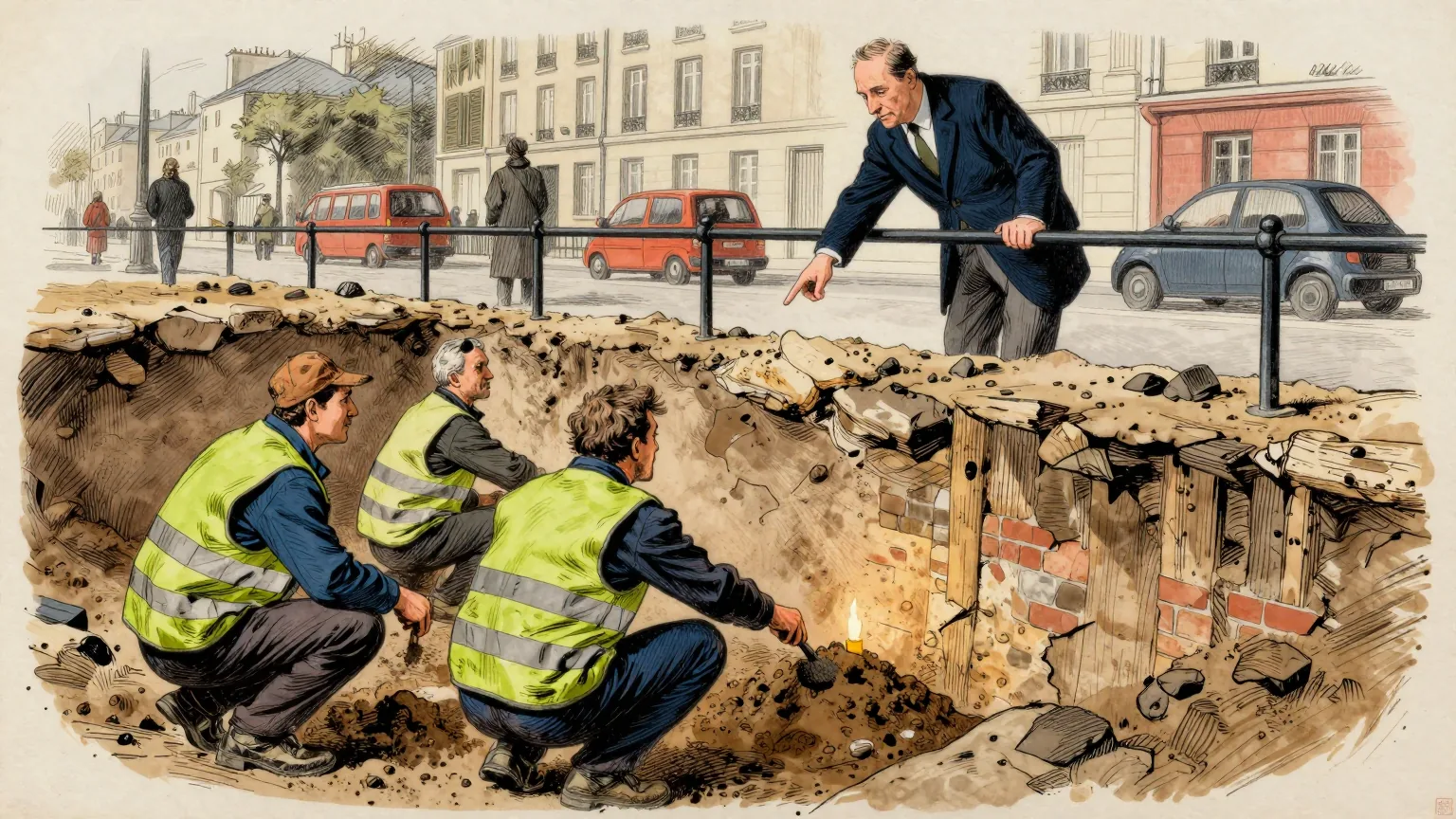
An ancient wall discovered beneath Paris has been described as a "major breakthrough" by France's culture ministry, with the find possibly confirming the location of the city's original settlement.
A roughly 20-metre stretch of wall dating from the Gallo-Roman period was uncovered this summer beneath a building on the Île de la Cité, near Notre Dame Cathedral in the heart of the French capital.
The stone-and-wood structure is thought to be a fragment of the ramparts of Lutetia, the ancient name for Paris, built by the Gallic Parisii tribe who lived along the River Seine in the iron age.
The question the wall may settle is older than the excavation. The Île de la Cité has traditionally been regarded as the centre of Lutetia, but a rival theory, backed by some archaeological research, places it at Nanterre, a suburb to the west.
"We may be looking at one of the most important remains ever discovered for understanding Gallic Lutetia," the culture minister, Catherine Pégard, said in a statement on Wednesday. "Scientific caution still requires that we verify its function and its chronology, but the convergence of evidence is particularly remarkable at this stage."
Lutetia is first mentioned in book seven of Julius Caesar's Gallic Wars, where it is described as being on an island in the River Seine. The vagueness of that description has sustained competing theories for generations.
The wall, uncovered during excavations beneath the Hôtel-Dieu hospital, bears traces of fire. That detail matters, because it may correspond to Caesar's account that the Gauls set fire to their own town before the Battle of Lutetia against the Romans.
Carbon dating of the charred material placed the find between 200BC and 10BC, the ministry said, a timeframe that covers the battle, fought in 52BC.
It is worth being exact about what that timeframe is. It is 190 years wide. The battle it contains lasted a day.
The convergence of evidence, then, is a convergence in the sense that a day is contained within roughly 69,400 other days, all of which the dating admits equally. The wall has been placed within two centuries of the event that explains it, which is precisely as close as two centuries allow.
This newspaper regards the result as sound and would go further. If burning within the window is what identifies the fire, then every fire lit anywhere in the vicinity between 200BC and 10BC satisfies the same criterion, and the Parisii must be credited with having set fire to their town continuously for 190 years in order to be certain of catching the Romans on the correct afternoon.
The Department of Unnecessary Research finds this the more impressive achievement, and one that the ministry's statement does not acknowledge. A single act of defensive arson is a tactical decision. A programme of it, sustained across six or seven generations without anybody rebuilding in stone, is municipal policy.
It also resolves the dispute with Nanterre neatly. A settlement that burns itself down every day for nearly two centuries leaves charred material over a wide area, which is consistent with the evidence at both sites and therefore confirms both.
The minister's caution is likewise satisfied. Scientific caution requires that the function and chronology be verified, and the chronology has been: the wall is from the period in which it is from.
The Île de la Cité is the largest island in the Seine in the Paris region, and became the centre of the Roman settlement of Lutetia.
The wall has not been asked to be more specific.