
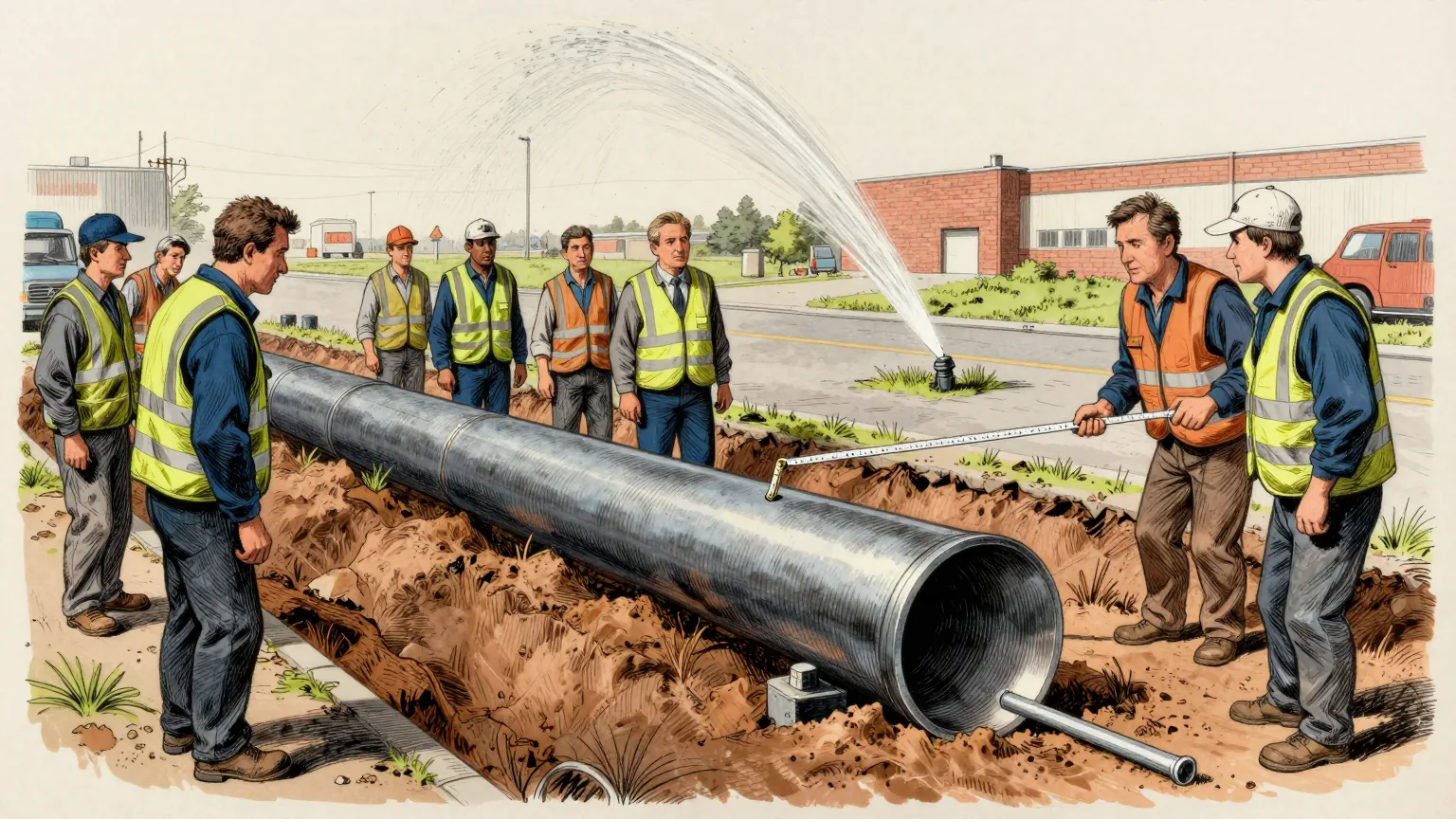
Tasmanian businesses have criticised a recommendation by the state's water utility that customers affected by this year's bill increases should reduce the size of their pipes.
From July, water bills for Tasmanian households and small businesses will rise by an average of 5.7 per cent each year for the next four years. Businesses and sports clubs say they have been hit hardest, with some citing increases of as much as 500 per cent to their fixed water bill.
At a parliamentary inquiry into TasWater's financial and operational performance on Thursday, representatives suggested that one option for reducing bills would be to reduce meter connections to 20 millimetres in size.
The arithmetic behind the charge is not in dispute. TasWater Customer and Community General Manager Callan Paske explained the pricing by saying that "a larger water meter connection lets a property draw more water at any time than a standard home".
"Our pipes, pumps, treatment plants and storages have to be built and maintained to meet that potential demand, whether it's used on a given day or not," Paske said. "Fixed charges recover the cost of holding that capacity available."
The effect on individual bills has been considerable. Stuart Boyd, co-director of the Rocherlea steel fabricating business HP Engineering, said the company's monthly water bill in June was $625, equivalent to $7,500 a year. After the changes it rose by more than 500 per cent to $3,800 a month, or more than $45,000 a year.
Boyd said reducing the company's inward water pipes, currently 150 millimetres, could cost as much as $100,000 once engineers, consultants, a building surveyor, design work and digging up the road from the street inward were accounted for. TasWater has previously said that while the upfront cost would be several thousand dollars, the returns would be greater.
Haylee Sheehan, whose furniture transport business is at Youngtown on the outskirts of Launceston, said her fixed water bill rose by 172 per cent between June and July. Of that bill, $9.60 was for water and sewage usage; the rest was fixed charges. Her pipes are 100 millimetres, and fire hydrants on the property may rule out reducing them at all.
Not every connection can shrink. Trevallyn Parks and Improvement Association president Collin Burns said the Launceston park relies on two 50-millimetre pipes and a 25-millimetre pipe, and that its automatic watering system of 10 pop-up sprinklers needs the pressure a 50-millimetre pipe provides to lift the sprinklers out of the ground at all.
TasWater said it recognised the scale of the increase for some non-residential customers and was actively consulting the economic regulator on other ways to minimise the impact. It applied last year for average increases of 11.5 per cent a year, and the regulator knocked that application back earlier this year. The utility says the money is needed to upgrade ageing infrastructure, and it lost 24.5 per cent of its treated water in the 2023-24 financial year.
It is worth restating the principle exactly as the utility states it. The fixed charge does not recover water. It recovers the cost of holding capacity available, whether the capacity is used on a given day or not. What is being billed is the possibility of drawing water.
Read that way, the remedy follows without difficulty. A business that narrows its connection is not buying less water. It is buying less possibility. The bill falls because the range of things the business might do has been reduced.
This newspaper has followed the logic to its terminus. Every millimetre removed from a connection removes some quantity of hypothetical water, and every millimetre is therefore a saving. At 20 millimetres a customer retains a modest reserve of possibility. Below that, the savings continue.
The Department of Unnecessary Research has costed the fully optimised case. A property with no connection at all holds no capacity available, generates no potential demand, and requires no pipes, pumps, treatment plants or storages to be built or maintained on its behalf. Its fixed charge is the lowest obtainable in Tasmania.
The park at Trevallyn has already established the boundary condition. Its sprinklers need pressure to leave the ground, pressure needs diameter, and diameter is the thing being charged for. The cheapest lawn in Launceston is the one nobody waters.