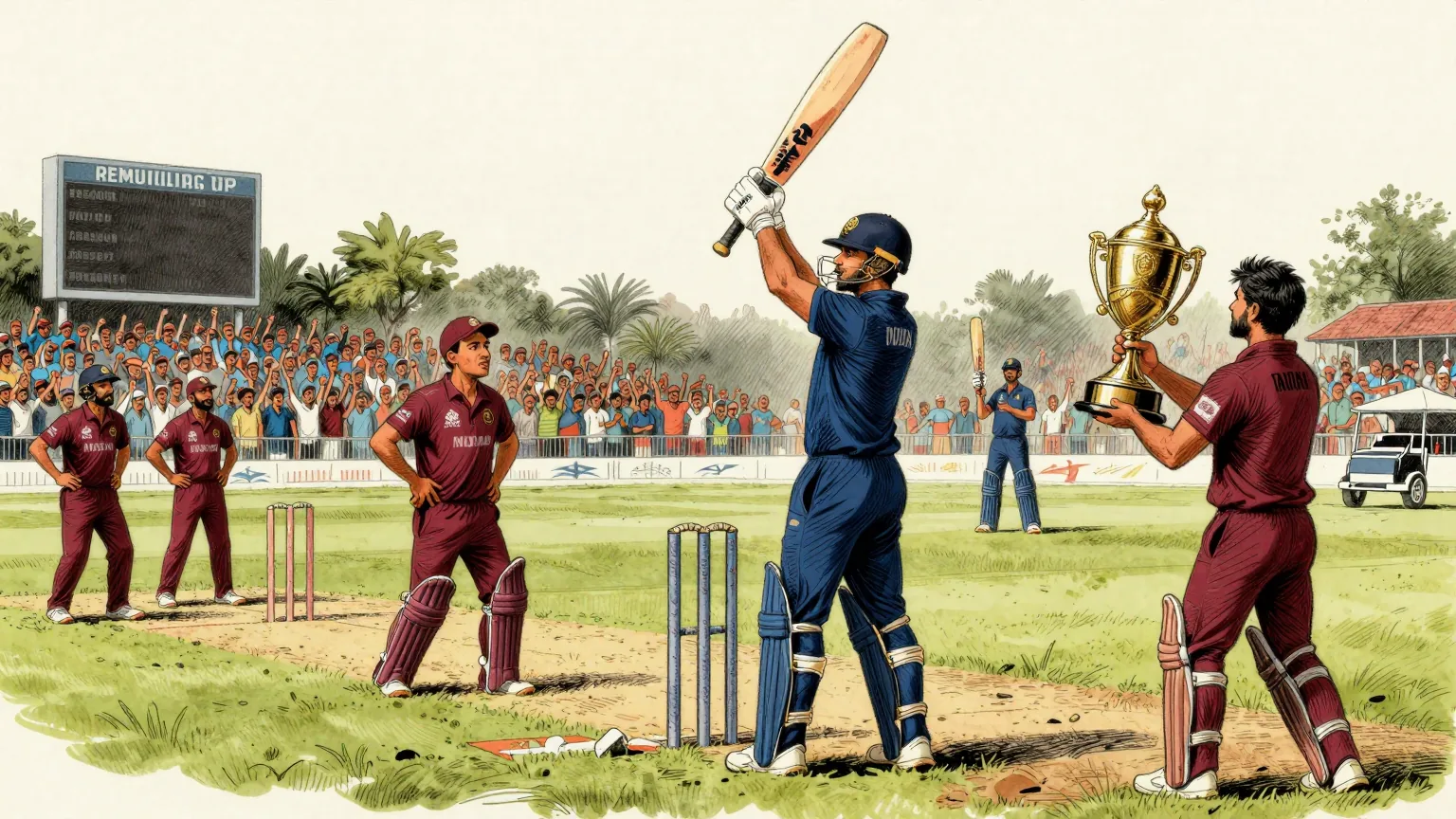
India chased down 406 in Guwahati on Wednesday with 39 balls to spare, completing the second-highest successful run chase in the history of men's one-day international cricket and beating West Indies by eight wickets.
West Indies had made 405 for seven in their 50 overs, their highest ever total in the format, and at the interval they looked the likelier winners.
Three of their batters made centuries: John Campbell 101 from 65 balls, Shai Hope 104, the twentieth ODI century of his career, and Amir Jangoo 114 from 77. It was only the sixth innings in ODI history in which three batters have reached three figures.
The innings was built on two stands. Campbell and Hope put on 110 in 79 balls for the second wicket, and Hope and Jangoo added 182 for the third. Campbell, a left-handed opener, struck five sixes in his century and took 22 from a single Prasidh Krishna over.
India's reply removed the question almost immediately. Shubman Gill and Rohit Sharma put on 255 for the first wicket, Rohit making 101 from 72 balls and passing 12,000 ODI runs in the process, before being trapped lbw.
Gill, India's captain, was in extraordinary form. He reached his century from 62 balls, his fastest in the format, and his double century 55 balls later, from 117 in all: the fastest ODI double century ever made. He finished unbeaten on 223 from 133 balls with eight sixes and 26 fours, the third-highest individual score in men's ODIs, having made his first double century against New Zealand at Hyderabad in 2023.
Virat Kohli fell for 29 and Ruturaj Gaikwad joined Gill to finish the job in 43.3 overs. Auqib Nabi, making his ODI debut for India, conceded 84 runs, the fourth-most by an Indian bowler winning his first cap, and ended on the winning side.
"When it was 13 overs, it felt like we had fielded for 25 overs, the way they were batting," Gill said afterwards. "Great game."
West Indies, two-time World Cup winners, face a battle to qualify directly for next year's tournament and have been consigned to a qualifier in early 2027.
It is worth noticing that the record total and the eight-wicket defeat are the same innings. A side that posts the highest score in its history and loses with 39 balls unused has not been outplayed in the ordinary sense. It has been answered, and the answer was 406.
The relationship is close to exact, which is what makes it instructive. West Indies made 405. India made 406. One run more than was set, scored in six and a half overs less than was available, by a side that lost two wickets doing it.
On the Guwahati evidence, then, a first-innings total of 405 produces 406 against it. A total of 200 would, on the same ratio, have produced 201, and a total of 60 would have produced 61. The chasing side stops the moment the target is passed, so the runs a team concedes are set by the runs it scores, and by nothing else it does with the ball.
This has a clear implication for the rulebook, and the rulebook permits it. The only way to restrict an opposition is to give them less to pass, and the lowest available first-innings score is none at all, against which no side can win by any margin, because there would be nothing to exceed.
The Department of Unnecessary Research has reviewed the three West Indian centuries in this light and recommends fewer. Hope's hundred was his twentieth, which on these figures makes him the most generous batter in the match.
West Indies have never played a better innings. It is also the one they lost by eight wickets.