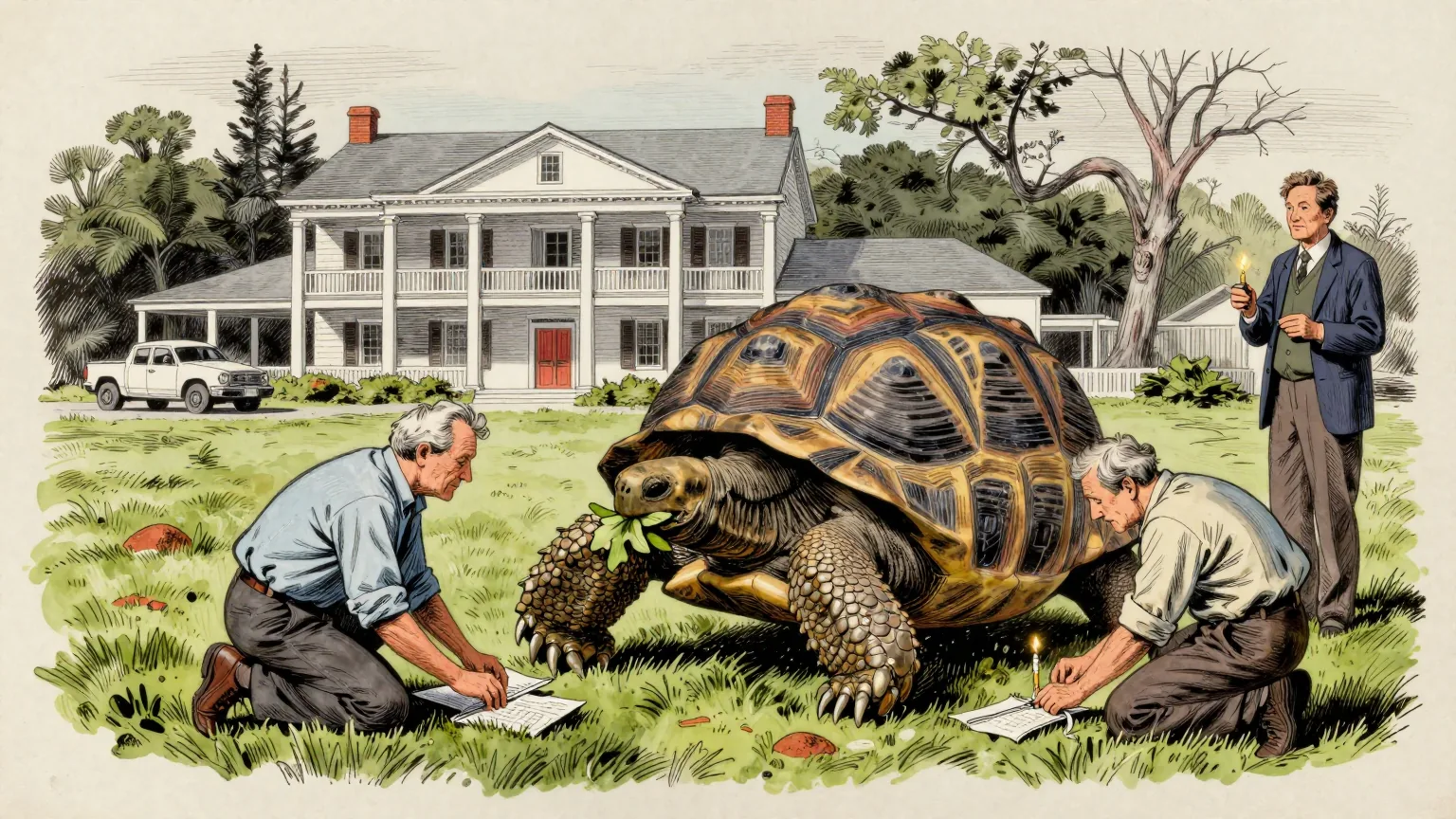
Scientists have analysed the genetic code of the world's oldest living land animal, a giant tortoise called Jonathan who lives in the grounds of Plantation House, the official residence of the governor of St Helena in the South Atlantic.
Jonathan is believed to be 194 years old, which makes him a contemporary of Queen Victoria and Charles Darwin. He arrived on the island in 1882.
Analysis of his DNA found a host of genetic variants across most of the biological pathways for ageing that scientists have identified. Together, those pathways help organisms survive by repairing damaged DNA, regulating their metabolism and fending off cancer.
More intriguing to the researchers were the chemical patterns sitting on top of his genes. Methyl groups are tags that attach to DNA and typically silence the genes they latch on to, and the patterns they form change over a lifetime.
Writing in Science Advances, the international team, led by Benjamin Vaisvil, compared the methylation patterns on Jonathan's genes with those of other giant tortoises. On many of his genes the patterns looked like those of other old animals. On the genes linked to mitochondrial function, they looked like those of animals very much younger.
Mitochondria are the battery-like structures that power biological cells, and ailing mitochondria have been strongly linked to ageing and to age-related disease.
"We're still trying to work out how ageing occurs and Jonathan gives us a real window on to what happens over a long period of time," said Stephen Clark, a senior researcher on the project at the non-profit Kallel Foundation. "His mitochondria must be especially stable and that's an insight into longevity in general. It's important that the mitochondria are kept as pristine as possible."
The team is careful about what the work shows. It is not clear whether, or how much, the chemical patterning contributes to Jonathan's lifespan. "How do we test this idea?" Clark said. "Is there a way that makes the mitochondria young, or can we replace the mitochondria and see if it extends longevity? That's one of the next steps."
Jonathan's care was taken over in 2009 by Joe Hollis, then St Helena's senior veterinary officer. The tortoise was not faring well: cataracts had left him blind, he had lost his sense of smell, and his beak had gone soft and crumbly, making foraging difficult. Hollis began hand-feeding him, and within six months to a year he had regained weight and grown a hard, serrated beak.
He appears to be enjoying himself. A few months ago he was found mating with Emma, who shares his paddock, and was afterwards discovered upside down. "Emma has a very semicircular shell," Hollis said. "So if you slip sideways fast enough the momentum will flip you right over. It's phenomenal though. He's 194. You're going to have an accident, aren't you, at 194?"
The study's central observation, stated plainly, is that different parts of the same tortoise are different ages. Most of Jonathan's genome carries the marks of a very old animal. The genes that run his mitochondria carry the marks of a considerably younger one.
Age, in this literature, is read off those marks. It follows that Jonathan is 194 in general and rather less than that in the one compartment anybody has measured for the purpose.
This newspaper has gone looking for the part of him that is actually 194 and is struggling. The mitochondrial genes read young. The beak he is using dates from 2010 or thereabouts. What is unambiguously 194 is the date, which is held in the records of St Helena and is in excellent condition.
Our analysts regard that as the finding's real contribution to human longevity. Jonathan has not extended his life so much as distributed it, so that no single tissue is required to carry the whole 194 years and the full figure survives only in the archive.
The Department of Unnecessary Research has drawn the practical conclusion. The oldest surviving part of the world's oldest land animal is his paperwork, which is why it should be kept as pristine as possible.