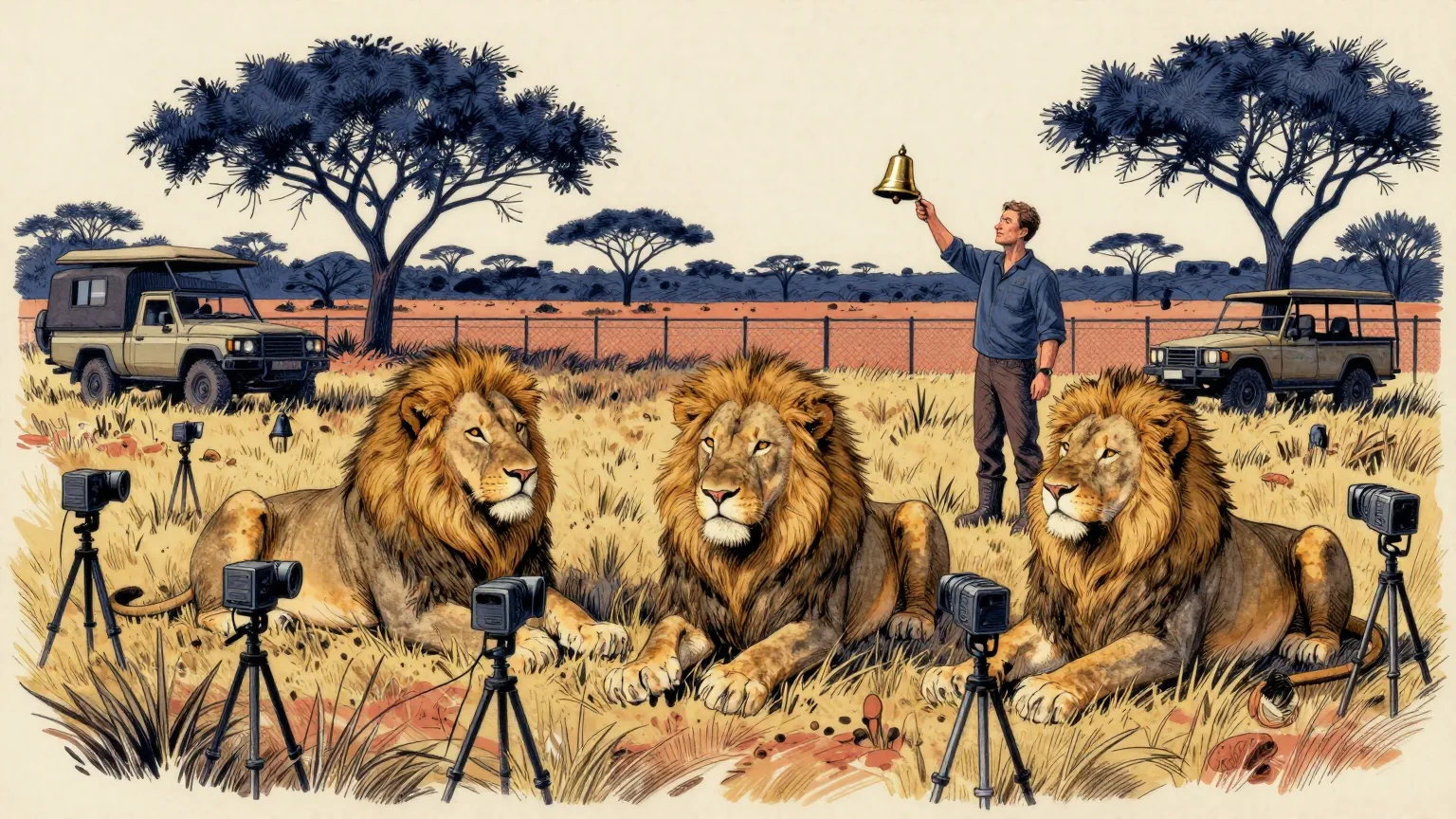
Three adult male African lions behaved markedly more like wild lions after their keepers began adding whole animal carcasses to their feeding routine every nine days, according to a study by Adelaide University and Monarto Safari Park in South Australia.
The research, published in Applied Animal Behaviour Science, used continuous video monitoring over three months and eight infrared cameras, producing one of the most detailed 24-hour datasets yet assembled for African lions in human care under a carcass feeding regime.
The difference on carcass days was substantial. The lions spent almost three times as long eating as they typically did, fed more frequently and for longer stretches, and tore at, pulled and manipulated the food. During the experimental phase the three lions received approximately 200 kilograms of carcasses, left available for as long as three days.
Once they had finished, they spent considerably more time lying down and resting. As the fasting period went on, their movement gradually increased again. That repeating pattern of intense feeding, extended rest and rising activity closely matched the feast and fast rhythm documented among wild lion populations.
"Wild lions don't eat at the same time every day. They experience natural periods of feasting and fasting depending on hunting success," said the lead author, Lesia Hryhorenko of Adelaide University's School of Animal and Veterinary Sciences.
"Providing whole carcasses changes much more than the nutritional content of the diet," she said.
The team, which included a visiting Belgian master's student from the University of Liege, also tracked pacing, a repetitive behaviour in carnivores often linked to anticipation. Pacing increased slightly over the study period but did not consistently rise as the lions went longer without food. The largest increases occurred around predictable events such as keeper arrivals and times when the animals were moved between areas of their habitat.
That suggests pacing may have been more strongly connected to familiar daily routines and the expectation of feeding than to hunger itself. The researchers found no increase in aggression and no disruption to the lions' social stability during whole carcass feeding events.
"Many zoo studies focus only on what happens immediately after food is provided," said a co-author, Associate Professor Alexandra Whittaker, who said feeding schedules could influence behaviour for days afterwards.
The finding is a welfare result and should be read as one. It is also, taken literally, an administrative achievement. The wild rhythm did not return of its own accord. It was introduced, on the ninth day, by staff.
The schedule is the variable. A wild lion feasts and fasts because hunting sometimes fails. The lions at Monarto feast and fast because a routine says so, and at the level of the data the two are hard to tell apart.
The pacing result completes the picture. The strongest anticipation the cameras recorded was not of food but of keeper arrivals and of being moved between areas of the habitat. The internal clock has been calibrated against the staff rota.
On this evidence, wildness in a large carnivore is deliverable: at a frequency of once every nine days, in consignments of about 200 kilograms, available for up to three days at a time. Those are not biological quantities. They are a service level.
This newspaper notes the uncomfortable corollary for the comparison group. The wild lion reaches the same rhythm unsupervised, but cannot guarantee it, because nothing on the savannah is rostered. On reliability, the enclosure wins.
The Department of Unnecessary Research has therefore filed the only recommendation the dataset supports: that the wild be issued with a timetable.